The nine-coin money reading
The Counting House
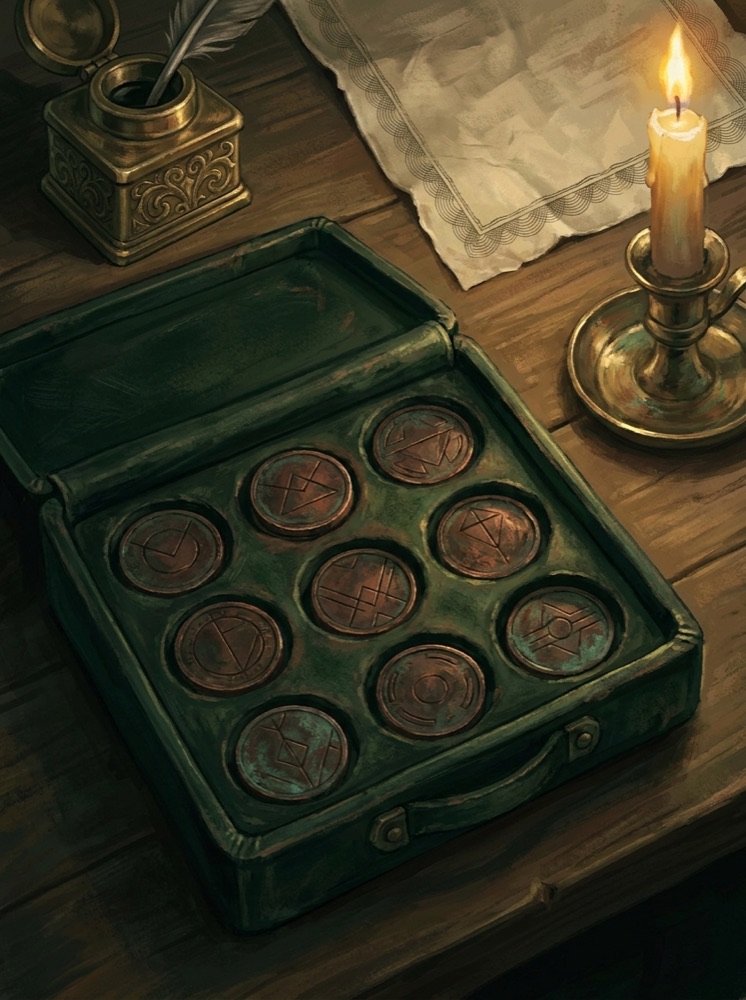
A midnight room of bottle-green leather and old brass. Nine coins lie face-down in a worn till, each minted with a different way of holding money. You bring one honest question, turn one coin over, and read the emblem that has been yours all along.
Open the ledger at the line that is yours.
What a money reading is in this room
Let us be exact, because money deserves exactness. A reading in the counting house is a mirror for your relationship with money — the habits, the inherited beliefs, the stories that got into your pockets before you were old enough to have pockets. It is not advice. It does not know your accounts, it offers no strategy, and it makes no forecast about what money may or may not do next. The coin you turn over reads the hand, not the balance.
The till works like every honest game of chance: nine coins, all tarnished to the same dull brown, shuffled fresh each time the drawer opens. You cannot read the emblems through the tarnish, which is the point — your choice carries no calculation, only the small preference of a hand reaching into a drawer. Whichever coin turns over, its emblem names a way of holding money: keeping it, moving it, feeding people with it, watching it, building with it.
None of these ways is the correct one. Every emblem in the till has kept somebody fed and cost somebody something; the reading is interested in which trade you have been making, often without noticing. The till reopens every Monday. Turn your coin, sit with the emblem for the week, and come back when the brass has had time to speak.
Your money story was written before you could read
Ask most people what they think about money and they'll tell you something reasonable. Watch what they do around it and you'll get an entirely different document — one written a long time ago, in a kitchen, by adults who didn't know you were listening. The specific silence that fell when a bill arrived. The way one parent said we can't afford that and the other said nothing at all. Whether money in your house was a subject or a weather system.
That is the thing the till reads. Not your salary, not your savings, not what you ought to do next — the reflex. The reflex is why you round your own prices down without noticing. Why you can spend forty pounds on someone else without a flicker and feel faintly sick spending twelve on yourself. Why the balance is fine and you check it anyway, three times, on a Sunday night. None of that is arithmetic. It's inheritance, and it's running unexamined, which is the only way inheritances get to keep running.
What the counting house will not do
I want to be blunt here, because this is the room where people most want to be lied to. Nothing in this till will make you money. It offers no strategy, no forecast, no opinion about a market, a job, a purchase, or a debt. It does not know your accounts and it will never claim to. If you are looking for financial advice, this is emphatically not that, and the person to talk to is a qualified professional who can actually see your numbers.
What the emblem on your coin can do is smaller and, I think, more useful. It gives a name to a way of holding money — keeping it, moving it, feeding people with it, watching it, building with it — and every one of those ways has kept somebody fed and cost somebody something. The reading is a reflection on that trade. Read it, recognise yourself or don't, and then go and make your own decisions with your own eyes open. That's the honest edge of what a coin can do, and I'd rather show you the edge than pretend it isn't there.