A reflective practice
Pick a Question. Pull a Card.
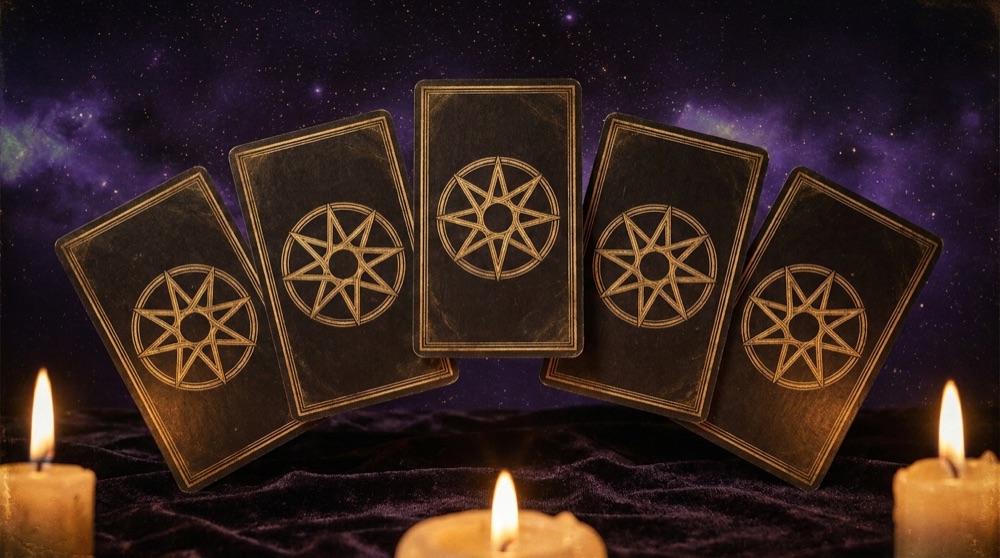
This is a reflective practice, not a prediction. The cards are a mirror, not a map. Choose the question that is sitting with you right now, then select one card from the spread.
Love
About this practice
Pick-a-card readings have been a part of tarot practice for as long as readers have laid cards on a table. The structure is simple: you hold a question, you draw one card, and you sit with what surfaces. The card does not know your name or your circumstances. What tends to be useful is the act of paying attention, of choosing to stop and ask something honest.
Each question here is designed as a frame rather than a search query. "What is my heart hiding from me?" is not asking the cards to reveal information you don't have. It's an invitation to look at what you may already know but have not yet named. The card that appears becomes a surface for that looking.
The 22 cards you can draw from are the Major Arcana, which tend to point at larger patterns rather than day-to-day events. Whatever card you draw, the reading is about your own state of attention, not about external certainty. Read it as a question back, not an answer forward.
Choosing the question is most of the work
Nine questions sit above, and you will feel the pull toward the safe one. Everybody does. "What should I focus on this week?" is a perfectly nice question and it costs you nothing, which is precisely the problem — a question you can answer without flinching will produce a reading you can forget by lunch.
The one to pick is the one you'd rather not. You'll know it because you skipped over it slightly too quickly on the way down the list, and because your eyes went back to it once. That small flinch is the tell. It doesn't mean the question is dangerous; it means the question is live — that there's something in it you have not yet finished thinking about, and a card laid down beside it will have something to catch on.
Why one card, and not three
A three-card spread gives you a shape: behind, present, ahead. It's generous, and it's also easy to hide in. With three cards you can always find a narrative that lets you off — the difficult card becomes "what's behind me," the flattering one becomes the future, and the reading resolves itself into something comfortable before you've felt anything.
One card doesn't offer that exit. There is a question and there is a card and there is nowhere to put the discomfort. Whatever turns up has to be about the thing you asked, which is why single-card draws are the sharper instrument even though they look like the simpler one. If you want the wider weather of the day rather than an answer to one question, today's three cards are the better door.
What to do with the card you get
Don't reach for the meaning immediately. Look at the image first. The posture of the figure, what they're holding, what they're refusing to look at. Say aloud the first thing you notice, before you have read a word of the interpretation, because that first noticing is the only part of the reading that is entirely yours. Everything after it is a negotiation with a paragraph somebody else wrote.
If you draw a card that seems to have nothing to do with your question, resist the urge to redraw. Sit with the mismatch for a minute. Fairly often the card is not answering the question you asked but the one underneath it — and that second question, the one you didn't quite have the nerve to click, is the one that was actually keeping you up.
Whatever surfaces here is a reflection, not a forecast. It cannot tell you what another person will do, what your money will do, or what tomorrow holds. What it can do is give you an honest hour with something you already half-knew. If you want to read a specific card more closely afterwards, every one of the 22 has its own page in the Major Arcana card meanings.