Major Arcana · IV
The Emperor Tarot Card Meaning
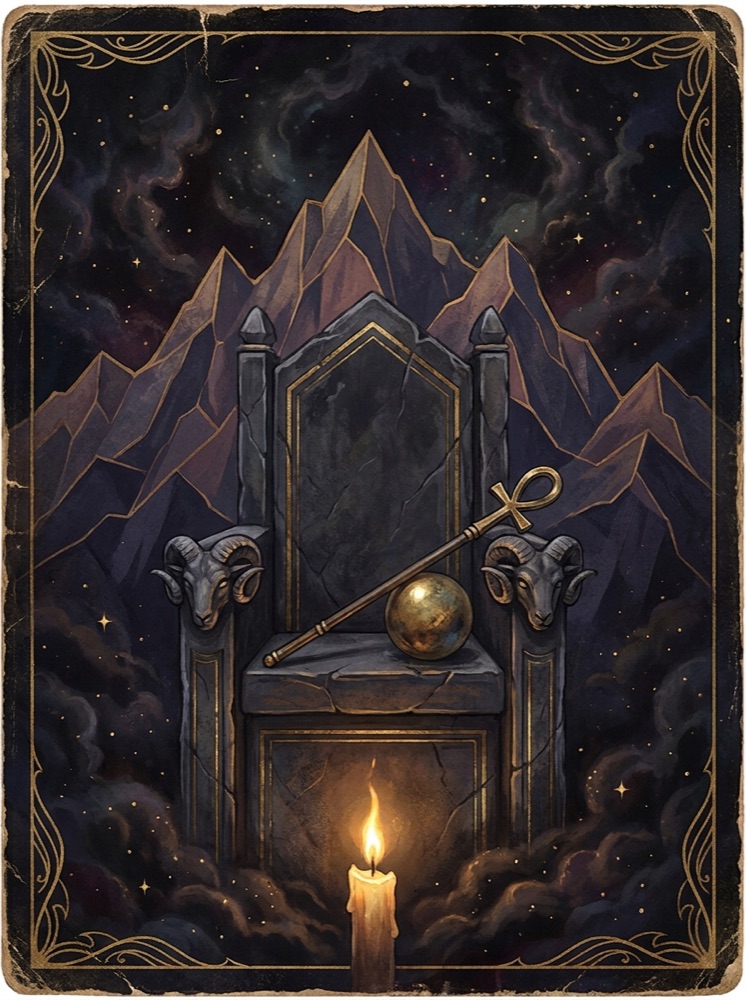
IV The Emperor
- Number
- IV (4)
- Element
- Fire
- Association
- Aries
- Upright
- structure, authority, stability, order, discipline, leadership
- Reversed
- rigidity, domination, authoritarianism, structural collapse, inflexibility, overcontrol
The Emperor sits on a stone throne. Ram heads are carved into the arms and the orb he holds. He wears a red robe, and armor is visible beneath it — the capacity for conflict is present even when peace holds. The mountain behind him is bare rock, no wheat fields, no rivers, no cushioned ease. He has surveyed this territory and given it form. He is not comfortable in the way the Empress is comfortable; he is stable in the way a load-bearing wall is stable, which is a different thing and requires different conditions to maintain.
Where the Empress governs the principles of creative abundance and cyclical flow, the Emperor takes what the Empress generated and gives it shape, boundary, and duration. Pollack reads him as the principle of order applied to the world — the recognition that creative energy, without form, dissipates. The Emperor represents human-made structure, and Pollack is deliberate about noting that this principle operates in any person, regardless of gender or social role. The pop-tarot habit of assigning the Emperor exclusively to “father figures” or “men in authority” misses the real question the card asks: what is your personal relationship to structure, authority, and the rules that govern your life?
The Emperor Upright
Upright, the Emperor tends to reflect the capacity to build and maintain structures that allow creative energy to become something lasting. Greer describes this as the archetype of the builder who understands load-bearing design: sustainable creation requires hierarchy where hierarchy serves the whole, boundary-setting, and the willingness to hold a line. The Emperor often appears when a situation is calling for more structure than is currently present — a project that needs a framework, a relationship that needs clearer agreements, a creative practice that needs a schedule.
The card may also reflect a moment when authority needs to be claimed rather than deferred to someone else. The Emperor’s authority is not inherited; it is built, held, and maintained. When the card comes up, it can point to a place where the person drawing it has the actual capacity to establish order and has been waiting for someone else to do it instead. The question the upright Emperor tends to ask is not “who is the authority here?” but “what structure would allow this to hold?”
The Emperor Reversed
Reversed, the Emperor tends to split in one of two directions, and context usually clarifies which. The first is structural rigidity: rules applied past their usefulness, authority maintained out of ego rather than function, the inability to adapt a framework when circumstances have outgrown it. The shadow Emperor is the person who has confused control with order. The structure is real, but it now serves the person maintaining it rather than the people or work it was meant to support.
The second direction is structural collapse: the absence of order that is costing the situation its form. The inability to establish needed boundaries, to hold agreements, to build a framework that holds under pressure. This can look like chronic disorganization, the project that never gets its scaffolding, or the relationship that keeps renegotiating its terms without ever landing on any. Both readings share a common root: the relationship with authority and structure is not working as intended, and the reversal asks honestly which direction the imbalance runs.
Symbolism in the Rider-Waite-Smith Image
The throne of stone carries the Emperor’s most important quality: permanence. Stone is immovable — a strength and, in excess, a constraint. The Emperor’s power is not temporary or emotional but enduring and structural. The ram’s head imagery (carved into the throne arms and held in the orb) names Aries, the sign that drives through by instinct and force of will — the Emperor’s authority has a martial quality. It is not gentle. The orb and scepter together signal sovereign power: the orb is dominion over the world, the scepter (in the form of an Egyptian ankh) is the life force exercised through the act of ordering. The red robe over visible armor holds the central tension: passion at the surface, readiness for conflict beneath. He governs from a position of defended power, peacefully until he cannot.
The Emperor in Love, Money, and Energy
In love, the Emperor often reflects the pattern of expressing care through provision, protection, and structure-building rather than through emotional openness. Love demonstrated as a made thing: the house kept, the plan secured, the practical problem solved. This can be a genuine and sustaining form of love, or it can be the armor that keeps real contact at a distance. The Emperor love reading may name which is currently operating.
In money, the card tends to mirror the relationship with financial systems and with authority structures — either the capacity to build and enforce structures that protect financial life, or the friction that arises when someone else’s rules are experienced as a personal affront rather than a navigable system. The Emperor money reading holds this pattern directly.
In matters of energy, the Emperor often reflects the body as a system to be managed rather than listened to. The person who pushes through signals that would stop other archetypes, who structures sleep and rest as inputs to performance rather than as information from the body itself. The Emperor energy reading tends to surface where this pattern is running at cost.
The Emperor’s Place in the Fool’s Journey
Between the Empress at card III and the Hierophant at card V, the Emperor gives the Fool the lesson that creative energy must be given form to produce lasting results. The Empress offered the generative principle; the Emperor shows the Fool what happens to that generativity when it is structured — it becomes capable of duration. What follows, the Hierophant, takes the Emperor’s personal authority and extends it into the domain of community, tradition, and institutional transmission. The Emperor holds the first principle of individual order; the Hierophant holds the communal one.
A Question to Sit With
What structure in your life is currently missing, and whose job do you imagine it is to build it?
Notice whether you have been waiting for an authority figure — an employer, a partner, a parent — to impose the order you actually want and could provide for yourself. The Emperor does not ask you to become rigid. He asks whether the framework you need is one you are capable of creating, and whether you have been deferring that creation while privately resenting its absence.
The Emperor in a reading
Pull The Emperor for one of the three pick-a-card questions and read the card as a reflection on a single area of your life — never a verdict.
The Emperor combinations
How The Emperor tends to read when it lands alongside another Major Arcana card. Each pairing is a reflection on the two energies together — never a forecast.
Where to go next