Major Arcana · IV + XVI
The Emperor and The Tower Tarot Combination
Read each card on its own first: The Emperor meaning · The Tower meaning.
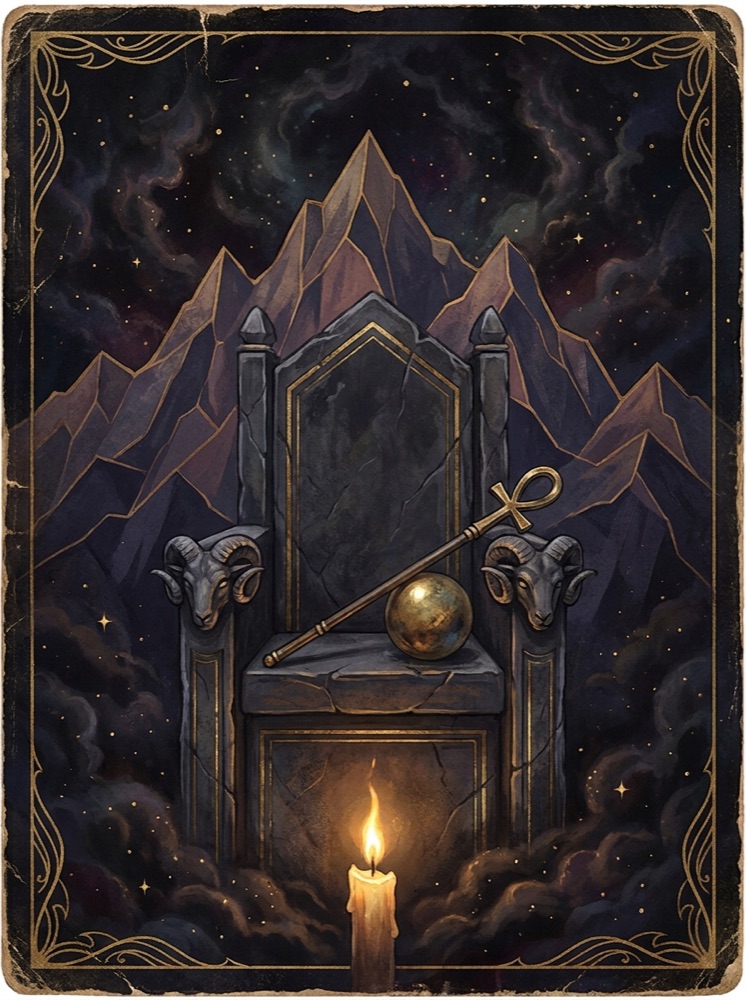
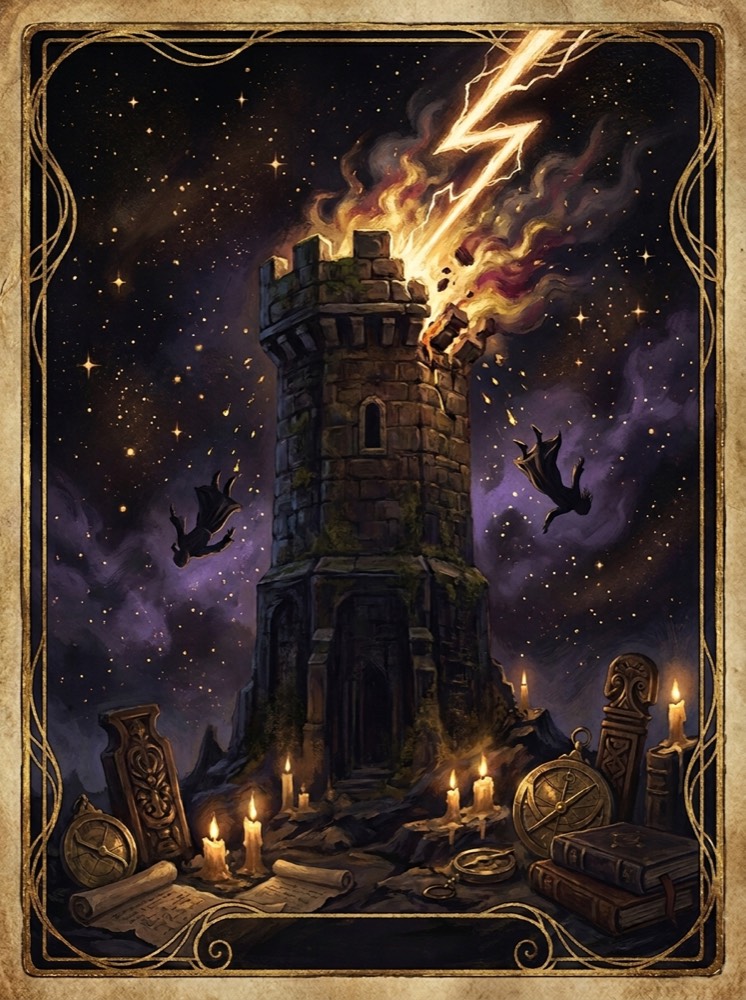
The Emperor sits on a stone throne carved with rams’ heads, the symbol of Aries, wearing full armor beneath his red robes. He holds the orb and the ankh-scepter. Behind him, the mountains are bare. Everything about his image signals dominance through structure: the rigid seat, the unyielding rock, the visual weight of a man who does not bend. The Tower, twelve cards later, is being struck by lightning. Its crown is blown off. Two bodies fall from its windows into darkness. It was the tallest thing around. That is why the lightning found it.
When these two cards appear together, the reading is pointed. The Tower does not destroy everything equally. It tends to find the structures that were built on the wrong thing.
When The Emperor and The Tower Meet
The Emperor is not a villain. At his best, and Greer’s account is fair about this, he is order in service of genuine security: the capacity to create reliable conditions that allow others to function and flourish. Good law, good structure, consistent protection. The Emperor as benevolent governance is one reading.
But the Emperor also represents the risk of authority that has stopped being accountable to anything outside itself. The stone throne, the bare mountains, the armor worn where no battle is currently being fought — these can read as a form of self-protection that has calcified into habit. When authority is no longer tested by truth, it tends to become brittle rather than strong. It looks solid. It cannot flex.
The Tower, in the Pollack reading, is not random destruction. It is the collapse of the false structure specifically. The lightning is revelatory — it shows what was already hollow. And what tends to be hollow are the structures that were built on the premise that authority itself is enough justification, that the rightness of the form does not need to be earned again through honest reckoning with what the form is actually doing.
The Tension Between These Cards
The Emperor tends to experience structure as protective. The Tower tends to experience that same structure as the thing that made the fall worse. This is the core tension, and it is not merely philosophical. Anyone who has worked inside a hierarchy that failed, or built something that looked solid and then couldn’t survive a real confrontation with reality, knows the specific quality of that collapse: the way the very thing that was supposed to protect became the thing that focused the damage.
The Emperor card often asks whether the authority you are building from, or building under, is genuinely grounded. Not whether it looks legitimate. Not whether it has the markers of credibility. Whether the thing it is organized around is true. Because what the Tower tends to find, what the lightning seems to seek out, are the structures that were built to look indestructible rather than to be honest.
This Pair in Love, Money, and Energy
In love, The Emperor and The Tower together may reflect a relationship structure built more on roles, expectations, or control than on anything that can bear honest scrutiny. The Emperor’s card meaning and the Tower’s card meaning can help locate where the structure is most rigid and where the lightning might find its way in. This pairing often surfaces when what was arranged clearly — who has authority, who defers — turns out not to have been a foundation at all.
In money, this combination often appears around institutional or organizational structures that have been running on authority rather than genuine function: the company whose leadership had stopped being accountable, the system that worked until something external required it to be honest about what it was actually producing. The question it tends to raise is what was actually solid in the structure versus what was only protected by the assumption that it was solid.
In matters of energy, The Emperor and The Tower together can reflect the particular exhaustion of maintaining a structure that has become more demanding than it is useful. The Emperor’s mode requires constant upkeep of authority. When the Tower arrives, that upkeep reveals itself as what it was: a form of control that substituted for the harder work of actual grounding.
Reading the Two Cards Together
It is worth noting that not all Emperor structures fall. The Tower does not destroy what is genuinely built on truth. What this pairing asks is precisely the distinction: what has been built on authority, on position, on the performance of stability — and what has actually been built to last? For the experience of what comes after the Tower has done its work, The Tower and The Star is the natural companion reading — the first card of genuine hope that tends to arrive in the bare ground after collapse.
A Question to Sit With
What would the structure you are building — or living inside — look like if the authority holding it together were removed?
If the answer is “it would still stand,” the Emperor is well-placed. If the answer involves more uncertainty than you expected, the Tower may be asking for your attention before it arrives uninvited.
Where to go next