Major Arcana · XVI
The Tower Tarot Card Meaning
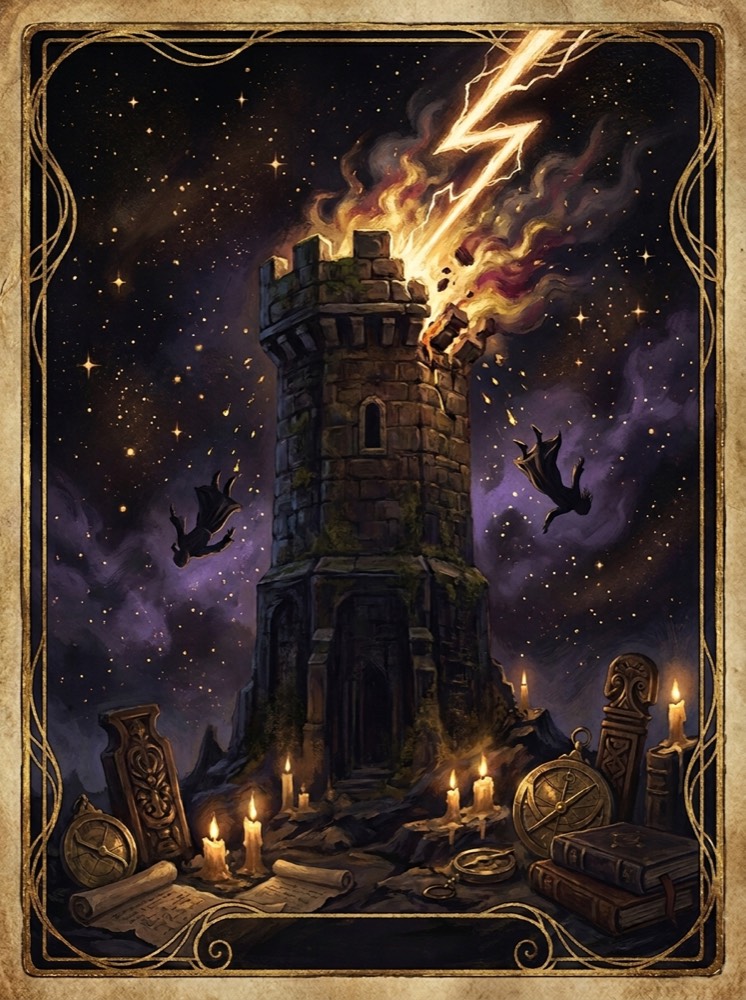
XVI The Tower
- Number
- XVI (16)
- Element
- Fire
- Association
- Mars
- Upright
- sudden change, revelation, collapse of false structures, breakthrough, disruption, truth
- Reversed
- avoided collapse, internal pressure, slow structural failure, deferred reckoning, destruction without clarity, forcible revelation
The image is stark. A stone tower, flames shooting from the upper windows, a crown blown free from the top by a bolt of lightning. Two figures fall from the height, arms out, no soft landing visible. Most people who pull this card feel a jolt of something close to dread. The Tower has that reputation — the unwanted card, the one that signals things going wrong.
But the reputation is incomplete, and getting it right matters. Rachel Pollack writes in Seventy-Eight Degrees of Wisdom that the lightning strikes the Tower because the Tower was built on false foundations. What falls is what was never as stable as it appeared. The crown at the top was never truly earned. The collapse is not punishment; it is accuracy. What the Tower image actually shows is not catastrophe visiting an otherwise sound structure. It shows a structure that was already compromised meeting the truth that exposes it.
The Tower Upright
Upright, the Tower tends to reflect sudden revelation — the moment when a truth that has been accumulating beneath the surface breaks through the framework that was containing it. This can arrive as an external event: a conversation that changes everything, a financial picture that becomes undeniable, a relationship dynamic that can no longer be minimized. Or it can arrive internally: the understanding that falls into place after years of circling the same question, the recognition that the story you have been telling yourself about a situation is not accurate.
The operative word in both Pollack and Mary K. Greer’s readings is necessary. The Tower’s disruption is not random. What falls was already false; the lightning’s job is to make the falseness visible and irreversible. Greer reads the Tower as the archetype of the necessary breakthrough, the event that strips away the inessential and reveals the actual ground. After the Tower, the ground you are standing on is real. That is the card’s offer, and it is a considerable one. The disruption may be sudden and unwelcome; the clarity it delivers tends to be both.
The Tower Reversed
Reversed, the Tower often reflects the pressure that has been building without release. The internal architecture is compromised, the cracks are visible, but the collapse has not yet happened. Energy is being spent maintaining a structure that the person knows, somewhere they do not quite say out loud, is no longer sound. The reversal can point to the exhaustion of that maintenance, or to the quiet awareness that what is being held together may not be worth the effort of holding.
In another expression, the reversed Tower reflects the slow structural failure that has been underway invisibly — the relationships, financial arrangements, or self-conceptions that are eroding incrementally rather than falling dramatically. The reversal sometimes asks: what are you propping up, and at what cost? There is also a shadow reading: destruction pursued without the clarity of what is actually load-bearing versus what is false, which produces collapse without the useful revelation the upright card delivers. The Tower reversed is not necessarily easier than the Tower upright. It can indicate a harder reckoning that keeps being deferred.
Symbolism in the Rider-Waite-Smith Image
The lightning bolt arrives without warning and cannot be anticipated or argued with. Pollack reads it as sudden divine truth: the flash of genuine insight or external event that the structure simply cannot contain. The crown blown from the top signals that whatever authority this structure claimed has been stripped away; the legitimacy was part of the illusion. The two falling figures remind us that a Tower event displaces everyone who has been sheltering inside the false structure, not only the person who built it. The flames from the windows indicate that the interior is burning completely: no fragment of the old arrangement survives intact to deceive again, which is precisely what makes reconstruction possible on honest ground.
The Tower in Love, Money, and Energy
In love, this card often reflects the relationship revelation — the moment when a truth about the partnership that has been building for some time can no longer be contained and changes the structure permanently. That can be a rupture, or it can be a clarification that was needed for the relationship to proceed honestly. What the Tower points to is rarely a surprise on close inspection; the foundation of the revelation was usually already there. The Tower love reading may offer a more specific reflection on what this can look like.
In money, the Tower tends to mirror the financial structure under hidden stress: the arrangement that held until it did not, and the productive clearing that follows when false architecture is released rather than rebuilt in the same shape. The honest accounting that becomes possible after a Tower event can be the beginning of something more stable than what preceded it. The Tower money reading explores this territory.
In matters of energy, the card often reflects the body’s sudden demand for restructuring: the point where a level of output or suppression that has been maintained through will finally breaks down and requires a genuine response. The body’s Tower events tend to carry accurate information about what has been overextended.
The Tower’s Place in the Fool’s Journey
Card XVI marks the Fool’s most forceful confrontation with the limits of his own constructions. He has built things — structures, identities, relationships, beliefs about how the world works — and the Tower is the moment he learns that some of those things were built on foundations that could not hold. Pollack reads this as one of the journey’s essential teachings: some truths are only accessible through the sudden collapse of the frameworks that were obscuring them. There is no gentle path to what the Tower reveals. That is why it comes when it does, and why what follows it — the Star, card XVII — is one of the most quietly hopeful cards in the deck.
A Question to Sit With
Where in your life is something being maintained that you know, on honest examination, was built on a premise that no longer holds?
Noticing this does not mean forcing a collapse. The Tower’s lesson is that what is genuinely false tends to fall on its own schedule, and the invitation is to stop spending energy on the maintenance of it. The ground that is real will still be there after. The cards that flank this one are worth sitting with: the Devil (card XV) asks what voluntary structures you have been sustaining, and the Star (card XVII) asks what remains when what was false is finally gone.
The Tower in a reading
Pull The Tower for one of the three pick-a-card questions and read the card as a reflection on a single area of your life — never a verdict.
The Tower combinations
How The Tower tends to read when it lands alongside another Major Arcana card. Each pairing is a reflection on the two energies together — never a forecast.
Where to go next