Major Arcana · XV
The Devil Tarot Card Meaning
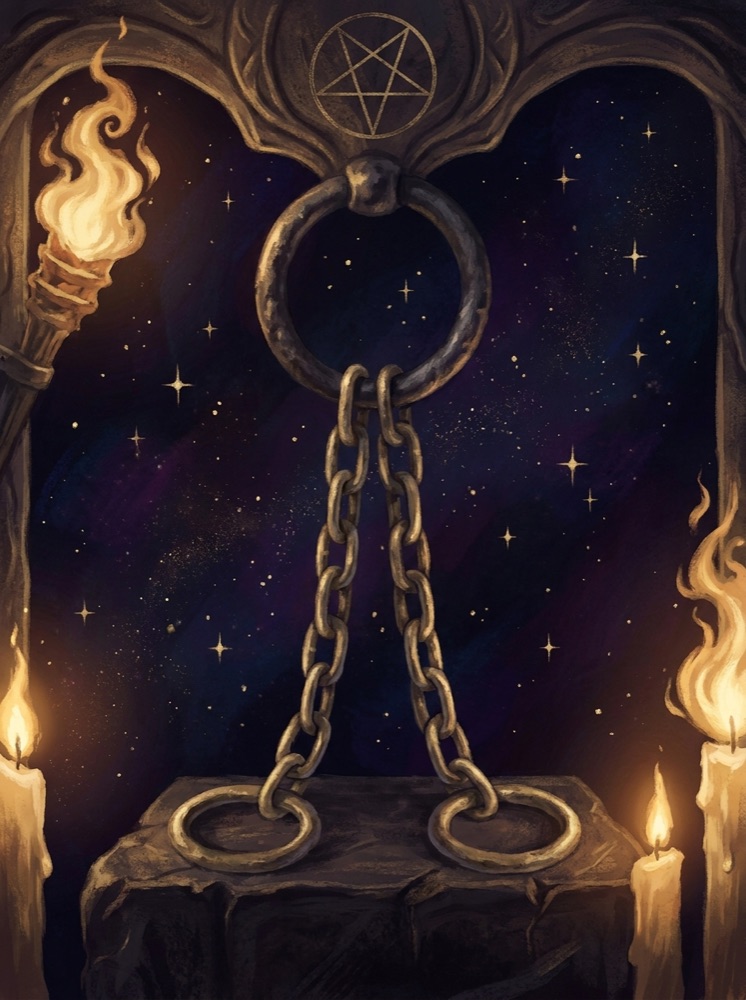
XV The Devil
- Number
- XV (15)
- Element
- Earth
- Association
- Capricorn
- Upright
- bondage, voluntary constraint, addiction, shadow, materialism, recognition
- Reversed
- liberation beginning, deepening denial, releasing chains, compulsion, unhealthy attachment, seeing agency
The image stops most people. A horned, bat-winged figure crouches on a black pedestal. Below him, two human figures stand chained by the neck — one with a tail ending in fire, the other with grapes. Everything about the composition reads like a threat. But look more carefully at those chains. They hang loose around the figures’ necks. Wide enough to lift off. The figures could remove them right now, in this moment, and they have not.
That detail is the whole card. The Devil — card XV, arriving just after the patient integration of Temperance — is not a card about external evil visiting your life or a warning that someone is working against you. Rachel Pollack writes in Seventy-Eight Degrees of Wisdom that the binding in this image is consensual and ongoing. The constraint is something being maintained, not something being done to the figures against their will. That shift in framing changes the card from a horror image into an invitation, and a genuinely empowering one at that.
The Devil Upright
Upright, the Devil tends to reflect the voluntary arrangements that have become invisible through repetition. These are the agreements, habits, routines, and patterns that bind not by external force but by ongoing personal consent. A lifestyle cost that felt manageable three years ago and now shapes every choice you can make. A dynamic in a relationship that you have never named out loud but have also never moved to change. A way of working that is recognizable as a trap and has been for some time. The card asks: what am I choosing to remain in, and what would it cost me to see it honestly?
Pollack is careful here. The Devil is not a moral condemnation. Mary K. Greer reads the card as the archetype of shadow integration — the invitation to acknowledge what has been denied, repressed, or scapegoated rather than faced. Upright, it often points to the precise thing a person already knows but is not quite ready to name: the financial arrangement that feels like a ceiling, the relationship role that fits badly and is worn daily, the appetite that offers enough reward to maintain and enough cost to regret. Recognition is the first movement. The chains are loose. The question is whether the hands are ready to lift them.
The Devil Reversed
Reversed, the Devil can tip in either direction, and the reading depends heavily on context. In one expression, the reversal signals the beginning of liberation: the chains are being recognized for what they are, the mechanism of the bind is becoming visible, and the first honest conversation with oneself about agency is starting. This is one of the more hopeful reversals in the deck, because the hardest part of leaving an arrangement is seeing it clearly, and that seeing may be precisely what is beginning.
The other expression of the reversal is more difficult: the binding deepens into the unconscious, becoming harder to see rather than easier. The compulsion or the attachment becomes more automatic, less examined, more defended. In this reading, the reversed Devil can point to denial that is thickening rather than thinning — the situation that is uncomfortable but increasingly difficult to name, and the gradual way a voluntary arrangement can begin to feel like fate. Neither reading is punishment; both are invitations to look. Mary K. Greer’s shadow-integration framing holds in either case: what cannot be seen cannot be changed, and the Devil’s task is always to bring the unseen into view.
Symbolism in the Rider-Waite-Smith Image
The loose chains are the central symbol and the one most often missed. They hang around the figures’ necks with no lock, no knot tight enough to hold against genuine effort. Pollack’s central reading is built on this: the voluntary nature of the binding is not incidental but is the whole point. The inverted pentagram on the Devil’s forehead places material concerns above the spiritual — not as condemnation of the material world but as a signal that when appetite becomes the primary lens, perspective narrows. The small horns and tails growing on the human figures indicate that the longer an arrangement is maintained, the more it shapes the person maintaining it; consent sustained becomes identity over time. The torch burning downward is passion without wisdom, fire that perpetuates rather than transforms.
The Devil in Love, Money, and Energy
In love, this card often reflects the voluntarily maintained dynamic — the relationship pattern that is uncomfortable on honest inspection but not, in truth, impossible to change. It may point to a role that is being performed rather than chosen, to an agreement that was made a long time ago and has not been revisited, or to the particular kind of loyalty that is really inertia wearing loyalty’s name. The card asks what would be different in this relationship if you could see your own agency in it clearly.
If you are exploring what the Devil reflects in your own love patterns, the Devil love reading may offer a useful mirror.
In money, the Devil tends to reflect the financial binding that has been accepted as permanent: the debt structure that shapes every decision, the income arrangement that pays enough to stay and not enough to leave, the golden handcuffs that came with conditions that only became visible later. The card asks not for self-blame but for a clear look at what has been consented to and what the actual options are. The Devil money reading explores this pattern in more detail.
In matters of energy, the card often reflects habits and patterns that offer enough reward to maintain while costing enough to register as a drain. The loop is recognized but not yet broken. This is the most practical face of the card: not demonic possession but the ordinary human experience of the difficult-to-stop pattern, whatever its form.
The Devil’s Place in the Fool’s Journey
Card XV arrives after Temperance’s long patience and integration, and it carries a specific role in the arc: the Fool meets the shadow and is confronted with the voluntary nature of the constraints he has been attributing to forces outside himself. Pollack reads this as one of the journey’s essential confrontations. You cannot integrate what you cannot see. The Devil is the moment of seeing, and what makes it empowering rather than damning is precisely what the image encodes: the chains are loose. They always were.
A Question to Sit With
What is one arrangement in your life — a financial one, a relational one, a daily pattern — that you describe to yourself as fixed, but that, on closer inspection, involves your ongoing participation?
Sit with that for a day before trying to answer it. The point is not guilt about having stayed; the point is noticing that staying has been, at some level, a choice. That noticing is not the end of something. It is the beginning of being able to see your own options clearly, which is the only condition under which anything can genuinely change. The neighbor cards on either side hold useful context: Temperance (card XIV) asks what the patient middle path looks like before this confrontation, and the Tower (card XVI) shows what happens when the structure comes down.
The Devil in a reading
Pull The Devil for one of the three pick-a-card questions and read the card as a reflection on a single area of your life — never a verdict.
The Devil combinations
How The Devil tends to read when it lands alongside another Major Arcana card. Each pairing is a reflection on the two energies together — never a forecast.
Where to go next