Major Arcana · XI + XV
Justice and The Devil Tarot Combination
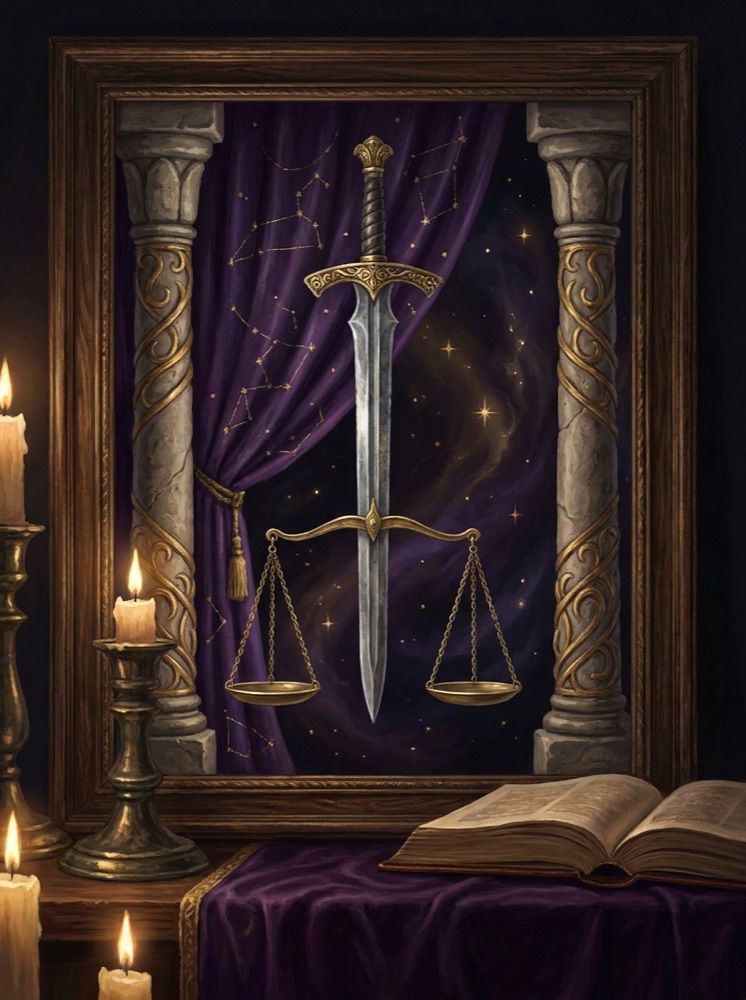
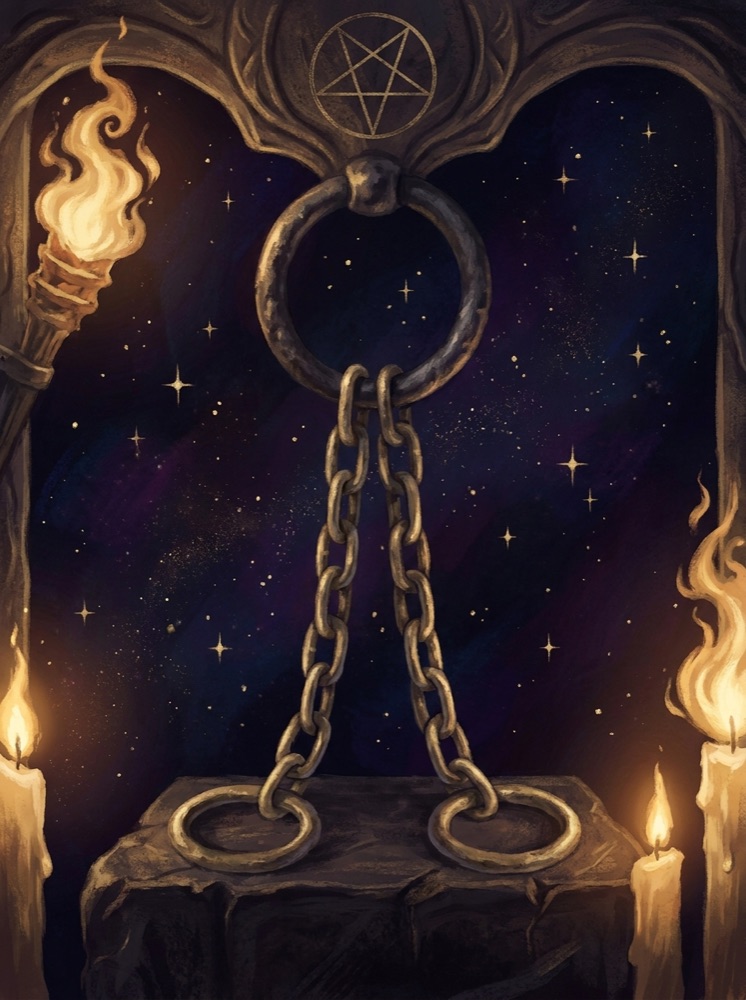
Read each card on its own first: Justice meaning · The Devil meaning.
Most people pull Justice and want it to deliver a verdict on someone else. The scales will balance. The wrong that was done will be accounted for. The person who lied, who took without asking, who built something on a contract they never intended to keep — they will face what they made. Justice, in this fantasy, arrives like a court ruling in your favor. The Devil tends to complicate that very quickly, because the Devil is where the chains are visible and the hands are free.
When Justice and The Devil Meet
Justice is card XI. In the Rider-Waite-Smith tradition it reflects cause and consequence stripped of emotion — the precise, impartial weighing that does not factor in how the outcome will feel. Mary K. Greer reads it as the card of clarity and right action: you see the situation as it is, you name your part in it honestly, and you are able to act from that clarity. The sword Justice holds cuts through distortion, including self-flattering distortion. It does not confirm the story you want to tell.
The Devil is card XV, and in the Greer/Pollack canon it tends to reflect the chains of self-created bondage rather than external force. The two figures in the Rider-Waite-Smith image are chained to the Devil’s throne, but the chains are loose enough to slip over their heads. They stay not because they must, but because they have forgotten they are free to go, or because something about the arrangement still suits them at a level they have not admitted to.
Together, these two cards form the honest audit: the moment when you ask not just “what went wrong” but “what did I do, and what did I keep doing after I knew better.”
The Tension Between These Cards
The tension is uncomfortable in a specific way. Justice asks for a clear accounting. The Devil points at where you participated in the thing you want Justice to correct — the relationship where you stayed too long because the comfort was real even if the dynamic was not, the professional arrangement where you accepted terms you knew were wrong because the alternative required more courage than you had at the time, the pattern you returned to again and again because leaving it would have meant admitting what you already knew.
This pair can feel accusatory. It may not be. In the Pollack tradition, the Devil is not a moral judgment — it is a pattern recognition. The chains the two figures wear are made of the same material as the arrangements they found themselves in. Recognizing that is not self-blame. It is the first step toward the loosening that Justice makes possible.
This Pair in Love, Money, and Energy
In love, this pair tends to surface in readings about relationships that were or are genuinely harmful but also genuinely difficult to leave. The Justice meaning and the Devil meaning together often point to the moment of honest reckoning: not just “this person wronged me” but “what kept me here, and what did I tell myself while I stayed.” That accounting does not erase what the other person did. It just means you can make a real decision going forward rather than a reactive one.
In money, this pair can reflect contracts and arrangements that were lopsided and that you saw as lopsided at the time of signing — or relationships around money where the terms were unfair and you accepted them anyway because you needed the deal or feared the alternative. Justice asks for the honest tally. The Devil shows you where you handed something over before the accounting was complete.
In matters of inner life, this combination often surfaces the specific discomfort of wanting someone or something to be held accountable when the accounting includes you. That discomfort is worth sitting with rather than resolving quickly.
Reading the Two Cards Together
Justice comes before the Devil in the Major Arcana sequence, but in a spread they can be read in either direction. Pulled after the Devil, Justice often reflects the reckoning that becomes possible once the chains are named. Pulled before it, Justice can reflect the clarity that makes the Devil visible — you see the pattern only after you have stopped looking away.
What the pair does not tend to do is deliver a simple verdict. Justice here is not an external force that comes to rescue you from the Devil’s arrangements. It is an internal one: the capacity to look at what is, without the story, and act from there. For how this dynamic begins, with the initial choice and entanglement, The Lovers and The Devil offers useful context. For the sudden break that sometimes follows this kind of recognition, The Devil and The Tower is worth a look.
A Question to Sit With
In the situation you are bringing to this pair — what part of the accounting have you been avoiding because it requires you to include yourself in the story?
That part tends to be where the real clearing starts.
Where to go next