Major Arcana · XI
Justice Tarot Card Meaning
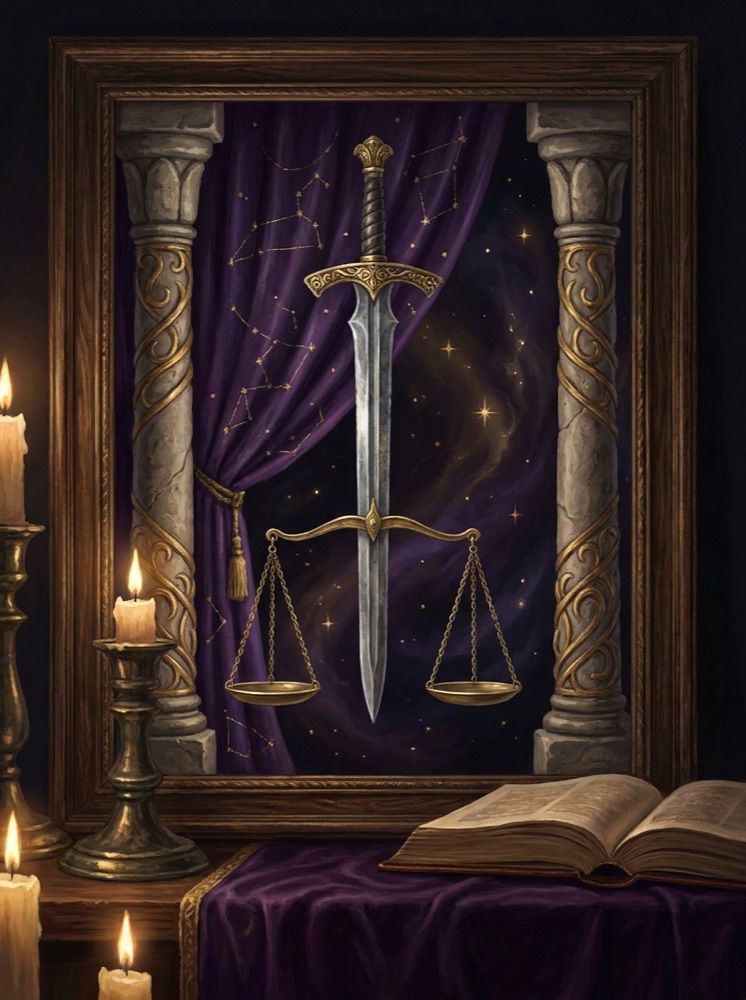
XI Justice
- Number
- XI (11)
- Element
- Air
- Association
- Libra
- Upright
- balance, truth, accountability, fairness, cause and effect, clarity
- Reversed
- injustice, denial, excessive self-judgment, imbalance, unfair systems, avoidance of truth
In the Rider-Waite-Smith image, a figure sits on a stone throne between two pillars, holding a sword upright in the right hand and a set of scales in the left. The sword does not move. The scales are level. A grey cloak covers a red robe beneath it, and a crown rests on the head without flourish. The expression is neutral — not cold, not warm, not sympathetic, not harsh. The face of someone who has committed to seeing accurately.
A housekeeping note before anything else: this card is numbered XI in the Rider-Waite-Smith deck, and that is the numbering used here. In the Thoth deck and several older Marseille traditions, Justice is numbered VIII and Strength is XI — those systems swapped the two cards. In RWS, which is the canonical source for this site, Justice is always XI and Strength is always VIII. If you encounter sources that assign Justice to position 8, they are drawing from a different tradition.
Justice Upright
Upright, Justice often reflects a moment of honest reckoning — the point where cause and effect become visible and the accounting can no longer be deferred. Rachel Pollack’s reading in Seventy-Eight Degrees of Wisdom is precise on this: Justice is not mercy and is not punishment. It is accurate accounting. Every action produces consequences; the Justice card tends to appear when those consequences are arriving, or when the honest examination of them is overdue.
This card often reflects the capacity — or the invitation — to look at a situation without flinching and name what is actually true rather than what is preferred. That might mean acknowledging your own role in how something has unfolded. It might mean recognizing a pattern in how agreements go, in how relationships settle, in how financial decisions land. Mary K. Greer describes Justice as the archetype of discernment applied to action and its effects. The upright card doesn’t require harsh self-judgment; it requires honesty. Those are different things. The scales aren’t tipped against you. They simply need to be read clearly.
Justice Reversed
Reversed, Justice tends to reflect one of two distinct imbalances. The first is denial — the refusal to see the consequences of one’s actions, the insistence that a situation is unfair without the willingness to look at one’s own contribution to it. The reversed card in this configuration often shows up around the same story being told in the same way, repeatedly, without the additional information that honest self-examination might add.
The second reversal pattern is excessive self-judgment: the scales tipped permanently against the self. This can look like scrupulous honesty but it is a distortion — holding yourself to a standard of accounting that you do not apply equally in the other direction. Justice reversed in this configuration may name a pattern of accepting responsibility for what is not yours while avoiding the harder look at what actually is. There is also a third reading: situations where the system itself does not deliver fair accounting, and the card reflects the psychological cost of living inside that inequity. The reversed Justice can name injustice, not merely the individual’s avoidance of it.
Symbolism in the Rider-Waite-Smith Image
The upright sword is the card’s most important symbol and the one most often read reductively as threat. Pollack corrects this: the sword is held upright, not raised to strike. It is the instrument of clear discrimination, the cut that reaches truth. The act of truth-telling is the act of the card, not punishment. The balanced scales are the secondary symbol and the more demanding one: equitable weighing requires ongoing active attention. The scales are not fixed in position; balance must be maintained. A one-time verdict is not what Justice offers. The crown signals authority derived from principle rather than from popularity or force. The red robe beneath the grey cloak confirms something important: Justice is not indifferent. The passion and commitment to truth are there, beneath the neutral exterior. She is not cold; she is not partisan.
Justice in Love, Money, and Energy
In love, Justice often reflects the patterns of reciprocity and balance in a relationship — the honest audit of what is given, what is received, and whether that accounting has been running even. The card tends to surface not when everything is clearly unjust but when the imbalance has been quietly accumulating and both parties have been politely not naming it. The invitation is to say what the scales actually show, without softening it and without catastrophizing it. For a more specific reflection on how Justice tends to appear in relationship readings, the Justice love reading explores that terrain.
In money, Justice tends to mirror the relationship with financial truth: the capacity to look honestly at numbers, agreements, and consequences without adjusting the accounting in your favor. This might mean looking clearly at what a business arrangement is actually producing rather than what it was supposed to produce. It might mean acknowledging the financial consequence of a habit or choice you haven’t wanted to examine. The Justice money reading works through some of those patterns more directly.
In matters of energy and wellbeing, Justice often reflects the body’s own balance-seeking. Symptoms, fatigue, and physical imbalance can function as accurate reports of an accounting that has been running uneven for some time — too much output without sufficient recovery, or the accumulated cost of a mismatch between what is being given and what is being received. This is a reflection prompt, not a diagnosis. The card asks what the body’s report might be naming, not what treatment it requires.
Justice’s Place in the Fool’s Journey
Card XI sits at the midpoint of the Major Arcana, and Pollack identifies this as structurally significant: Justice is the hinge of the Fool’s Journey. The first ten cards, from the Fool through the Wheel of Fortune, have been about the Fool building a self and encountering the world. Justice arrives as the accounting point: the choices made back at the Lovers (card VI), carried through the Chariot’s motion, and shaped by Strength and the Hermit’s inner work, now have consequences that must be honestly reckoned with. Justice follows the Wheel of Fortune (card X — Wheel of Fortune) and precedes the Hanged Man (card XII — The Hanged Man). The Wheel showed the Fool the larger forces at work; Justice asks how the Fool has acted within those forces; and the Hanged Man will ask for a complete suspension of forward motion to absorb what Justice has shown.
A Question to Sit With
Where in your life is the accounting running — and are you looking at what it actually shows, or at what you would prefer it to show?
Hold that question without turning it into a verdict. Justice doesn’t require a sentence; it requires an accurate read. The most useful thing the card tends to point toward is not what needs to be punished but what needs to be seen — the honest difference between those two things being, often, the whole distance between paralysis and genuine forward motion.
Justice in a reading
Pull Justice for one of the three pick-a-card questions and read the card as a reflection on a single area of your life — never a verdict.
Justice combinations
How Justice tends to read when it lands alongside another Major Arcana card. Each pairing is a reflection on the two energies together — never a forecast.
Where to go next