Major Arcana · XII
The Hanged Man Tarot Card Meaning
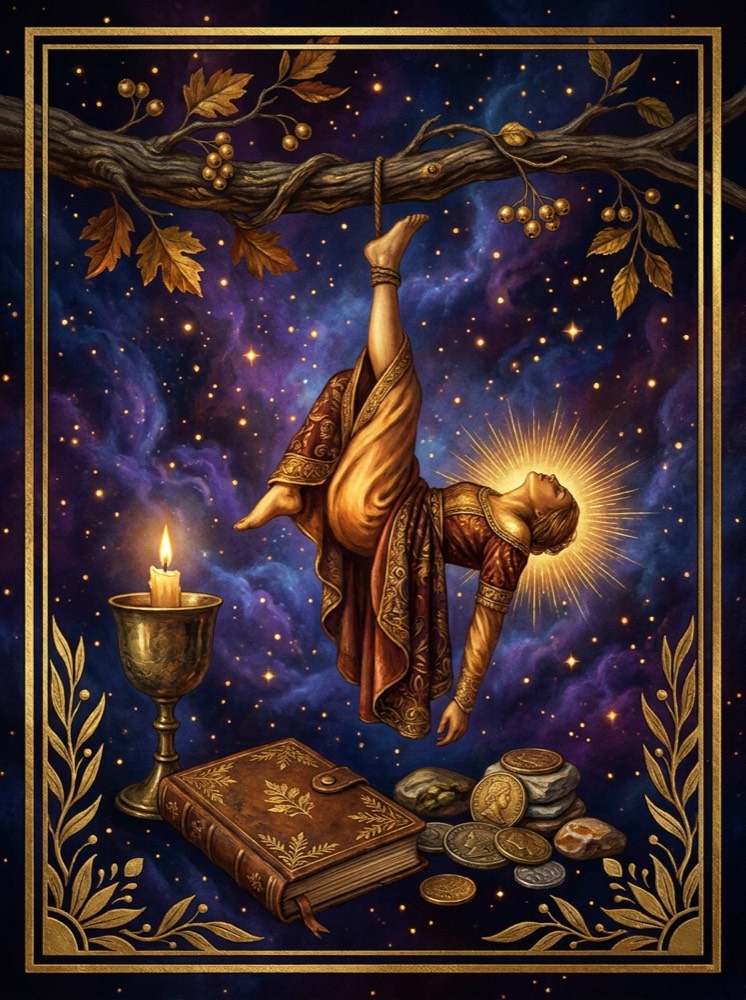
XII The Hanged Man
- Number
- XII (12)
- Element
- Water
- Association
- Neptune
- Upright
- surrender, pause, perspective shift, sacrifice, suspension, acceptance
- Reversed
- forced pause, martyrdom without insight, resistance to necessary waiting, stalling as avoidance, inability to surrender
In the Rider-Waite-Smith image, a figure hangs upside down from a living tree by one ankle. The other leg is bent behind the knee, forming the shape of the number four. The tree is leafed and alive. Around the figure’s head glows a halo of golden light. The expression, and this is the part most people notice and then quickly pass over, is serene.
The most important thing to say about this card, before anything else, is that the suspension is chosen. This is not an execution. It is not punishment. Rachel Pollack’s account in Seventy-Eight Degrees of Wisdom is careful on this point: the figure is hung by his own ankle, not by an external force, and his face shows not anguish but calm. He has inverted himself deliberately, and from the inverted position the world makes different sense. Pop tarot often reads this card as “being stuck” or “feeling victimized” — that reading is not canonical and it is worth saying so directly. The Hanged Man is a seeker who has chosen the suspension because something about his ordinary frame of reference was no longer serving him. The pause is productive. The halo confirms it.
The Hanged Man Upright
Upright, the Hanged Man often reflects the value — and sometimes the necessity — of a complete stop. Not a rest, not a pause to recalibrate, but a genuine surrender of forward motion that allows something to be seen that the motion was obscuring. Mary K. Greer describes this as the archetype of the person who discovers truth by letting go of the need to act, to fix, or to proceed. That is a harder discipline than it sounds for people who have built their sense of competence around motion and problem-solving.
The card tends to appear when the pressure to act is high and the next right action genuinely isn’t clear yet, and when acting from that unclear position would produce a result that is motion for its own sake rather than genuine progress. The Hanged Man is asking for the specific quality of suspension that produces a perspective shift — not waiting in the hope that clarity comes eventually, but actively choosing the inverted view. Often this means sitting with a situation from a completely different angle: asking what the person you are most in conflict with might understand that you currently don’t, or what would be visible if you stopped defending your current position long enough to examine it.
The Hanged Man Reversed
Reversed, the Hanged Man can reflect two distinct patterns. The first is the inability to pause — continuing to force motion and action when what the situation requires is surrender and genuine waiting. The forced action can look like productivity, but it tends to produce the same outcomes repeatedly because the perspective that would generate a different result hasn’t been allowed to form.
The second pattern is the stuck suspension: the pause that has become indefinite, the waiting that has been extended past the point where it was productive into the territory of avoidance. The distinction matters. The upright Hanged Man’s pause is chosen and purposeful, and it ends. The reversed Hanged Man’s pause may have begun with genuine intentionality and then quietly became a reason to avoid the return. There is also a shadow form worth naming: martyrdom without insight — making a sacrifice, enduring a suspension, absorbing a difficulty, without receiving the wisdom the pause was meant to deliver. The card asks whether the suffering is still producing anything.
Symbolism in the Rider-Waite-Smith Image
The Tau-cross formed by the body is a cross of sacrifice in multiple traditions; the Hanged Man’s posture creates it through his own arrangement, not through external imposition. The sacrifice is self-directed. The halo of light around the head confirms that illumination is actively arriving during the suspension. The pause is not a waste of time; the golden light is the evidence that something is being received. The one free leg bent behind the knee is often underread: the figure has agency. He is not completely bound. The bent leg forms the number four — Pollack reads this as the Emperor’s number, the principle of structure and rigidity, now subordinated, placed behind the figure. The old structural self is being consciously set aside. The living tree matters enormously: this is not a dead scaffold but a living one. The context of the sacrifice is growth, not destruction.
The Hanged Man in Love, Money, and Energy
In love, the Hanged Man often reflects a period of suspension in a relationship — the space between one chapter and the next where the way forward isn’t yet clear and where forcing a resolution produces less than waiting produces. This might be the pause after a significant conversation before knowing what it meant. It might be the period of sitting with a decision about a relationship without making it. The Hanged Man love reading explores what this particular stillness often reflects in relationships.
In money, the Hanged Man tends to mirror the productive quality of a deliberate financial pause — the refusal to act before clarity arrives, the willingness to wait for the right angle on a decision even when the pressure to decide now is high. This might look like indecision from the outside. From the inside it often feels like the awareness that the next move isn’t visible yet, and that moving from that state of not-yet-seeing tends to cost. For more on how this pattern shows up in financial decisions, the Hanged Man money reading works through it specifically.
In matters of energy and wellbeing, the Hanged Man often reflects the body’s requirement for genuine rest-as-suspension: not sleep-as-recovery but the deeper fallow state where the nervous system actually stops producing and begins receiving. Many people have learned to rest without actually stopping. The Hanged Man tends to surface when the body is asking for the kind of pause that feels uncomfortable precisely because it offers no output.
The Hanged Man’s Place in the Fool’s Journey
Card XII arrives after Justice (card XI — Justice) has delivered its honest accounting. The Fool has now seen clearly what the consequences of his choices have been. That clarity is significant, but acting immediately from it risks producing more of the same. The Hanged Man is the pause between the honest seeing and the action that follows it — the integration period, the chance to let the new perspective settle before the next move. What follows is Death (card XIII — Death), which is the release of what no longer fits. The Hanged Man’s suspension is the preparation for that release: you cannot let something go completely until you have stopped long enough to see it clearly.
A Question to Sit With
What might you see about this situation if you stopped defending your current position in it — just for the length of a single honest look?
The Hanged Man doesn’t ask you to abandon your position permanently. It asks for the temporary inversion that produces a different view. Often the answer arrives not in the first few seconds of holding the question but in the pause that follows them — the moment after the obvious answers have run out, before the mind reaches for another argument to maintain the current frame.
The Hanged Man in a reading
Pull The Hanged Man for one of the three pick-a-card questions and read the card as a reflection on a single area of your life — never a verdict.
The Hanged Man combinations
How The Hanged Man tends to read when it lands alongside another Major Arcana card. Each pairing is a reflection on the two energies together — never a forecast.
Where to go next