Major Arcana · XIII
Death Tarot Card Meaning
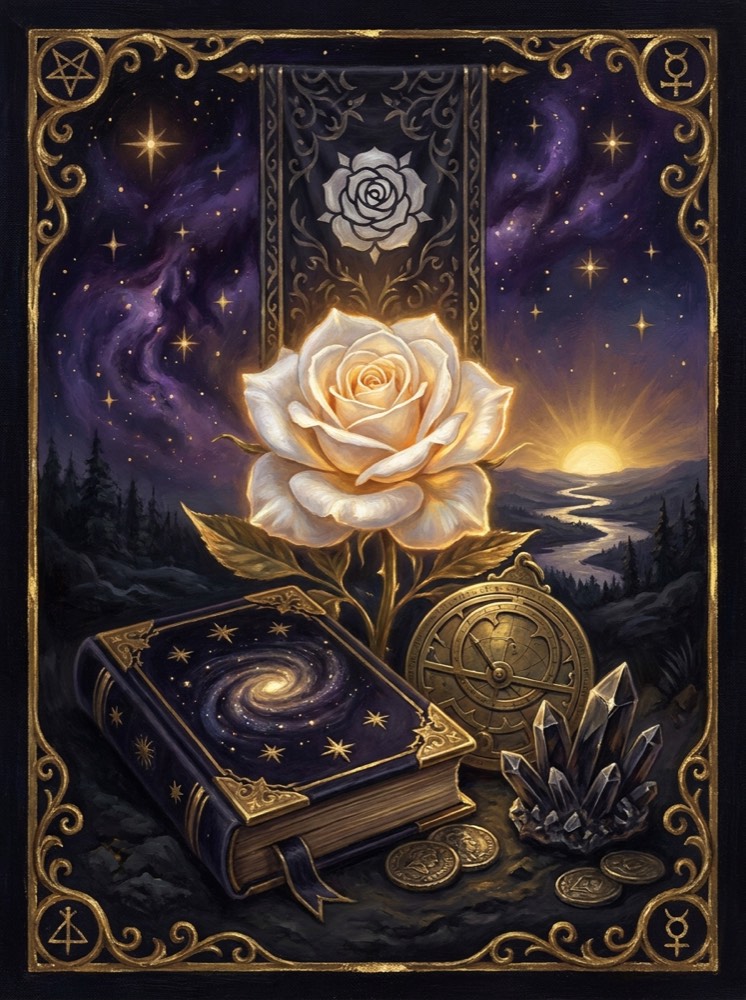
XIII Death
- Number
- XIII (13)
- Element
- Water
- Association
- Scorpio
- Upright
- transformation, endings, release, change, transition, clearing
- Reversed
- resistance to ending, inability to let go, stagnation, failed transformation, fear of change, prolonged dying
First, the thing that needs to be said plainly: the Death card in tarot does not predict physical death. It has never predicted physical death in the Rider-Waite-Smith tradition, and it doesn’t in a reading here. Rachel Pollack addresses this directly in Seventy-Eight Degrees of Wisdom, and it is worth being specific rather than vague about it: when Death appears in a reading, it is pointing to the end of a phase, an identity, a structure, or a belief — not to any threat to a physical body. If drawing this card produces anxiety, that anxiety is rooted in the card’s name and image, not in its meaning. The two are not the same.
In the Rider-Waite-Smith image, a skeleton in black armor rides a white horse through a landscape. Before the horse, a bishop stands with hands clasped. A king lies dead on the ground. A young woman turns away. A child looks up at the rider with what might be curiosity rather than fear. The sky behind the skeleton is a dark orange, and between two towers in the far distance the sun sits exactly at the horizon — neither setting nor rising. That ambiguity is deliberate: every ending contains its morning.
Death Upright
Upright, Death reflects the principle of necessary endings and the clearing that makes new life possible. The rider moves past all social classes — king, bishop, maiden, child — which is Pollack’s way of confirming that endings are universal and non-negotiable. No arrangement or identity is permanent. The card tends to appear when something has genuinely run its course: a phase of life, a relationship structure, a belief about oneself, a way of working, a pattern of relating. The question it often opens is not “what is ending” but “what has already ended that you have not yet acknowledged.”
Mary K. Greer’s reading of Death focuses on what transformation requires: release. The new cannot occupy the space the old still holds. This is the card’s essential teaching, and it is worth sitting with rather than rushing past. Often when Death appears upright, the ending is already underway — the card names what the person often already senses. What tends to still be undecided is whether the release will be allowed to complete, or whether energy will continue to be spent keeping alive what has already outgrown its usefulness.
Death Reversed
Reversed, Death tends to reflect resistance to a necessary ending — the holding-on past the natural close, the putting of dying things on life support at significant personal cost. The pattern is common enough to be worth recognizing: the relationship that has reached its genuine conclusion but continues because the release feels personal, or like failure, rather than like the natural completion of something finite. The career phase that has run its course but is maintained because stepping out of it would require admitting that the phase is done.
There is also a shadow form of the reversed card worth naming: using the language of transformation while refusing the actual surrender that transformation requires. This can show up as talking at length about wanting change while systematically avoiding the specific ending that would create the conditions for it. The reversed Death may reflect grief that has not moved through — a transition that began but was not metabolized, an ending that was announced but not allowed to complete. The card tends to ask: what are you keeping alive that you already know is done?
Symbolism in the Rider-Waite-Smith Image
The skeleton in black armor signals that death, as this card depicts it, is an impersonal force — not cruel, not targeted, not a punishment. The armor is significant: death here is not absence of power but a particular form of it. The white rose on the black banner is the image Pollack returns to most often: purity of transformation, carried by death itself. The white rose is the symbol of life; Waite placed it on Death’s banner deliberately, insisting that death and life are not opposites but partners in the same process. The river in the background flows endlessly regardless of the event in the foreground. Continuity beneath the ending is built into the image. The sun between the two towers holds the card’s most important visual ambiguity: is it dawn or dusk? The card refuses to answer. Every ending contains its sunrise. The ambiguity is the teaching.
Death in Love, Money, and Energy
In love, Death often reflects a relationship at or past a natural close — the honest question of whether a connection is being sustained by something alive between the two people or by the difficulty of release. This is a reflection prompt, not a verdict. The card doesn’t say the relationship must end; it asks whether what is sustaining it is genuine or whether it is the weight of history and the fear of the conversation that would acknowledge the truth. For a more specific reflection on how Death tends to show up in relationship readings, the Death love reading offers a considered angle.
In money, Death tends to mirror dead income streams, investments past their productive life, or career phases that have run their course. The pattern many people recognize: the thing that used to work has stopped working, and significant energy is still being routed toward it out of habit or hope. The card asks whether the allocation reflects the current reality or the last cycle’s reality. The Death money reading looks at this more specifically.
In matters of energy and wellbeing, Death often reflects the body’s exhaustion from maintaining effort in directions that have been completed. The specific quality of this fatigue is worth noticing: it is different from the tiredness of working hard at something alive. It has a quality of keeping something propped up that would otherwise fall — the effort of maintenance rather than the effort of building or creating. The card tends to surface when the body is carrying what the mind has not yet given permission to put down.
Death’s Place in the Fool’s Journey
Card XIII arrives after the Hanged Man (card XII — The Hanged Man) has asked the Fool to pause and genuinely see his situation from a new angle. What the Hanged Man revealed was the shape of what no longer fits. Death is the act of letting it go. The sequence is deliberate: you cannot release what you haven’t first seen clearly, and you cannot see clearly when you are still in motion. Death follows the surrender of the Hanged Man and precedes Temperance (card XIV — Temperance), which will ask for the patient integration of what remains after the clearing. The lesson at card XIII is that the soul’s growth depends on the willingness to release what has been outgrown — not as failure but as the engine of what comes next.
A Question to Sit With
What have you already known was finished — and what has it cost you to keep it going past that knowing?
That is a question worth carrying for a few days rather than answering immediately. The Death card rarely points to something surprising. It tends to point to the thing you already knew. The more interesting question is usually not what but when — and what the cost of the delay has been, in energy, in clarity, in the space that hasn’t been available for what actually wants to grow.
Death in a reading
Pull Death for one of the three pick-a-card questions and read the card as a reflection on a single area of your life — never a verdict.
Death combinations
How Death tends to read when it lands alongside another Major Arcana card. Each pairing is a reflection on the two energies together — never a forecast.
Where to go next