Major Arcana · XIII + XX
Death and Judgement Tarot Combination
Read each card on its own first: Death meaning · Judgement meaning.
Not every transformation is the same kind of transformation. Something can end completely: a chapter, a role, a structure that shaped your days. And you can walk out of it largely the same person you were. Or something can end and you walk out different — not just changed in circumstance, but changed in some harder-to-name way that means the old self doesn’t quite fit anymore. Death and Judgement together tend to ask which is happening, and whether you know the difference.
When Death and Judgement Meet
Death, card XIII, is the Major Arcana’s card of transition through form. The skeleton on the white horse moves through a landscape where a king lies fallen, a child looks up unafraid, a bishop prays. The river in the background keeps flowing; the sun rises between the towers in the distance. Rachel Pollack’s reading of Death emphasizes the completeness of the ending: a phase has genuinely run its course, and its completion is what makes the next thing possible. Something is over. That is not catastrophe. It is the deck’s quiet acknowledgment that forms must end.
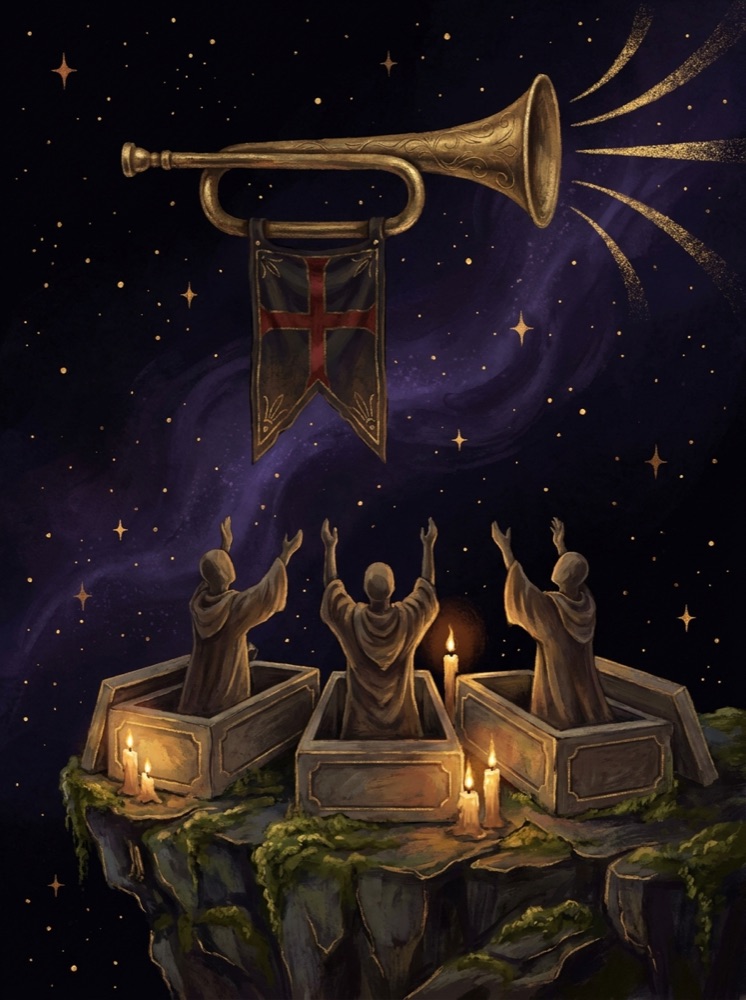
Judgement, card XX, moves on a different axis entirely. The angel’s trumpet sounds, and the figures rising from their coffins are not simply moving to a new location. They are responding to a call that requires them to recognize something about themselves: to become, not just to move on. In Pollack’s reading, Judgement is one of the great awakening moments in the fool’s journey: the self is being seen clearly, perhaps for the first time, and that clarity is irreversible. This is not an external event. It is an interior one.
When both appear together, the reading often sits at a moment that contains both: something in the world is ending, and someone in that world is also being reborn.
The Tension Between These Cards
The practical difference matters for how you move through what is happening. Death asks for release: the willingness to let the form go, to stop maintaining something that has completed, to grieve what is over without demanding its return. That is its task. It is complete-able. You grieve; you let it be over; the river keeps flowing.
Judgement’s task is harder to schedule. Being reborn — in the sense of recognizing something true about yourself that you can no longer unknow, and being asked to live from that recognition — doesn’t follow a grief timeline. It tends to arrive on its own schedule, and the work it asks of you continues well after the external change is finished. You can complete Death’s task and still be in the middle of Judgement’s.
This pair can surface when someone is trying to treat an interior awakening like an ending to be processed and filed. You have not just lost something. You are also becoming something, and those two things may require different kinds of time and attention.
This Pair in Love, Money, and Energy
In love, Death and Judgement together may reflect a relationship chapter that is ending while something else is also clarifying: not just what this relationship was, but what you now understand about who you are and what you need in connection. The Death card’s arc in love tends toward the honest closing of what no longer works; Judgement’s love dimension tends toward the recognition that reshapes what you want going forward. Both processes can run at once, and this pair often marks exactly that overlap.
In work and money, this combination often turns up at genuine career junctures: not just a job change but a shift in what work means to you, what you are willing to spend your time on, what version of professional identity you are closing and what is trying to emerge. The ending is real. And underneath it, something about your actual values and capacities may be becoming clearer than it has been in years.
In inner life, Death and Judgement together are perhaps most directly the mid-life-reckoning pair. Not mid-life in the demographic sense, but the interior experience of a significant chapter ending at the same time that a recognition arrives about what the next one needs to be built on. Both processes are asking for your full attention, and they don’t always move at the same pace.
Reading The Two Cards Together
Death clears the form; Judgement reshapes the self. Reading them together, the question is not only what is ending but who is being asked to rise. For the version of this that focuses more purely on endings, Death and The Tower examines what happens when the closing comes faster than expected. For what tends to follow when the Judgement reckoning resolves, Judgement and The World holds that completion.
A Question to Sit With
Of the two things happening right now — the ending and the becoming — which one are you paying more attention to?
That question is worth sitting with. Neither is more important than the other, and both tend to be underserved when they arrive together. The ending has its own grief and its own completion. The becoming has its own demand. They are not the same task.
Where to go next