Major Arcana · XX
Judgement Tarot Card Meaning
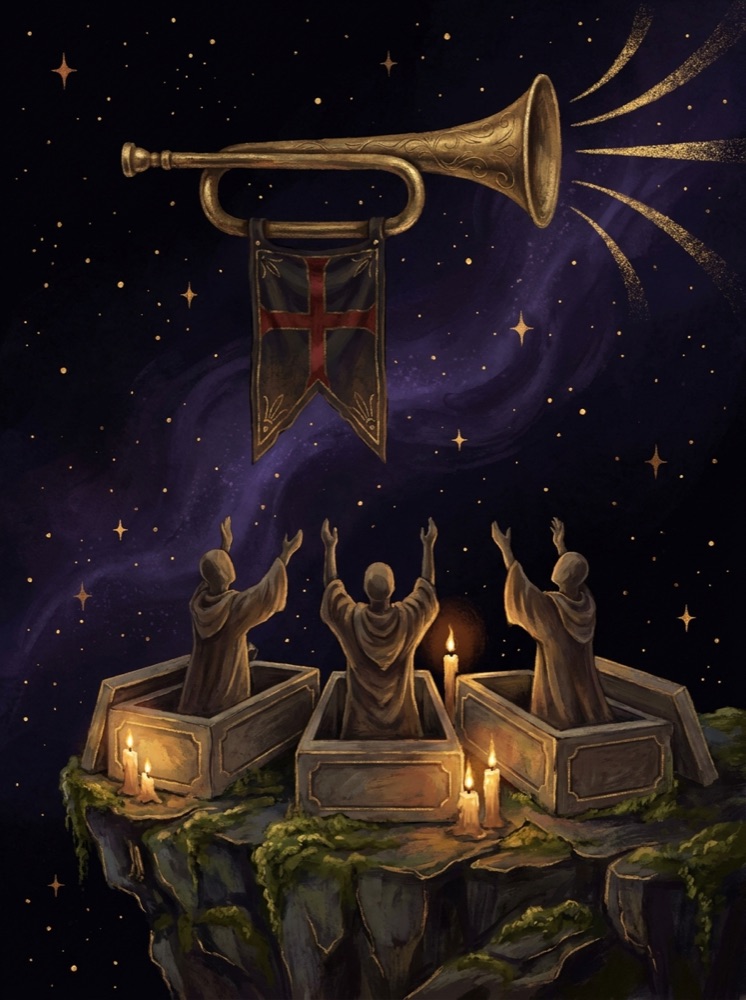
XX Judgement
- Number
- XX (20)
- Element
- Fire
- Association
- Pluto
- Upright
- awakening, calling, purpose, reckoning, transformation, authentic response
- Reversed
- unanswered call, deferred purpose, self-judgment, doubt, hearing but not responding, the call suppressed
An angel with enormous wings blows a trumpet from above the clouds. Below, figures rise from stone coffins, arms raised, faces turned upward. Mountains stand at the horizon, solid and permanent. The scene is drawn from the imagery of the Last Judgement, but what Waite built into this card is not guilt or punishment. The faces of the rising figures are open. Their arms reach toward the trumpet. They are responding to something they have been waiting for.
Card XX carries a name that can feel heavy. Judgement. But Rachel Pollack writes in Seventy-Eight Degrees of Wisdom that the Judgement in this card is not the judgement of condemnation or punishment. It is the summoning of the soul to its own truth. The figures rising from the coffins were not dead; they were asleep in the half-lives they had been living. The trumpet does not judge them. It calls them. And the question the card holds is not whether you are found wanting. It is whether you are listening.
Judgement Upright
Upright, Judgement tends to reflect the call toward a more authentic, more fully inhabited version of yourself or your life. This can arrive as a clear and unmistakable sense of direction — the understanding of what is being asked of you that has been clarifying for some time and has finally become specific enough to act on. Or it can arrive as a reckoning with something long deferred: the choice that has been postponed, the conversation that has been avoided, the version of your life that has been acknowledged privately but not yet moved toward.
Mary K. Greer reads Judgement as the archetype of the person who finally hears the call that has been waiting to be answered and allows it to reorganize the life. That phrase is worth sitting with: allows it to reorganize the life. The call is not asking for a small adjustment. Judgement tends to reflect a moment of genuine decision at the level of values and direction, the kind that changes what comes after. The card does not prescribe the specific content of the call — that is yours, and it is different for every person who draws it. What it tends to name is the state of having heard it and being at the threshold of choosing whether to respond.
Judgement Reversed
Reversed, Judgement often reflects the unanswered call: the sense of purpose or direction that is clearly present and persistently deferred. The awakening that began but was shut back down. The decision that was close and then, somehow, was not made. This can happen for recognizable reasons — fear of what responding to the call would change, the genuine cost of reorganizing a life around something true — or it can happen through the subtler mechanism of simply letting the busyness of the existing life fill up the space where the decision would live.
There is also an excessive self-judgment reading of the reversal that is worth naming: the harsh internal verdict that prevents forward movement, the person who has already been found wanting by their own internal tribunal before the actual call can be heard. This kind of self-judgment can mimic discernment while actually being a form of avoidance — a way of staying in the dock rather than answering the trumpet. Judgement reversed may ask whether the judge delivering the harsh sentence is the authentic reckoning the card offers, or whether it is the mechanism being used to avoid it.
Symbolism in the Rider-Waite-Smith Image
The angel Gabriel’s trumpet is the call that can be heard across all previous conditions and all previous failures: it summons without coercing. Pollack notes that the angel’s call reaches even into the coffins of the sleeping self. It is available regardless of what came before. The figures rising with open arms are responding, not fleeing: their posture is one of willingness, even joy. They are not afraid. The equal-armed cross on the banner is, in the RWS theological frame, the symbol of the four elements integrated, completion and balance rather than martyrdom. The grey mountains in the background stand permanent and solid: the call speaks to and from something that does not change, something more durable than any of the circumstances that have been living in the foreground.
Judgement in Love, Money, and Energy
In love, this card often reflects the call toward a love that is fully oneself: not love that requires performance or concealment, not the relationship that asks you to be a more manageable version of yourself to remain in it. It can also reflect a reckoning with what a current relationship is and is not — the honest accounting that Judgement asks of all domains. The Judgement love reading may offer a more specific reflection on what this tends to surface.
In money, Judgement tends to mirror the gap between the income that sustains the current life and the income that would sustain the called life: the recognition that the financial picture and the authentic call are not yet the same shape, and the question of what it would take to close that gap. It can also reflect the moment when someone decides to align their financial choices with what they actually value rather than with what they have always done. The Judgement money reading explores this territory in more depth.
In matters of energy, the card often reflects the vitality that returns when the authentic call is answered, and the particular quality of depletion that accumulates when it is chronically deferred. Living in a life that is not quite the one being called toward tends to cost something. Judgement may name the source of a tiredness that sleep has not been fixing.
Judgement’s Place in the Fool’s Journey
Card XX is the penultimate card of the Major Arcana. The Fool has traveled through all twenty of the preceding cards — every trial, every integration, every defeat and recovery — and has arrived at the threshold of the final summons. Pollack reads Judgement as the moment when the entire journey reveals its purpose: the preparation for this precise call. Everything that came before was practice, exposure, education. The trumpet is sounding for the life that was always the actual destination.
A Question to Sit With
What call has been present in your life for longer than you have been willing to admit, and what would actually change if you answered it?
Not what you think should change, or what you believe others would want changed. The question is about the call that belongs specifically to you — the direction, work, relationship quality, or way of being that you recognize on hearing it, even if you cannot yet explain it to anyone else’s satisfaction. The Sun (card XIX) revealed you to yourself; Judgement asks what you are going to do with that knowledge. The World (card XXI) waits at the end of the arc with its completed circle, once the answer has been given.
Judgement in a reading
Pull Judgement for one of the three pick-a-card questions and read the card as a reflection on a single area of your life — never a verdict.
Judgement combinations
How Judgement tends to read when it lands alongside another Major Arcana card. Each pairing is a reflection on the two energies together — never a forecast.
Where to go next