Major Arcana · XXI
The World Tarot Card Meaning
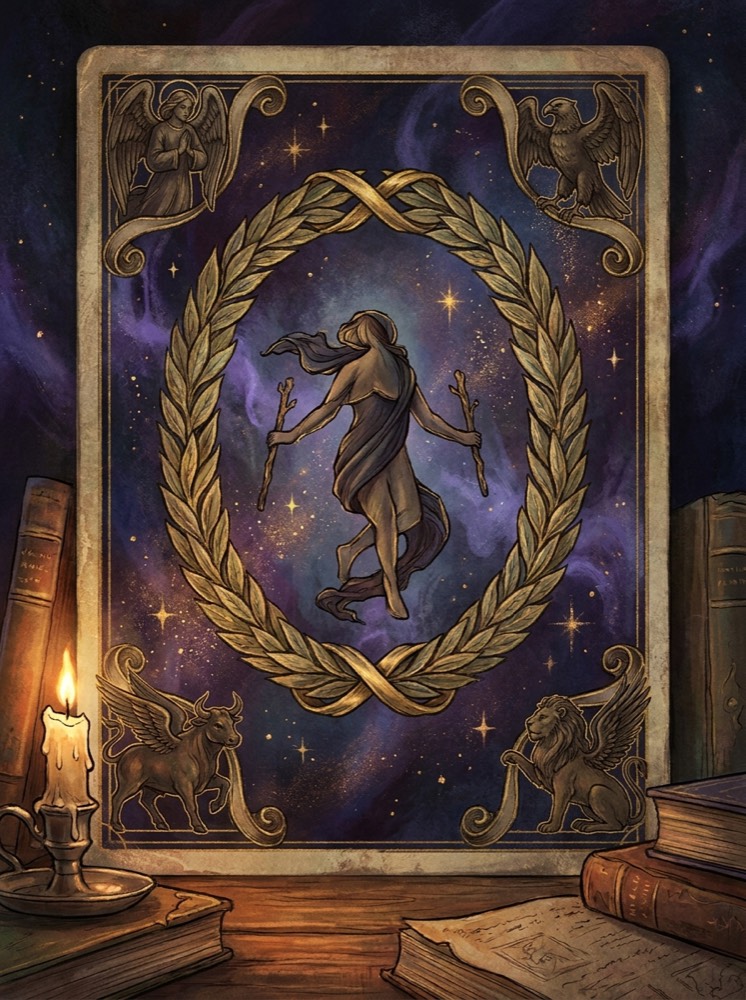
XXI The World
- Number
- XXI (21)
- Element
- Earth
- Association
- Saturn
- Upright
- completion, integration, wholeness, achievement, the completed cycle, fulfillment
- Reversed
- incompletion, stopped short of the finish, inability to close the cycle, achievement withheld, the cycle unfinished
The dancing figure at the center of this card is surrounded by a wreath that forms a full ellipse. She holds a wand in each hand. The four corners of the image hold the same four figures as the Wheel of Fortune: the winged bull, the lion, the eagle, the angel. She is in motion. The image contains no tension, no unresolved pull in any direction. For the first time in the Major Arcana, the figure at the center is neither arriving nor departing, neither ascending nor falling. She is simply, fully, here.
Card XXI is the last numbered card of the Major Arcana, and everything about it reflects that position. Rachel Pollack writes in Seventy-Eight Degrees of Wisdom that the dancing figure has achieved the full synthesis of the journey. She has become the Fool again, but now with the complete depth of twenty-one previous cards behind her. This is the crucial distinction the card requires and that pop tarot often misses. The World is not just a success card. It is a completion that is also a threshold.
The World Upright
Upright, the World often reflects the moment when a long body of work, effort, or experience reaches its natural point of integration. This might look like a project finally completed, a phase of life genuinely closing, a skill that has crossed the threshold from learned to simply how you do things. It tends to reflect the gestalt that only becomes visible when enough pieces are in place: the sense that what you have been building has arrived at something that can now be held and recognized as whole.
Mary K. Greer’s account of the World adds the structural dimension: this is not a static arrival but the completion of a cycle that was always oriented toward its own beginning again. The wreath in the image forms a zero, an egg shape. Completion becomes potential. The World can therefore reflect not only the satisfaction of a finished chapter but also the particular mixture of fulfillment and readiness that comes from knowing the next beginning is close. These are not contradictory feelings. The dancer moves because the work is done and the body is free, not because there is nothing left.
The World Reversed
Reversed, the World often reflects the incomplete cycle — stopped just before the natural close. This can look like a project that has reached 95% and cannot get across the line, a relationship that is essentially over but has not been allowed to close, a version of yourself that is ready to be released but is still being maintained past its time. The reversal points to the specific cost of near-completion held in suspension: the cycle cannot begin again until the current one is finished.
There is also a shadow expression of the reversal worth naming: the person who holds the achievement without releasing it, who has completed the cycle but will not let it be seen, used, or integrated. The mastery is present but withheld, either from the self or from others. And there is a third reading, subtler: the completed cycle used as an escape from the next Fool’s edge — completion as a place to rest indefinitely, rather than as the precondition for the next beginning. The World reversed may ask which of these patterns is present, and what it would take to let the circle close.
Symbolism in the Rider-Waite-Smith Image
The wreath of laurel honors the earned achievement: the natural world acknowledging what has been completed. Pollack notes that the wreath forms a zero or egg shape, which is the Fool’s number. The end of the sequence loops back to the beginning; the Fool’s potential is restored, now informed by everything the journey contained. The dancing figure is in motion within the completed circle: integration is not static but alive. She dances because the constraint of the incomplete work is gone and the body is free. The wands in each hand are the Magician’s tools from Card I, now held by the dancer at the journey’s end. What was potential at the beginning has been realized and then transcended. The four fixed signs at the corners are the same four from the Wheel of Fortune (X): what was turning in the midst of the journey is now held in harmony. The cycle that was turning has resolved.
The World in Love, Money, and Energy
In love, this card often reflects the quality of a relationship that has moved through enough cycles to have achieved genuine integration: the love that has been tested rather than merely sustained, that is richer because of what it has been through rather than despite it. It can also reflect the completed chapter — the relationship, or the version of a relationship, that has reached its natural close and is ready to be honored and released. The World love reading explores what this card tends to surface in the domain of connection.
In money, the World tends to mirror the completed body of financial work: the career arc that has reached a point of integration, the financial practice that has become simply how one lives rather than something that requires maintenance, or the moment when a long-worked-toward goal is genuinely in hand. It may also ask whether what has been completed is being acknowledged as such or being overlooked in the rush to begin the next thing. The World money reading reflects on this in more depth.
In matters of energy, the World often reflects the body at the integration point: the practice that is now simply life, the health that is lived rather than managed, the particular ease of a system that has found its own working equilibrium. It can point to the completion of a long physical or practical effort and the renewed availability that follows when it is done.
The World’s Place in the Fool’s Journey
Card XXI is where the Fool’s first great cycle completes. Every principle encountered along the way — the Magician’s will, the Empress’s creative receptivity, Justice’s accountability, the Tower’s revelation, the Star’s renewal, the Moon’s depths, the Sun’s clarity, Judgement’s call — has been integrated into the wholeness the dancing figure embodies. Pollack writes that the World is the destination that was always also a threshold. The Fool has arrived. He has also, in the same moment, returned to zero, to the Fool’s edge, to the beginning that the wreath has been enclosing all along.
A Question to Sit With
What chapter of your life is actually, genuinely complete — and have you given it the acknowledgment it deserves before moving toward the next one?
The World does not demand grand ceremony. It asks for honest recognition: this was real, this happened, this is finished. The failure to close a cycle keeps its energy tied up in the incomplete, which is part of why the next beginning can feel harder to locate than it should. Let the chapter close. Give it its due. Then notice what the freed-up space feels like — that particular quality of available, which tends to be the Fool’s territory again. Judgement (card XX) asked whether you would answer the call. The World is what it looks like when you did.
The World in a reading
Pull The World for one of the three pick-a-card questions and read the card as a reflection on a single area of your life — never a verdict.
The World combinations
How The World tends to read when it lands alongside another Major Arcana card. Each pairing is a reflection on the two energies together — never a forecast.
Where to go next