Major Arcana · XIV + XX
Temperance and Judgement Tarot Combination

Read each card on its own first: Temperance meaning · Judgement meaning.
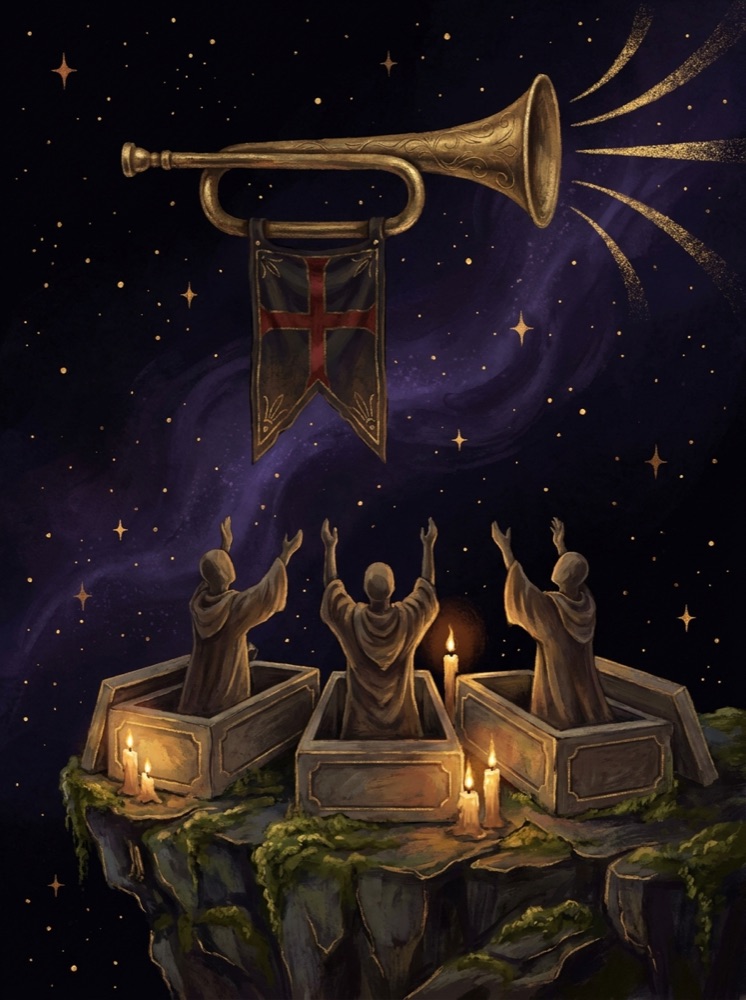
Temperance is the long patience. She stands at the edge of water in the Rider-Waite-Smith image, pouring liquid between two cups in the endless, careful movement of integration. One foot on the earth, one touching the water. The sun rises behind her but it has not yet fully crested. She is not rushing it. There is a path in the background that winds up toward the horizon, but she is standing at the stream, doing what needs doing here first. Judgement arrives twenty cards later. The angel blows the horn. The dead rise from their coffins with arms stretched wide. The waiting is over.
When these two appear together, the reading they make is one of the more honest in the deck: this person has been doing the work, and the moment to answer the call has arrived.
When Temperance and Judgement Meet
Temperance in the canon, and Pollack is precise about this, is not passivity. The figure is actively working. The water passing between cups is not spilling; it is being modulated, combined, alchemized. The card reflects the long interior labor of becoming someone whose different parts have stopped fighting each other. It tends to appear when that process is genuinely underway: when a person has been living with a question, holding competing realities, resisting the urge to force a resolution before the elements are actually ready.
Judgement does not ask whether you are ready. The horn sounds. The graves open. In the Fool’s journey, this is not judgment in the punitive sense: it is the moment of recognition, when the life you have been building finally calls out its full name. Mary K. Greer describes it as awakening to purpose; the resurrection imagery signals that what rises is something that was always there but could not be claimed until the right moment.
Together, these two cards describe the arc from long preparation to the moment the preparation becomes an answer.
The Tension Between These Cards
Temperance knows how to wait. Judgement does not offer the option. The tension here is productive. It is almost the definition of productive tension, and it is real. Someone who has spent months or years in the patient integration the Temperance figure models may have built a relationship with the process itself, a loyalty to the ongoing, carefully-maintained middle space. Judgement asks that person to stop pouring between cups and hear the horn.
This can feel more disorienting than it sounds. There is a particular comfort in the Temperance mode: the sense that you are taking things seriously, honoring the complexity, not rushing. That comfort can, over time, become its own form of delay. The tension this pair tends to name is the moment when more integration will not be more useful, when the call has arrived and the question is not “am I ready?” but “what does answering the call actually look like now?”
This Pair in Love, Money, and Energy
In love, Temperance and Judgement together can reflect a relationship that has been held carefully, worked on slowly, and may now be arriving at a moment that asks for a clearer answer than the ongoing careful work has been providing. Not necessarily a crisis — often the opposite. More like a threshold. The Temperance card meaning and the Judgement card meaning can help locate where the tension is sitting. This pair often asks what it might mean to claim something you have been keeping in the “still figuring it out” category for a long time.
In money, this combination often surfaces in situations where someone has been building capability and depth quietly, often without much external recognition, and is now at a point where that work could be declared — offered, priced, claimed as a body of expertise. The Temperance process is real; the question is whether Judgement is now asking for an action that matches what has been built.
In matters of energy, this pair may reflect the specific kind of readiness that does not feel like confidence but is. The figure in Judgement rising from the coffin is not performing certainty. The horn has sounded, and rising is what the moment asks for. Temperance’s long patience tends to mean the person in this reading has more resources than they realize. The calling is not arriving too early.
Reading the Two Cards Together
Temperance at 14 and Judgement at 20 bracket the Devil, the Tower, the Star, and the Moon — all the cards of confrontation, collapse, hope, and the underwater inner life that comes between careful preparation and genuine awakening. What this pair often reflects is someone who has been through enough of that territory to have genuinely integrated it. The long arc is not decorative. It is the preparation. For the moment after the call has been answered, Judgement and The World traces what follows the rising — the question of what completion actually means, and what comes after recognition.
A Question to Sit With
What have you been calling “still in progress” that might actually be finished — and what would you do today if you believed that?
Temperance is honest about the value of patience. But it cannot keep pouring indefinitely. Judgement does not ask whether you have more preparing to do. It asks whether you are willing to answer to what you have already become.
Where to go next