Major Arcana · X
Wheel of Fortune Tarot Card Meaning
X Wheel of Fortune
- Number
- X (10)
- Element
- Fire
- Association
- Jupiter
- Upright
- cycles, change, fortune, destiny, turning point, flow
- Reversed
- resistance to change, bad luck felt as permanent, clinging to a phase, inability to read the cycle, passive fatalism
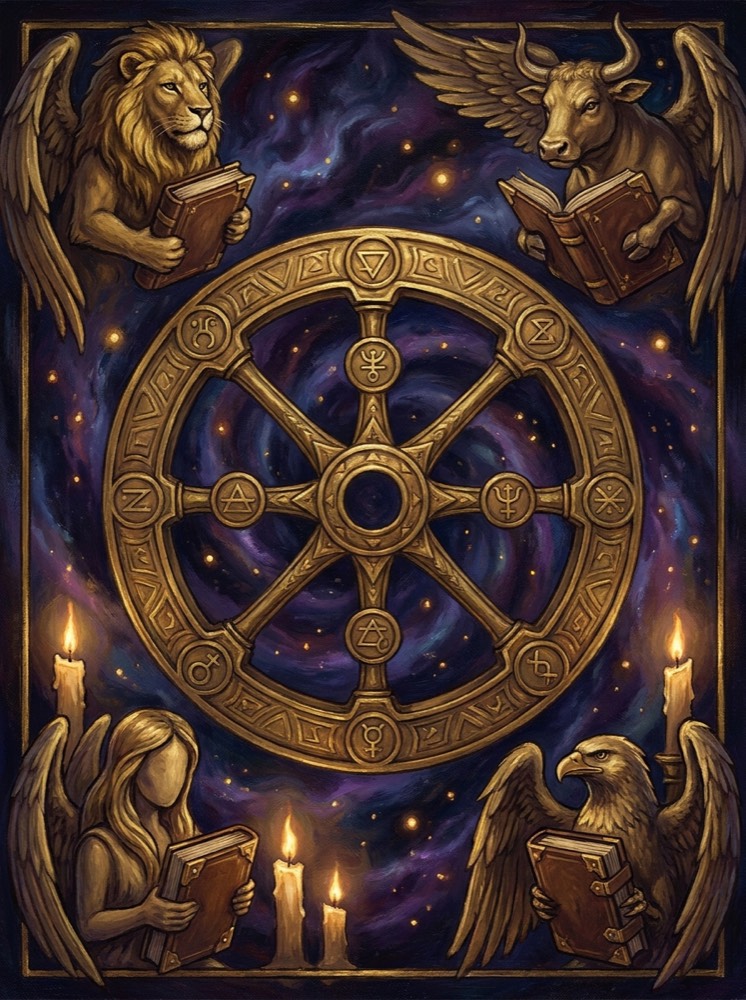
The Wheel of Fortune is the densest image in the Major Arcana. At the center, the wheel turns. Around its rim, Hebrew letters and alchemical symbols crowd every segment. In the four corners, four winged figures (a bull, a lion, an eagle, and an angel) read from books, each wearing a calm, absorbed expression. Three figures ride the wheel itself: one ascending, one at the top, one descending. Above them all, the sphinx sits still. The Wheel turns. The sphinx does not.
It’s worth pausing on what the card does not say. It does not promise that what goes down must come up — that formulation gets the Wheel half-right but misses what Rachel Pollack emphasizes in Seventy-Eight Degrees of Wisdom: the Wheel promises change, not positive change. The cycle turns in both directions and the only constant is the turning itself. The word “luck” appears in almost every pop-tarot description of this card, which may explain why so many people draw it hoping for good news and find it refuses to cooperate with that hope. The card’s real skill has nothing to do with luck. It has to do with reading which phase of the cycle is currently active.
Wheel of Fortune Upright
Upright, the Wheel often reflects a moment when the larger forces shaping a situation become briefly visible — when what looked like a string of unrelated events resolves into a pattern, a cycle, a phase. Mary K. Greer describes this archetype as the cycle-reader: the person who can perceive the larger movement within which individual events are phases, and who can use that perception to time their actions rather than simply react to circumstances.
The Wheel may come up when a cycle is completing or beginning — when something that has run its course finally closes, or when a new phase opens that was not anticipated. It often tends to arrive when conditions are shifting in ways that exceed what personal effort alone has generated. The card asks a useful question: which phase are you in, and are you responding to this phase, or to the last one? There is a significant difference between acting from an accurate read of the current cycle and continuing to apply the strategy that worked in the cycle that has now turned.
Wheel of Fortune Reversed
Reversed, the Wheel often reflects resistance to change — the grip on a phase that is actively ending, the refusal to acknowledge that the cycle has moved. This can look like optimism, and it can even feel like optimism for a while. But there is a specific quality to the reversed Wheel’s energy: the effort of holding something stable that the larger forces are already in the process of moving. The cycle doesn’t care about the grip.
The reversed Wheel can also reflect the opposite: a passive fatalism that surrenders all agency to external forces, using cycles as a reason not to act. “The timing isn’t right” can be genuine cycle-reading or it can be a story that keeps the person permanently in waiting. The shadow of the reversed Wheel is the person who has outsourced all decision-making to fate — superstitious passivity dressed as spiritual wisdom. There is a difference between reading a cycle clearly and using the cycle as an excuse to stay still. The reversed card often asks which one is operating.
Symbolism in the Rider-Waite-Smith Image
The four Hebrew letters YHVH on the Wheel’s segments alongside the alchemical symbols (Mercury, Sulphur, Salt, and the Dissolve-and-Coagulate symbol) confirm that this is not merely a luck wheel. The Wheel contains the organizing principles of the universe; it is an image of natural law, not of arbitrary fortune. The four winged figures in the corners represent the four fixed signs of the zodiac: Taurus, Leo, Scorpio, Aquarius — the four evangelists, the four unchanging witnesses to the cycle. They read their books calmly while the Wheel turns; they are the stable points within the turning. The sphinx at the top holds the same stillness: it sits above the motion, the witness who understands the Wheel without being subject to it. The three figures on the Wheel (in descent, in ascent, at the peak) depict the universal pattern. Pollack notes that the letters on the Wheel’s rim spell ROTA (Latin for wheel) and also TARO: the Tarot itself is an image of the turning of existence.
Wheel of Fortune in Love, Money, and Energy
In love, the Wheel often reflects the cyclical nature of a relationship across time: the phases of intense closeness, the seasons of distance, the spiraling returns to familiar themes at new depths. Long relationships don’t stay in one phase; they turn. The card may reflect a moment of recognizing which phase is active — and whether the response to that phase is informed or habitual. For a reading that explores the Wheel’s cycle patterns in relationship, the Wheel of Fortune love reading offers a specific reflection.
In money, the Wheel tends to mirror the relationship with timing in financial life: the capacity to recognize which phase is active — expansion, consolidation, contraction, recovery — and to respond appropriately rather than applying last cycle’s strategy to this cycle’s conditions. Acting on a contraction-phase impulse during an expansion phase tends to cost. Acting on an expansion-phase impulse during a contraction phase tends to cost more. The Wheel of Fortune money reading looks at this pattern more directly.
In matters of energy and wellbeing, the Wheel often reflects the body’s own cycles — the rhythms of vitality, the seasonal fluctuations, the natural cadences of high output and necessary fallow periods. The card may ask whether you are treating your current phase as the only phase, or whether you can read the body’s signals as cycle-information rather than permanent conditions.
Wheel of Fortune’s Place in the Fool’s Journey
Card X arrives midway through the Major Arcana, and the placement is significant. The Fool has spent the first nine cards building an individual self — encountering will, inner knowing, creativity, structure, tradition, love, momentum, and solitude. Now, at the Wheel, something shifts: the Fool encounters for the first time a force larger than individual will. The realization is not disempowering. It is orienting. The card follows the Hermit (card IX — The Hermit) and precedes Justice (card XI — Justice). The Hermit found inner authority through solitude; the Wheel asks the Fool to locate that authority within a larger turning system; and Justice will then ask for an honest accounting of how the Fool has acted within it.
A Question to Sit With
What cycle are you actually in right now — and is the way you are acting a response to this phase, or a habit carried forward from the last one?
That question tends to produce more useful answers when held for a few days rather than resolved immediately. The Wheel’s patterns are not always visible from inside the phase you are in; sometimes the pattern only becomes clear when you take enough distance to see more than one point on the arc. Notice what the question opens up rather than what it closes down.
Wheel of Fortune in a reading
Pull Wheel of Fortune for one of the three pick-a-card questions and read the card as a reflection on a single area of your life — never a verdict.
Wheel of Fortune combinations
How Wheel of Fortune tends to read when it lands alongside another Major Arcana card. Each pairing is a reflection on the two energies together — never a forecast.
Where to go next