Major Arcana · IX
The Hermit Tarot Card Meaning
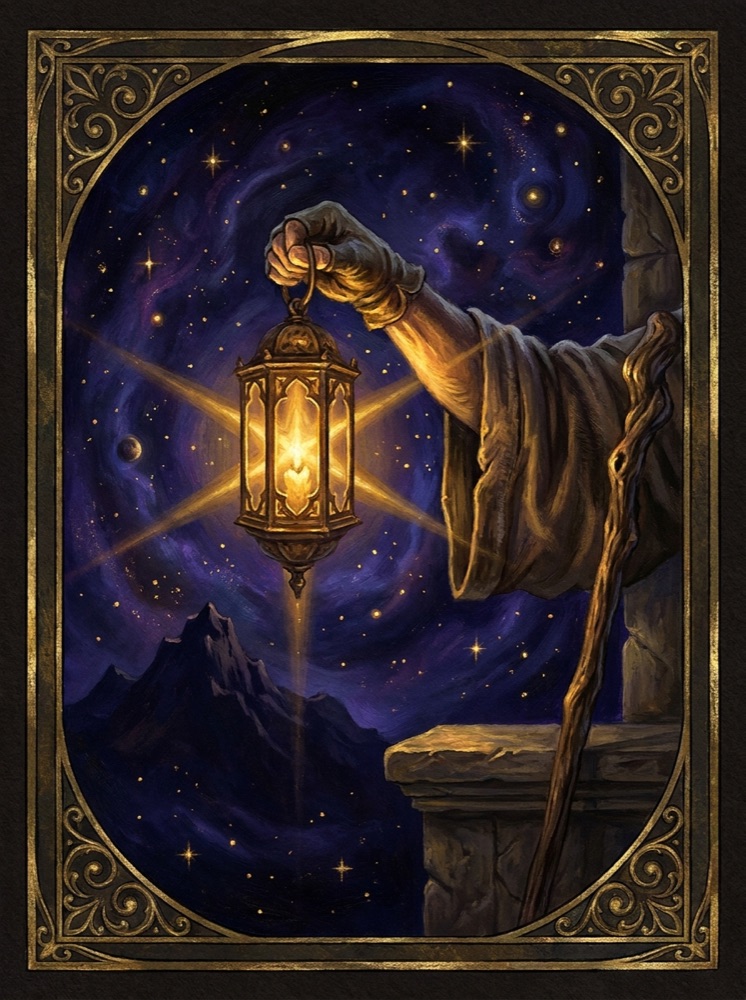
IX The Hermit
- Number
- IX (9)
- Element
- Earth
- Association
- Virgo
- Upright
- solitude, inner wisdom, reflection, guidance, withdrawal, contemplation
- Reversed
- isolation, avoidance, refusal to share wisdom, forced exile, intellectual superiority as shield, unwillingness to return
In the Rider-Waite-Smith image, an old man stands alone on a mountain peak in a grey cloak, holding a lantern aloft in one hand and a staff in the other. Snow is somewhere below him. He faces slightly to one side, not to the viewer. He is not performing. The lantern holds a six-pointed star, and its light is small but specific. It illuminates the next few steps of the path, not the whole landscape.
The common reading is “solitude” and that is not wrong, but it stops short. The card isn’t about being alone for its own sake. Rachel Pollack’s account in Seventy-Eight Degrees of Wisdom is more precise: the Hermit has not abandoned the world — he has stepped away from it in order to find the clarity that the world’s noise prevents. And crucially: the lantern is raised not for himself. He already knows the way. The light is held for those who come after. The withdrawal and the transmission are two phases of the same practice.
The Hermit Upright
Upright, the Hermit often reflects a period when outer direction has stopped being reliable and the inner life has become the more useful compass. Mary K. Greer describes this as the archetype of inner authority — the movement from knowledge borrowed from others toward knowledge that has been earned through solitude and genuine reflection. The mountain peak is not a failure or an exile; it is the height of attainment. The distance traveled is there in the snow below him.
When this card appears, it tends to name a season of deliberate pulling-back — from noise, from other people’s agendas, from the demands of being visible and available. This isn’t depression or avoidance, though it can be mistaken for both. The Hermit’s withdrawal is purposeful, and the purpose is clarity. The card may also point to the role of guide: the person who has walked far enough to carry a light for someone coming behind them. The wisdom has been earned. The question the upright card can ask is whether it is still being kept private long after it was ready to be shared.
The Hermit Reversed
Reversed, the Hermit tends to reflect one of two distinct patterns. The first is isolation that has crossed from productive to pathological — withdrawal that is now avoiding rather than processing, solitude that has become a shield against intimacy or accountability rather than a space for genuine inner work. The mountain was always meant to be descended from. The reversed Hermit may be staying up there past the point of usefulness.
The second reversal pattern is less common but worth naming: the forced re-emergence before the work is done. Someone or something pulls the Hermit back into the social world before the inner clarity has arrived. The lantern is out. The wisdom isn’t ready. The shadow form of the reversed Hermit is the person who uses intellectual distance and the performance of solitude to maintain superiority — keeping wisdom private not because it isn’t ready but because sharing it would require genuine relational risk. The question the reversed card often surfaces is an honest one: is the solitude still serving the work, or has it become a more comfortable habit than engagement?
Symbolism in the Rider-Waite-Smith Image
The lantern with the six-pointed star is the card’s most significant symbol and the one most often underread. The six-pointed star — the Star of David, the Seal of Solomon — is not an ordinary torch. It signals that what the Hermit carries is the light of integrated knowledge, the union of above and below, the marriage of opposites that wisdom requires. This is not common sense or intuition alone; it is earned clarity. The grey cloak signals deliberate withdrawal from the world’s colors and stimulation: not invisible, but self-quieted by choice. The staff carries two meanings: support on the long journey, and the authority that comes from having walked the distance. The mountain peak confirms that the isolation is not a ditch but a summit. The Hermit is not below the world; he has climbed above its noise.
The Hermit in Love, Money, and Energy
In love, the Hermit often reflects the challenge of bringing a rich interior life into genuine relational contact. Many people who carry this card’s energy know themselves deeply — their patterns, their history, their needs — but find that the knowing doesn’t automatically translate into intimacy. Knowing oneself and allowing oneself to be known by another are different skills, and the Hermit may excel at the first while finding the second more requiring. For a more specific reflection on this, the Hermit love reading explores that gap between interior depth and relational openness.
In money, the Hermit tends to mirror an income pattern built on depth, reputation, and the referral network that forms around genuine expertise rather than visibility or volume. The Hermit doesn’t usually do well with the marketing-forward, high-volume model. The income arrives through people who have been in the room with them, who have witnessed the quality of the knowledge over time. The Hermit money reading looks at what that pattern can tell you about how you’re currently positioned.
In matters of energy and wellbeing, the Hermit often reflects a body and nervous system that require genuine solitude as a restorative — not just quiet, not just being physically alone while still checking messages, but the full stop that comes with real withdrawal. The card tends to surface the distinction between being alone and being in restoration. Many people with this card’s pattern have learned to survive on partial rest. The Hermit asks whether that is still serving.
The Hermit’s Place in the Fool’s Journey
Card IX arrives after Strength (card VIII — Strength), which taught the Fool to befriend his own wildness and integrate his natural intensity. Having done that work, the Fool is now able to turn truly inward without being overwhelmed by what he finds there. The Hermit is the first card in which the Fool stops moving forward in the world and turns instead toward his own interior. The lesson is that the deepest wisdom cannot be handed over from outside; it must be found within the self through the long practice of solitude and honest reflection. This card precedes the Wheel of Fortune (card X — Wheel of Fortune), which will return the Fool to the awareness of larger forces and cycles. The Hermit’s preparation is the inner stillness needed to read those cycles clearly.
A Question to Sit With
What do you already know that you have not yet said aloud — to yourself, or to anyone else?
The Hermit’s lantern doesn’t reveal new territory; it illuminates what was always there but couldn’t be seen clearly in noisier light. Sit with that question without turning it into a task. Notice whether the answer arrives through thinking, or whether it arrives in the pause between thoughts — the small specific knowing that doesn’t need the whole argument to support it. That is the light the card is pointing toward.
The Hermit in a reading
Pull The Hermit for one of the three pick-a-card questions and read the card as a reflection on a single area of your life — never a verdict.
The Hermit combinations
How The Hermit tends to read when it lands alongside another Major Arcana card. Each pairing is a reflection on the two energies together — never a forecast.
Where to go next