Major Arcana · VIII
Strength Tarot Card Meaning
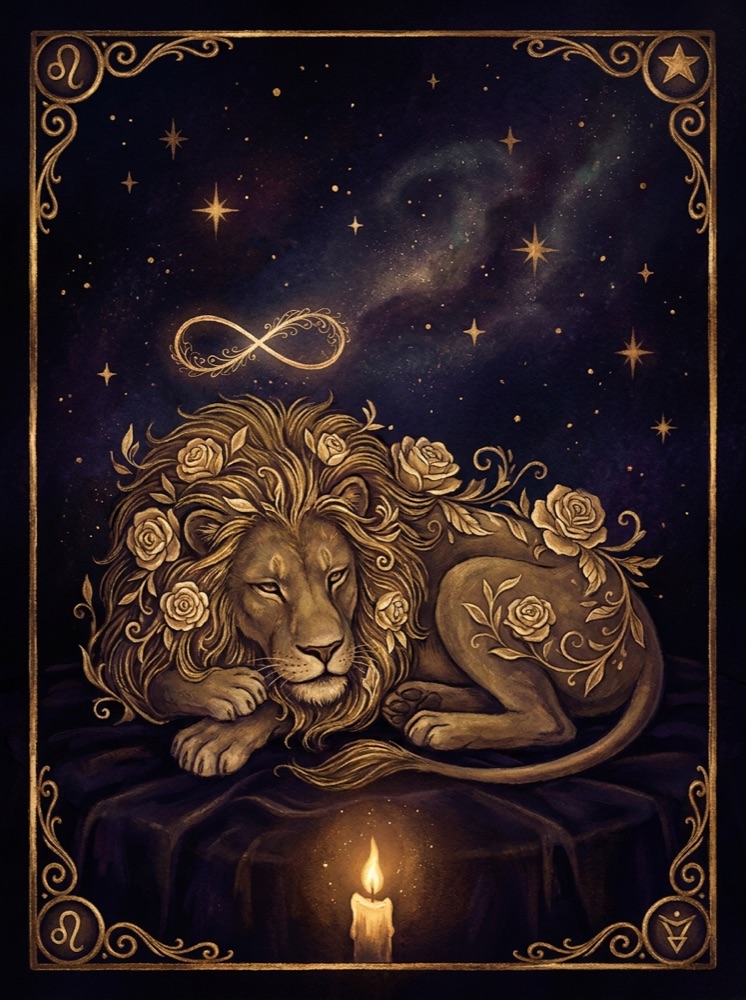
VIII Strength
- Number
- VIII (8)
- Element
- Fire
- Association
- Leo
- Upright
- inner strength, patience, composure, courage, gentle power, compassion
- Reversed
- suppressed passion, emotional explosion, self-abandonment, performance of strength, inner depletion, weakness disguised as niceness
In the Rider-Waite-Smith image, a woman in a white robe rests her hands on the open muzzle of a lion. Not gripping it. Not forcing it shut. Her posture is calm, almost casual, and above her head the same lemniscate that floats above the Magician — the infinity symbol — turns quietly. The lion’s mouth stays partly open. He has not been silenced or subdued. He has, somehow, accepted her presence, and that acceptance is the whole point.
The card is numbered VIII in the RWS deck, and that position matters. It follows the Chariot, card VII, which is about external will applied through sheer concentration of discipline — the Charioteer controlling two sphinxes through force of mind. Strength does something the Chariot could not: it tames what force cannot touch. The pop-tarot shorthand reduces this card to “inner strength,” which is accurate but misses the specific teaching. Strength, per Rachel Pollack’s reading in Seventy-Eight Degrees of Wisdom, is not the conquered wild but the befriended wild. The method is the meaning. Gentleness here is not a lesser form of power. It is the more difficult and more lasting one.
Strength Upright
Upright, Strength often reflects the capacity to hold your own intensity without either suppressing it or unleashing it on the room. Mary K. Greer describes this archetype as the integrated relationship with one’s own passions — not the self that has eliminated anger, hunger, or fear, but the self that has learned to be in the room with those drives without being overrun by them. The woman’s hands rest on the lion. She hasn’t locked him up. He’s right there, and she’s fine.
When this card comes up, it tends to mirror the quality of presence you bring under pressure. That might look like the long steadiness you offer in a relationship that asks a great deal of you, or the financial composure that can hold a position through a volatile stretch without panic. It may also name something less celebrated: the effort required to de-escalate consistently, to absorb what others project and still find your own floor afterward. The lemniscate signals that this composure isn’t drawn from finite willpower. It comes from somewhere deeper. The question the card often asks is whether you have been extending that deeper resource outward while the reservoir itself goes unreplenished.
Strength Reversed
Reversed, Strength tends to reflect one of two things: the lion locked away, or the lion loose. The first pattern is the suppression of natural intensity — the passions, the anger, the appetite — packed down so thoroughly that the self performing composure has lost contact with what it is actually feeling. The second is the point where that composure breaks. What was regulated all this time arrives at once, and it is rarely tidy.
There is also a third reversal pattern worth naming: strength performed rather than embodied. This can look, from the outside, like great stability. But the stability is increasingly hollow, a maintenance effort rather than a genuine ground. Pollack’s account of the reversed card suggests that the shadow version of Strength is the self that has been absorbing other people’s dysfunction indefinitely, staying composed for everyone else’s benefit while something accumulates underneath. The card reversed asks you to consider whether your steadiness is a genuine resource or a story you’ve been keeping up.
Symbolism in the Rider-Waite-Smith Image
The woman’s hands on the lion’s muzzle are the central image and its central teaching: the contact is gentle, the power is in the quality of the presence, not the force of the grip. The lion’s jaw is not clamped shut; the card does not depict domination. The lemniscate above her head connects Strength to the Magician and signals that she works with something beyond finite willpower — an ongoing, renewable source of composure. The lion himself represents the natural drives: hunger, sexuality, anger, the primal forces that civilization spends a great deal of effort pretending humans don’t have. Strength says these are companions to be integrated, not enemies to be locked away. The white robe and the garland of flowers are significant in what is absent: she carries no armor, no weapon, no defensive structure. Her protection is her composure itself.
Strength in Love, Money, and Energy
In love, Strength often reflects the role of emotional regulation in a relationship — the capacity to de-escalate, to hold the steady point when the dynamic gets hot, to stay present with someone else’s intensity without disappearing into it. That capacity is genuinely valuable. The question the card tends to surface is about the asymmetry it may have created over time: who is doing most of the regulation, and what is that costing them? If you find yourself consistently the one who stays calm while the other escalates, Strength may be asking you to look honestly at that arrangement. For a fuller reflection on how Strength shows up in relationships, the Strength love reading at the pick-a-card spread can offer another angle.
In money, Strength tends to mirror the capacity to hold steady during volatility — the investor who doesn’t panic-sell, the business owner who can absorb a slow month without catastrophizing. It also, interestingly, can point to the absence of that same steadiness when applied to one’s own financial decisions rather than others’. You may be very calm supporting someone else through a financial stress while being surprisingly reactive about your own. The Strength money reading explores that pattern more directly.
In matters of energy and wellbeing, Strength often reflects the body as the first place where absorbed tension lands. The pattern many people recognize: you have steadied yourself for others all day, and by evening the body carries what was never fully processed. This is not a diagnosis; it is a reflection prompt. The card asks you to notice whether the same regulation you extend outward is also being offered inward.
Strength’s Place in the Fool’s Journey
Strength follows the Chariot in the Fool’s Journey, and the sequence is deliberate. The Chariot’s lesson is external: how to direct opposing forces through will and discipline. Strength’s lesson is interior: how to befriend the wild inside oneself rather than control it from a distance. The Fool has learned how to move in the world; now he encounters the question of how to live inside his own nature. Strength comes before the Hermit (card IX — The Hermit) because the inner integration Strength teaches is the preparation for the solitude and self-inquiry the Hermit requires. You cannot do the Hermit’s work if you are still at war with your own depths.
A Question to Sit With
Where in your life have you been staying calm for someone else — and what has that steadiness cost you that you haven’t named yet?
Sit with that question without rushing to answer it. The Strength card doesn’t ask you to stop being steady. It asks you to notice whether the source is still full, or whether you have been drawing from a reservoir you haven’t taken time to replenish. The lion is not the problem. He may, in fact, be the part of you that knows exactly what needs to be said.
Strength in a reading
Pull Strength for one of the three pick-a-card questions and read the card as a reflection on a single area of your life — never a verdict.
Strength combinations
How Strength tends to read when it lands alongside another Major Arcana card. Each pairing is a reflection on the two energies together — never a forecast.
Where to go next