Major Arcana · VII
The Chariot Tarot Card Meaning
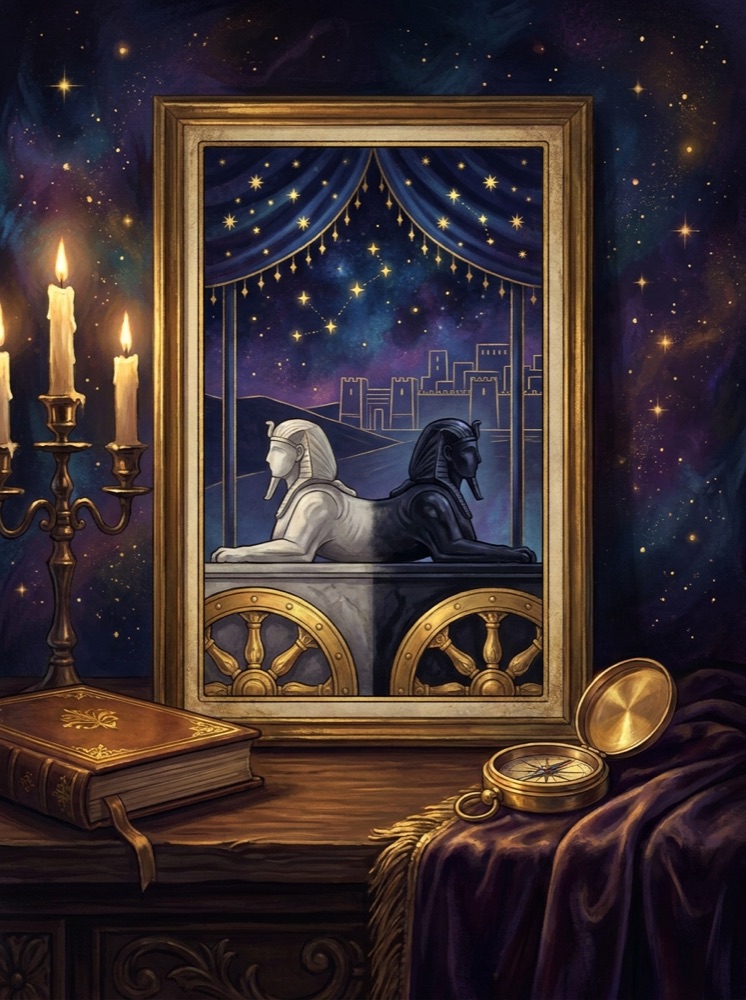
VII The Chariot
- Number
- VII (7)
- Element
- Water
- Association
- Cancer
- Upright
- will, momentum, direction, discipline, self-mastery, triumph
- Reversed
- lack of direction, aggression, burnout, loss of control, forced movement, scattered momentum
The Charioteer stands upright in his vehicle wearing armor decorated with astrological symbols, a canopy of stars above him. He holds no reins. Before him, two sphinxes — one black, one white — face away from each other. They pull in opposing directions by nature, and there are no reins to keep them aligned. What keeps them moving as a unit is the Charioteer’s presence: his concentration, his will, his capacity to hold the tension between the two forces without being pulled apart by it. The city is behind him. The open road is ahead. He has left the ordered world and is moving under his own direction.
Two things about this card surprise people who encounter it closely for the first time. The first is the absence of reins: the control the Charioteer exerts is not mechanical or physical but the result of focused will. The second is the astrological attribution — Cancer, a water sign. In a card of armored forward momentum, the hidden engine is emotional self-mastery: the capacity to know one’s own inner forces well enough to hold them in directed motion. Pollack is careful about this. The Chariot is not the same card as Strength, which follows it at card VIII. The Chariot’s mastery is external and willed; Strength’s mastery is internal and patient. Conflating them produces a confused reading. The Chariot conquers through discipline and momentum. Strength tames through gentleness. They are sequential cards and they are deliberately different in method.
The Chariot Upright
Upright, the Chariot tends to reflect a period of directed, sustained movement — the kind that comes not from easy circumstances but from the integration of opposing inner forces under a coherent will. Pollack writes that the Charioteer controls the two sphinxes not through reins but through sheer concentration. Greer identifies this as the archetype of sustained motion sustained by internal discipline: the person who keeps moving not because the road is clear but because the direction has been chosen and the will is present to hold it.
The card often appears when momentum is genuinely available and the question is about direction and discipline rather than capacity. There is enough force here to go somewhere. The Chariot tends to ask whether the somewhere is chosen consciously or inherited from the last phase, carried forward by inertia. Upright, it can name the moment when focused self-discipline is available and is the appropriate response — the time for speed rather than reflection, for decisive motion rather than additional deliberation.
The Chariot Reversed
Reversed, the Chariot most often reflects momentum without a coherent direction: moving fast, moving hard, arriving somewhere by the logic of accumulated motion rather than by conscious choice. The two sphinxes may be pulling against each other without the Charioteer’s will to hold them together; the opposing inner forces are no longer integrated. One dominates, or neither does, and the result is either aggressive overreach or scattered momentum that builds nothing.
The reversal can also reflect burnout: the sustained high-output movement of the upright position, run past the point where recalibration was available. The card may point to arriving at a destination that was chosen long ago and no longer serves, having gotten there through sheer momentum and discipline without stopping to check whether the heading was still right. The reversed Chariot tends to ask: when did you last deliberately choose the direction you are currently moving in?
Symbolism in the Rider-Waite-Smith Image
The two sphinxes (black and white) are the Chariot’s central image of what self-mastery means in practice. They are not docile animals trained to pull together; they are opposing forces held in temporary alignment by the quality of the Charioteer’s attention. Remove the attention and they separate. The canopy of stars establishes that the journey has a larger orientation: the Charioteer navigates by celestial reference, not only by the road in front of him. The armor with astrological symbols signals that his protection is multi-layered, both martial and symbolic. He is dressed for many conditions. The city behind, open road ahead closes the frame: this is departure. The structured world of the Emperor and Hierophant is receding; what comes next is genuinely open territory navigated by inner direction.
The Chariot in Love, Money, and Energy
In love, the Chariot often reflects the pattern of bringing forward momentum and goal-orientation into relationship in ways that can make partnership feel managed rather than inhabited. The relationship is real; the care is genuine. The question this card tends to surface is whether the Charioteer has slowed down enough to actually be in the relationship rather than moving through it. The Chariot love reading holds this pattern.
In money, the card tends to mirror the tendency to earn aggressively within an inherited definition of success rather than a consciously chosen one. Motion without a direction-check. The current trajectory may be the result of what looked right at an earlier stage and has not been revisited. The Chariot money reading may name the moment for that review.
In matters of energy, the Chariot often reflects a body running at a sustained high-output baseline without voluntary deceleration. The signals for rest are present; they tend to get overridden by constitutional momentum. The Chariot energy reading surfaces where this pattern is running, without diagnosing or prescribing.
The Chariot’s Place in the Fool’s Journey
Between the Lovers at card VI and Strength at card VIII, the Chariot represents the Fool’s first sustained self-directed movement in the world. The Lovers gave the Fool a genuine values-based choice; the Chariot is what happens when that choice becomes momentum. But Strength, which follows, delivers the lesson the Chariot cannot: that external will and discipline are not enough. The deeper integration the Chariot does not teach is patience, gentleness, and the taming of the inner wild through contact rather than control. The Chariot is necessary. It is also the lesson that must be completed before the next one becomes available.
A Question to Sit With
When did you last deliberately check the direction you are moving in, rather than simply maintaining your momentum in the direction you were already going?
The Chariot does not ask you to slow down for its own sake. It asks whether the heading is still consciously chosen. Sometimes it is, and the check takes thirty seconds and confirms everything. Sometimes the honest answer is that the heading was set a long time ago and has been maintained by discipline and inertia since. That answer is not a failure. It is the beginning of a more deliberate choice.
The Chariot in a reading
Pull The Chariot for one of the three pick-a-card questions and read the card as a reflection on a single area of your life — never a verdict.
The Chariot combinations
How The Chariot tends to read when it lands alongside another Major Arcana card. Each pairing is a reflection on the two energies together — never a forecast.
Where to go next