Love reading
The Hermit and the Question of the Heart
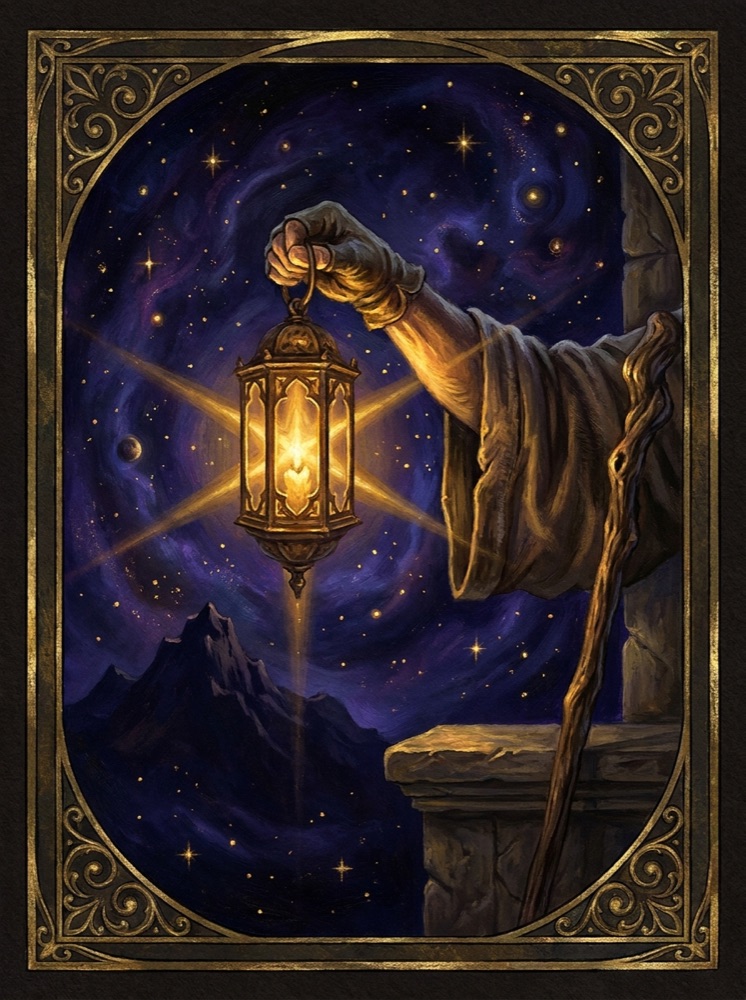
IX The Hermit
What The Hermit Is Holding
He stands alone on a snowy peak, an old man in a gray cloak, a staff in his left hand. In his right hand he holds a lantern, and inside the lantern glows a six-pointed star. He is not looking outward at a wide horizon. He is looking down at the small circle of light the lantern casts directly in front of him. He cannot see far ahead. He can see the next step, and he can see it clearly. That’s what the lantern is for.
In love, this card is about solitude, but the word needs to be precise here. Not loneliness, which is solitude without consent. Not isolation, which is solitude as withdrawal. The Hermit’s solitude is purposeful: it’s the territory you enter when you need to hear what you actually think, before the noise of connection, expectation, and other people’s needs fills the space. In a love reading, this card tends to appear when that kind of inward turning is either underway or overdue. The mountain can be a genuine retreat. It can also be a long-term address.
The number nine: near completion, the gathering of what’s been learned.
What This May Be Pointing At
This card often comes up for someone who has been alone for a period, by choice or circumstance, and is now sitting in the ambiguity of not knowing whether the solitude has run its course or whether there’s more to learn from it. The Hermit doesn’t answer that question. He holds the lantern and waits.
It also appears when someone who is in a relationship has been emotionally absent from it, present in the practical sense but spending their interior life somewhere else. That’s a different kind of solitude, and it tends to feel cramped rather than spacious.
A third reading: the Hermit surfaces for someone who has been using the vocabulary of self-knowledge (“I’m working on myself,” “I need to understand this better first”) as a reason to postpone something in their love life that is actually available now. Not as an accusation. As a gentle name for a specific form of readiness that keeps revising its own deadline.
There’s a fourth possibility worth naming: sometimes the Hermit appears not about your solitude but about someone else’s. The person who has gone quiet on you may be on their own mountain, and their distance may have less to do with you than it feels like it does. The card can’t confirm that. It can only remind you that the lantern in the image lights one person’s path at a time.
What to Notice
Notice whether your current solitude, or your current emotional inwardness, feels like it’s producing something. The Hermit’s lantern sheds light. Solitude that produces nothing but more solitude has usually passed its useful point.
Pay attention to the quality of your aloneness when you actually have it. Does it feel like relief or like avoidance? Like rest or like hiding? Both can feel like the same thing on a tired Thursday evening. The difference tends to become clearer when the aloneness is given more than an evening.
Notice whether there are things you’re waiting to understand about yourself before you allow connection to be available to you. Write those things down if you can. Then ask whether understanding them first is genuinely necessary or whether the understanding might actually arrive through connection rather than before it.
A Question to Sit With
What have you learned about yourself in the solitude or inwardness you’ve been in, and are you using that knowledge, or are you simply accumulating it? The Hermit’s lantern is a tool for moving forward, not for standing still in the dark indefinitely. The question isn’t whether you’ve learned enough. It’s whether the learning is informing anything yet.
Related Draws
The Hermit and Strength often read together in sequence: Strength does the quiet holding, and the Hermit emerges after that sustained effort to understand what has been held and what it means. The Emperor provides a useful counterpoint: where the Hermit turns inward and moves in small circles of lantern-light, the Emperor turns outward and builds structure. Both are valid responses to having been through something; they just face different directions. If the Hermit’s inwardness and long patience is also showing up around livelihood and security, The Hermit on the money theme reads that thread.
For the full meaning of The Hermit — upright, reversed, symbolism, and how it reads across love, money, and energy — see the The Hermit tarot card meaning guide.
Where to go next