A crystal love reading
The Velvet Tray
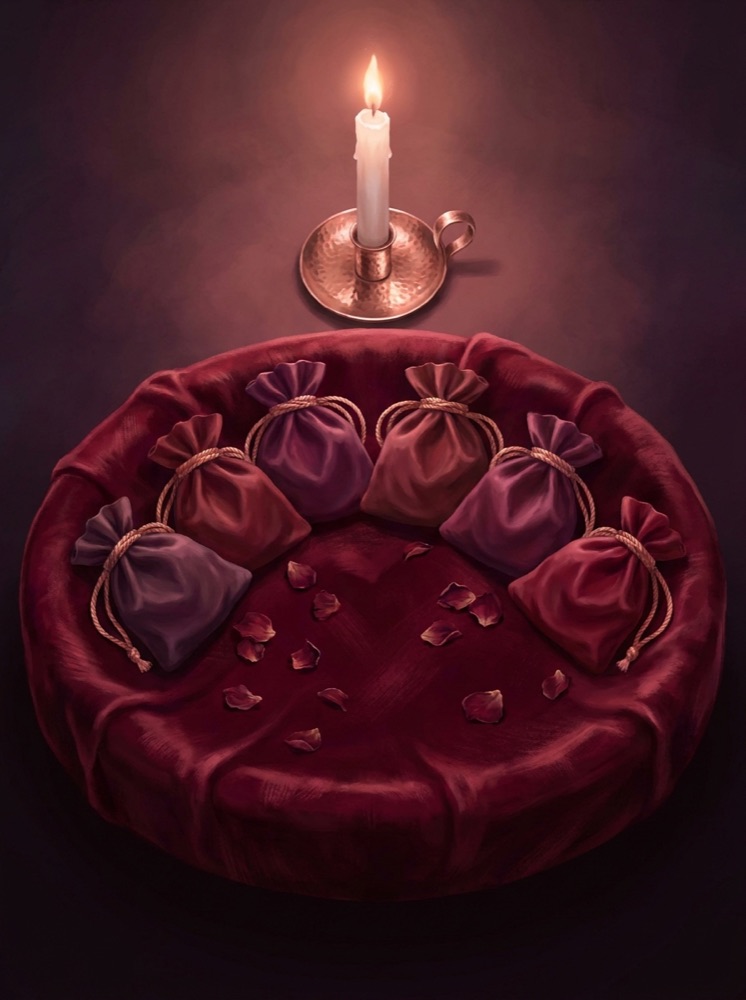
Eight stones rest in silk pouches on a tray of deep plum velvet. You bring one question about how you love, and you pick the pouch your hand wants before your head has time to argue. The stone you pull is a mirror for the way you tend to love — not a remedy, and not a verdict.
Begin with the question that is actually yours.
How the tray works
A crystal love reading, the way it is done here, has three movements. First you choose a question — not the cleverest one, the truest one, the one that has been sitting in your chest on the drive home. Then you come to the tray, where eight stones wait hidden in identical silk pouches, and you let your hand choose. Last, the silk opens, and you read what the stone tends to mirror in the people who reach for it.
Why pick before you reason? Because the reasoning mind is a skilled lawyer, and it will argue you into the answer you already decided you deserve. The hand is more honest. When the pouches all look the same, the small tug toward one of them is just preference without a story attached — and the reading that follows works on whatever that preference turns up.
Be clear about what the stones are not. They are not medicine, they do not carry powers, and they cannot tell you what another person feels or what a relationship will do next. What they can do is hold a pattern up to the light: how you give, how you guard, what you repair, what you walk away from. The tray turns over once a week — pull your stone, sit with it for a few days, and come back Monday with new hands.
What the eight stones are really sorting
The eight stones are not eight moods and they are not eight kinds of partner. They are eight positions along a single, uncomfortable axis: how much of yourself you make available, and how quickly. That's the whole instrument. At one end sit the stones of the people who arrive fully and early — who say the true thing on the second date, who love at a volume that occasionally frightens the room. At the other end sit the stones of the people who arrive slowly and in pieces, who keep a small unlit room at the back of the house that nobody has been shown, and who mistake that room for safety.
Neither end is the healthy one, whatever the internet has told you. The fast-arriving stones tend to surface a particular exhaustion — the person who has been the emotional engine of every relationship she's had, and who is very tired, and who has never once said so out loud. The slow-arriving stones tend to surface the opposite ache: being loved accurately by somebody who has only ever met the version of you that was cleared for release. Different stones, same loneliness, arrived at from opposite directions.
The week after you pull
Here's what I'd actually do with your stone, and it isn't much. Don't try to fix anything. For the next few days, just catch yourself doing the thing the stone described — once. That's the entire assignment. The moment you soften a request into a hint. The moment you say it's fine while something in your chest files a formal complaint. You don't have to act differently. You only have to notice, in real time, that you're doing it.
That noticing is the only thing on this site with any real power, and it has nothing to do with the stone. The stone is a peg to hang the noticing on. It cannot tell you whether to stay, whether to text back, or what someone else is feeling in a room you aren't in — no reading can, and any reading that claims to is selling you something. What it can do is name the pattern precisely enough that you catch yourself mid-gesture on a Thursday. Patterns you can see are patterns you get to have an opinion about.