Money reading
Wheel of Fortune and the Question of Flow
X Wheel of Fortune
What Wheel of Fortune Is Holding
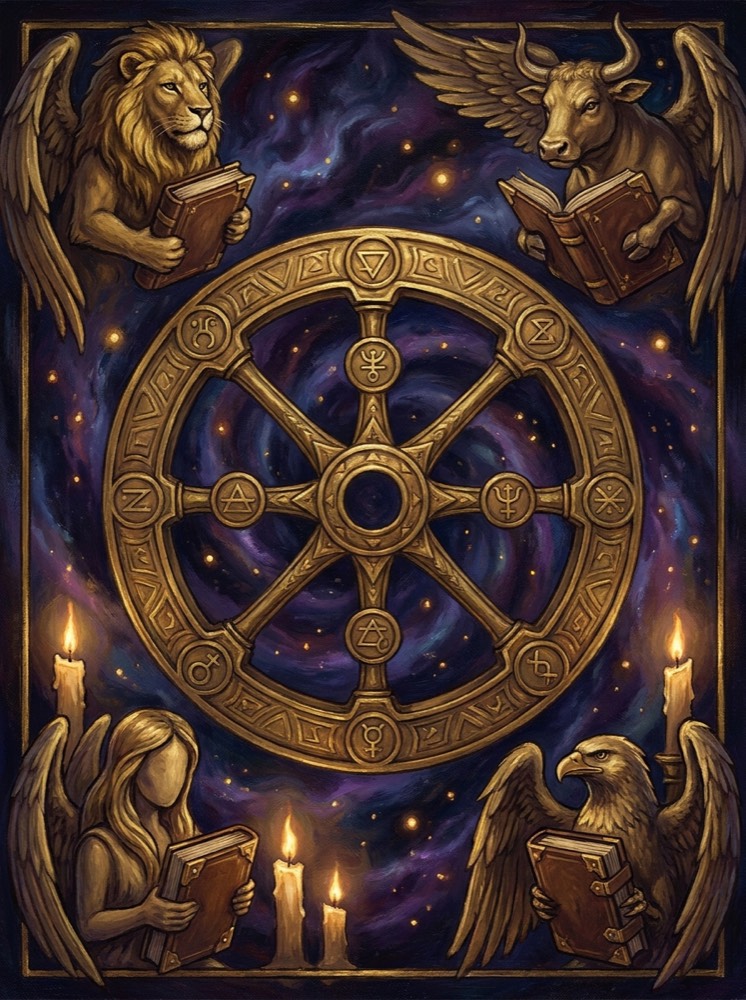
A great wheel turns in the center of the card, suspended in the sky. Around the outer rim: the letters T-A-R-O (or TARO-T, reading around), interspersed with the Hebrew letters for God’s name. Four figures ride the wheel: a serpent descends on the left, Anubis rises on the right, a sphinx sits crowned at the top. In the corners of the card, four winged figures read books: a man, a lion, an eagle, an ox. The whole image is cosmological. The wheel is not small.
Greer reads Wheel of Fortune as the card of cycles, the awareness that all states are temporary and that the pattern of rise and fall is built into the structure of things. It is Jupiter’s card, expansive and philosophical, the archetype of zoom-out. Pollack notes the sphinx at the top: still, balanced, neither rising nor falling. The sphinx knows something the figures riding the wheel do not.
On a money theme, this card tends to arrive with a very specific quality: the reminder that the current state is not permanent. That cuts both ways. A difficult financial period that feels like it has always been this way and always will be: the wheel turns. A prosperous period treated as though it will continue indefinitely without attention or adjustment: the wheel turns. This card is rarely a prediction. It’s an orientation.
What This May Be Pointing At
This card often comes up when someone has been treating her current financial situation as fixed. The scarcity feels structural rather than cyclical. Or the comfort feels permanent rather than requiring maintenance. The wheel’s central message is that financial states have a temporal quality that the human standing inside them tends not to see. You can’t feel the wheel turning when you’re on it.
It also tends to surface when someone is at a genuine inflection point in a financial cycle: the end of a contract phase, the point where a business investment starts returning, the month the savings rate finally became meaningful. These moments often feel less dramatic than expected. The wheel turns without announcement.
A third pattern: someone who has a sophisticated understanding of external market cycles but hasn’t applied the same cyclical awareness to her own financial patterns. Personal money often moves in cycles as predictable as markets, once you’ve watched them long enough. A December that always drains, a spring that reliably brings new clients, a rhythm that repeats every two or three years. The wheel tends to appear when the cycle is due to be named.
What to Notice
Notice whether you are currently treating your financial situation as though it is more fixed than it probably is. The person on the descending side of the wheel tends to feel like they have always been there. The person on the ascending side tends to act as though they always will be. Notice which feeling is yours right now and whether it’s accurate.
Notice what would change in your relationship to money if you genuinely believed the current state was temporary. Not hoped it, not affirmed it: actually oriented to it as a phase with a before and an after. That belief tends to change what people build and what they protect.
Notice the four corner figures with their books. They are outside the wheel. They are stable while everything else rotates. There is something worth considering in what positions you outside the wheel in your own financial life: the knowledge, the skill, or the practice that holds its value regardless of which phase the cycle is in.
A Question to Sit With
What in your financial life have you been treating as permanent that may actually be a phase, and what might you do differently if you believed that?
One thing specifically. The situation, the habit, the belief about money that has calcified into “just how things are.” The wheel doesn’t promise a change in direction. It suggests that the direction is already changing, always, and that the question is whether you are oriented to a moving situation or a fixed one.
Related Draws
If Wheel of Fortune came up here, The Fool on the money theme often connects in interesting ways: where the Wheel describes cycles and timing, The Fool describes the willingness to move with them. For the directed effort that tends to matter most during an upswing in a financial cycle, The Chariot on the money theme takes the wheel’s momentum and gives it a driver. And to see Wheel of Fortune as a quality of awareness rather than a question about money cycles, Wheel of Fortune on the energy theme turns the same cosmological card inward.
For the full meaning of Wheel of Fortune — upright, reversed, symbolism, and how it reads across love, money, and energy — see the Wheel of Fortune tarot card meaning guide.
Where to go next