Major Arcana · XVII
The Star Tarot Card Meaning
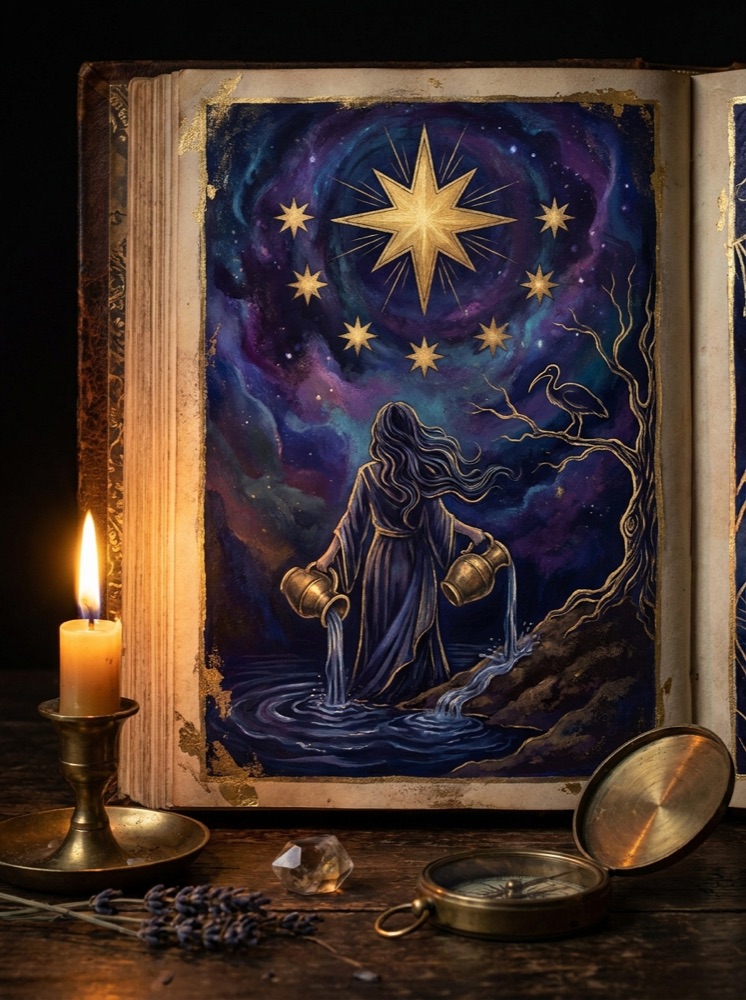
XVII The Star
- Number
- XVII (17)
- Element
- Air
- Association
- Aquarius
- Upright
- hope, renewal, serenity, trust, inspiration, the future
- Reversed
- hopelessness, disconnection from inner source, spiritual exhaustion, false hope, pessimism, depletion
The contrast with the card before it is deliberate and striking. Where the Tower was fire and falling bodies and the violence of collapse, the Star is a woman kneeling alone at the edge of still water beneath an open sky, pouring from two jugs in an unbroken, quiet stream. Eight stars hang overhead — one large and eight-pointed at the center, seven smaller ones surrounding it. The figure is unguarded. No armor, no walls, nothing concealed.
Card XVII follows the Tower not by accident but because of what that sequence means. The Star is not a generic hope card. Rachel Pollack writes in Seventy-Eight Degrees of Wisdom that the Star represents specifically what survives devastation: the quiet, unshakeable orientation toward the future that is not contingent on the present moment being comfortable, or even good. This distinction matters. A hope that requires good conditions to exist is not the Star’s hope. The Star’s hope holds after the Tower has fallen.
The Star Upright
Upright, the Star tends to reflect a quality of inner renewal that is not dependent on the outer situation having resolved. It often appears during or after a period of disruption, loss, or difficulty, and what it names is the thread of trust that is still present — not as a performance of positivity, not as denial of what happened, but as a genuine orientation toward what is still possible. Mary K. Greer reads the Star as the archetype of the person who can offer genuine renewal to others because they have found an inexhaustible source within themselves. The woman in the image pours continuously from both jugs without depleting. That self-renewing quality is the point.
The Star can also reflect a simpler and equally important thing: the first clearing of pressure after a long season of difficulty. Not resolution, not triumph, but the specific quality of exhale that comes when the worst has passed and the sky is visible again. It may point to the return of creative flow, the capacity to look forward, or the reopening of a part of yourself that closed during a hard period. Whatever the specific form, the card tends to ask: is the channel toward your own renewal open or has it been shut down by sustained depletion?
The Star Reversed
Reversed, the Star often reflects the loss of the inner thread — the disconnection from the source of renewal that leaves a person going through the motions of hope without feeling it. This can look like pessimism that has hardened into expectation, the specific exhaustion of someone who has been holding steadiness for others long enough that the resource itself has run dry. The channel is not gone; it has been closed or redirected.
There is a second expression of the reversal worth naming: the false hope that bypasses the actual situation. The Star reversed can point to inspirational bypassing — the performance of renewal without engaging honestly with the Tower’s debris still present. This kind of hope tends to feel brittle rather than quiet, and it does not last because it has not been grounded in what is real. The reversal may sometimes be asking not for more optimism but for a willingness to sit with what is still true and unresolved before reaching for the Star’s light.
Symbolism in the Rider-Waite-Smith Image
The woman pouring from two jugs is the central image of the Star’s gift: one jug replenishes the earth (the material world, the practical life), the other replenishes the water (the unconscious, the inner life). The stream is continuous and the jugs do not empty. What the Star offers is not a finite reserve but a self-renewing channel. The eight-pointed central star is associated in this tradition with Venus and with hope; the seven surrounding stars are the seven classical planets, giving the Star’s hope a scope that is not personal or momentary but oriented toward something larger. The naked figure carries the meaning Pollack names directly: after the Tower’s violence, the soul stands in complete vulnerability and openness, stripped of its defenses, and it is still intact. That intactness is the hope. The ibis in the tree — the bird of Thoth, the god of wisdom — watches quietly from the margin: wisdom is present even in this unguarded moment, observing without intervening.
The Star in Love, Money, and Energy
In love, the Star often reflects the quality of hope that sustains a relationship through difficulty: not the certainty that things will improve, but the genuine sense that the relationship holds possibility that the current hard chapter does not erase. It can also point to the openness that becomes available after a period of emotional closing down — the willingness to be seen again, or to reach toward connection after having drawn back. The Star love reading may offer a more specific reflection on what this looks like in practice.
In money, this card tends to mirror the inner orientation toward the future that shapes how risk and investment feel. The presence or absence of genuine long-range trust affects financial decisions in ways that are not always visible as such, and the Star can name that orientation directly. The Star money reading explores the relationship between this card’s quiet trust and the financial choices it might reflect.
In matters of energy, the Star often reflects the body’s own renewal capacity: the self-replenishing source that can be open or closed, available or depleted. After a period of sustained output or care for others, it can point to the specific practice of turning the stream back toward oneself — not as selfishness but as the condition that makes any further genuine giving possible.
The Star’s Place in the Fool’s Journey
Card XVII comes at the precise moment it needs to: after the Tower has stripped away what was false and the Fool is standing in the rubble of his own constructions, the Star is the discovery of what cannot be destroyed. Pollack reads this as one of the journey’s essential revelations. No matter what has fallen, the capacity for genuine renewal and orientation toward the future remains intact. The Fool has not been broken by the Tower. He has been cleared.
A Question to Sit With
Where in your life is a small source of genuine renewal still present, even in a season that has otherwise been difficult?
It does not need to be significant or dramatic. The Star’s renewal often announces itself quietly: a morning practice that holds, a person whose company genuinely replenishes rather than drains, a form of work or creative expression that connects to something real. The question is less about locating a grand source of hope and more about noticing whether the small one is being tended or taken for granted. The Tower (card XVI) brought down what was false; the Star asks what, having survived that, is worth protecting now. The Moon (card XVIII) waits with its own more complicated gifts further along the path.
The Star in a reading
Pull The Star for one of the three pick-a-card questions and read the card as a reflection on a single area of your life — never a verdict.
The Star combinations
How The Star tends to read when it lands alongside another Major Arcana card. Each pairing is a reflection on the two energies together — never a forecast.
Where to go next