Major Arcana · XVI + XVII
The Tower and The Star Tarot Combination
Read each card on its own first: The Tower meaning · The Star meaning.
If you are reading this because something recently fell apart and you drew these two cards hoping for reassurance, I want to give you something more useful than reassurance. The Tower and The Star are often called the “after the storm” pair, and that framing is not wrong. But the version of it that gets passed around — Tower collapses, Star arrives, renewal is assured — skips the hardest part of what these cards actually show when they appear together.
When The Tower and The Star Meet
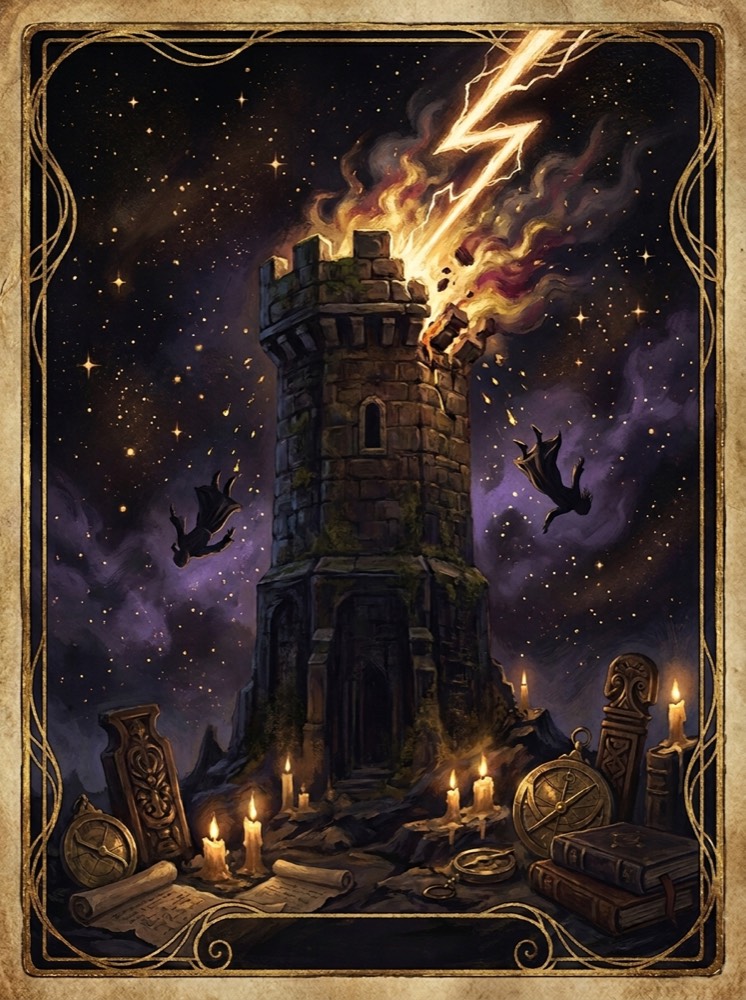
The Tower at card XVI is the deck’s image of sudden structural failure. Lightning hits. The crown falls. Two figures tumble from the windows. Whatever stood — a belief system, a relationship’s assumed shape, a career’s foundation, an identity built over years — has been knocked loose by a force that did not ask permission. The Rider-Waite-Smith image is not subtle about the violence of this.
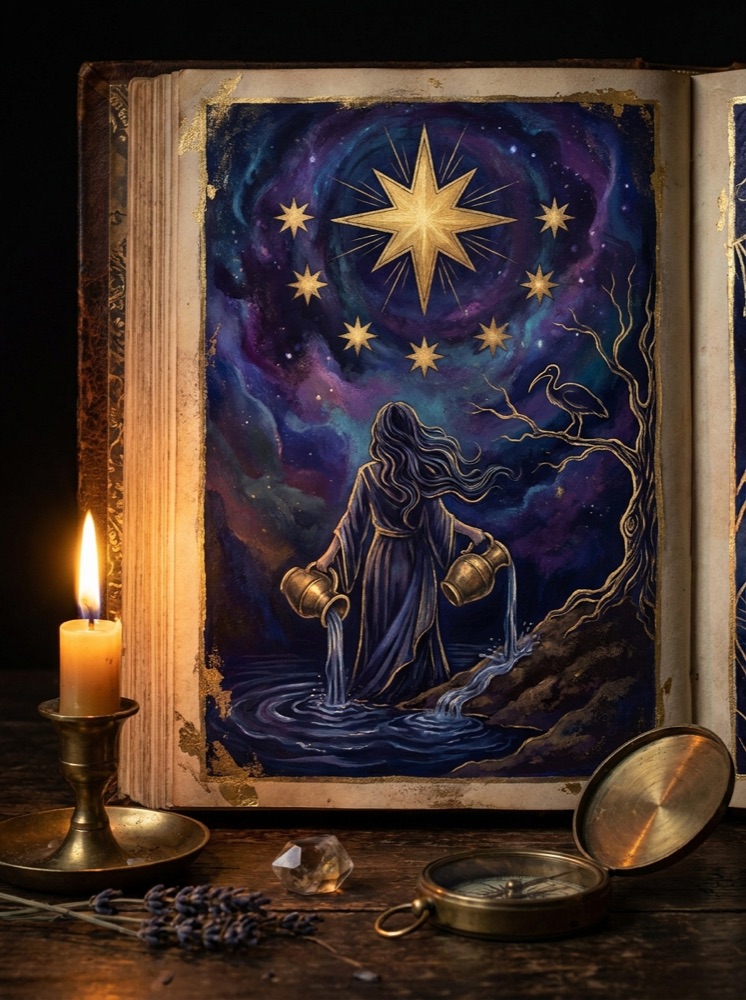
The Star at card XVII is what follows in Waite’s sequence. A nude woman kneels at a pool of water, one foot on land and one foot in the water, pouring from two pitchers without apparent effort. Eight stars glow above her. Everything in the image speaks to patience, replenishment, and a kind of gentle continuity the Tower did not permit. Rachel Pollack reads The Star as the soul’s own renewal instinct — the part that, once the false structures have been cleared, can finally do its quiet work.
Together, they name a real movement: what can grow in ground that has been cleared. That is not a false promise. But it is not automatic either.
The Tension Between These Cards
Here is the honest tension this pair holds. Hope is not the same thing as recovery. The Star does not promise that what was lost comes back, or that what grows next is recognizable as what you had before. What The Star tends to offer is the capacity to keep moving, the quality of attention that stays open even when the ground is bare. That is not nothing. It is also not everything that people want from it.
The specific discomfort of this combination is the gap between the two cards. There is no direct bridge from The Tower to The Star. The person still has to walk across the rubble. The Star does not arrive to remove the debris; it arrives to remind the person that they have enough in them to keep going. That reminder may feel small in the days immediately after a Tower event. It tends to feel more substantial with some distance.
If you pulled this pair and felt disappointed that it didn’t say more, that disappointment is worth sitting with. It may be pointing at the difference between wanting hope and being willing to practice it as a daily act rather than receive it as a fact.
This Pair in Love, Money, and Energy
In love, The Tower and The Star may surface after a relationship has broken open in some significant way: a truth revealed, a structure ended, an assumption demolished. The Tower meaning points to the fact of the rupture; the Star meaning does not promise the relationship heals. It often reflects instead the person’s own capacity to stay in their body and in their own hope while things are uncertain.
In money, this pair can appear when a financial structure has collapsed — a job, an income stream, an arrangement — and the person is in the early phase of rebuilding. The Star’s quality here is less about the money coming back and more about the patience required to rebuild without certainty, one small action at a time.
In energy, these two cards together often point to the particular tiredness that follows a sudden rupture. Not the tiredness of overwork but the tiredness of shock. The Star’s quality of slow, steady replenishment is what this kind of tiredness requires, and the card may suggest that the replenishment is possible if the pace is allowed to be what it needs to be.
Reading the Two Cards Together
The Tower cleared the ground; The Star is not a reward for having survived it. It is a description of what the person has available to them now that the false structure is gone. In Pollack’s framing, The Star’s naked figure represents the soul that has nothing left to hide behind — and is finding that the absence of armor is not the same as vulnerability in the bad sense. It can be the condition for genuine renewal.
For a longer look at how collapse tends to precede clearing, Death and The Tower examines a related pair with its own texture. For grief that moves alongside hope rather than after it, Death and The Star is worth reading next.
A Question to Sit With
What would it mean to treat hope as something you practice rather than something you wait to feel?
The Tower has already done what it came to do. The Star’s question is not “will things get better” but “can you show up for the quiet work that better requires?” Those are different questions. This pair tends to surface when the distinction matters.
Where to go next