Major Arcana · II
The High Priestess Tarot Card Meaning
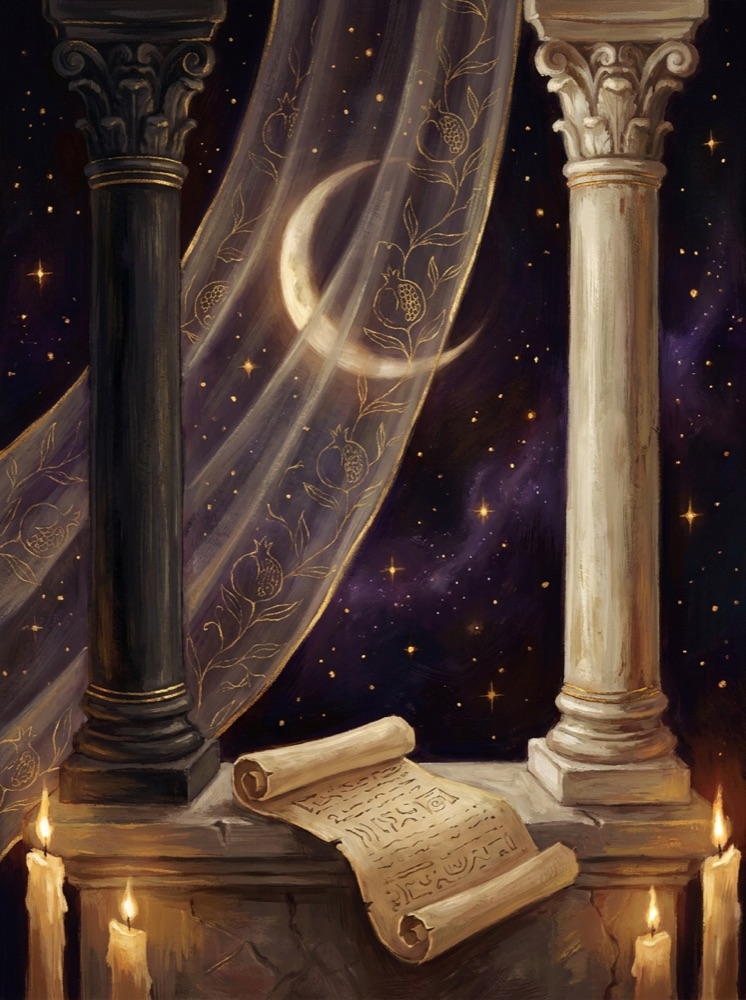
II The High Priestess
- Number
- II (2)
- Element
- Water
- Association
- The Moon
- Upright
- inner knowing, discernment, mystery, intuition, the unconscious, patience
- Reversed
- suppressed knowing, secrets withheld, paralysis by information, disconnection from inner voice, control through withholding
She sits between two pillars — one marked B for Boaz, one marked J for Jachin, the twin columns of Solomon’s temple. Behind her, a veil hung with pomegranates separates the visible world from whatever lies beyond. A scroll rests against her body, partially concealed. The crescent moon is at her feet. She holds her ground between opposites and reveals nothing she has not decided to reveal. If the Magician is the first principle of outward-facing will, the High Priestess is the first principle of something older and less visible: the knowing that arrives before words do.
She is often described in popular tarot shorthand as “trust your gut.” That reading is accurate but thin. Rachel Pollack’s account is more demanding. The High Priestess does not simply possess intuition — she holds the question of what to do with it. The withholding is as important as the knowing. The scroll is against her body; it is not sealed, but neither is it open. She sits in the tension between what is known and what should be spoken, and that tension is the heart of the card. Reducing her to “go with your instincts” collapses the nuance that makes her one of the most layered cards in the deck.
The High Priestess Upright
Upright, the High Priestess tends to reflect a form of knowing that precedes rationalization — the sense that something is true before the evidence has fully assembled itself. Mary K. Greer describes her as the archetype of discernment: not all knowing is meant to be immediately deployed. The High Priestess sits with what she knows, reads the moment, and determines whether the time to speak it has arrived. This is not passivity. It is a specific and demanding kind of patience that many people find harder to hold than action.
When this card comes up, it often names a situation where inner information is available and is not being fully trusted or acknowledged. This could look like a decision the conscious mind keeps avoiding, a read on a person or circumstance that the rational mind keeps overriding with logic, or a piece of knowing that the person already has but cannot yet justify to themselves or others. The High Priestess may point to the need to sit with the knowing longer before acting on it, or to the honest recognition that the knowing has been available for some time and has been suppressed rather than processed.
The High Priestess Reversed
Reversed, the High Priestess tends to reflect either suppressed inner knowledge or a distortion of discernment. In the first reading: something is known and is being refused entry into conscious acknowledgment. The inner voice is present and is being argued down, explained away, or drowned in information until it goes quiet. Pollack notes that this version can show up as a paralysis of data: the person who consumes so much information on a question that the original inner signal gets lost entirely.
The shadow expression is more uncomfortable. The High Priestess reversed can reflect the strategic withholding of knowing — using private information as a form of control, staying in the position of the one who knows while others seek. This is discernment turned toward power rather than toward service or genuine protection. It may also surface as secrets that are creating distance in relationships without protecting anything real. The reversal tends to ask whether the silence is serving the situation or serving only the person who holds it.
Symbolism in the Rider-Waite-Smith Image
The twin pillars (B and J) frame the most significant structural tension in the card: the High Priestess does not stand in one camp. She occupies the space between darkness and light, between mystery and revelation, neither collapsing into one nor rejecting the other. The veil decorated with pomegranates belongs to the mythology of Persephone — the fruit of the underworld, cyclical descent, the knowledge that comes only from having been in the depths. The veil hangs behind the High Priestess, suggesting she has access to what lies beyond it, but access is not the same as disclosure. The scroll (TORA) is partially visible against her body: the knowing is present, but the full text is withheld. The crescent moon at her feet marks the lunar and cyclical nature of the knowing she governs — this is intuitive, tidal knowing, not the solar linearity of the Magician.
The High Priestess in Love, Money, and Energy
In love, the High Priestess often reflects the private cost of reading a relationship more clearly than the other person does. The asymmetry of knowing — one person already sensing where a dynamic is heading, before it becomes visible or speakable — tends to surface here. The High Priestess love reading may bring this pattern into focus.
In money, she tends to mirror the pattern of rare discernment that has been given away freely. The person who reads situations with uncommon accuracy and charges nothing for it. The knowing has been operating as unpaid labor, offered without boundary. The High Priestess money reading can name where this particular cost has been running.
In matters of energy, she often reflects the accumulated weight of constant environmental reading. If you move through the world with a strong sense of what people feel before they say it, the High Priestess may be pointing to the structural cost of that capacity: the decompression requirement is not optional and not a personality flaw. The High Priestess energy reading tends to speak to this specifically.
The High Priestess’s Place in the Fool’s Journey
Between The Magician at card I and The Empress at card III, the High Priestess establishes the inner world as a domain as real and as demanding as the outer one. The Fool has met the principle of outward will; now he meets the principle of inner knowing. Pollack reads this as the second great polarity: the Magician and the High Priestess together represent the first pairing of conscious and unconscious, external and internal, masculine and feminine principles. The soul that rushes past the High Priestess toward action has not yet learned what it carries.
A Question to Sit With
What do you already know about this situation that you have not yet allowed yourself to say out loud, even to yourself?
Take a moment with that. Not to find an answer, but to notice whether there is a small contraction somewhere when you ask it — a slight bracing, a subject you find yourself moving away from. The High Priestess does not demand that you speak what you know before you are ready. She asks only that you acknowledge, privately, that you know it. That first acknowledgment is usually enough to change something.
The High Priestess in a reading
Pull The High Priestess for one of the three pick-a-card questions and read the card as a reflection on a single area of your life — never a verdict.
The High Priestess combinations
How The High Priestess tends to read when it lands alongside another Major Arcana card. Each pairing is a reflection on the two energies together — never a forecast.
Where to go next