Major Arcana · I
The Magician Tarot Card Meaning
I The Magician
- Number
- I (1)
- Element
- Air
- Association
- Mercury
- Upright
- will, skill, resourcefulness, focus, action, agency
- Reversed
- manipulation, blocked will, over-preparation, trickery, scatter, unfocused power
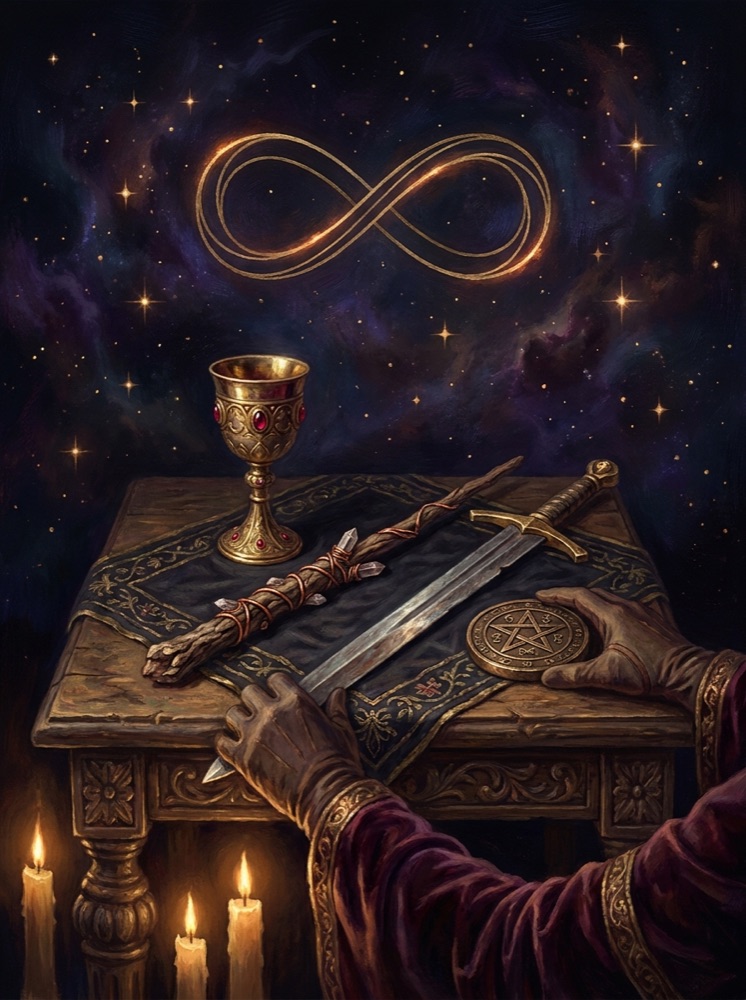
The Magician stands at a table laid with four objects: a wand, a cup, a sword, and a pentacle. One hand points toward the sky, the other toward the earth. Above his head, the lemniscate — the horizontal figure-eight of infinity — hovers in place. He is not waiting for something to arrive. The posture says that the gesture itself is the act; everything required is already on the table; the only remaining question is whether the will is present to direct it.
There is a version of the Magician that appears often in popular tarot, reduced to a card about willing your dreams into being or summoning things from nothing through positive thought. That is not what the card says, and it is not what Rachel Pollack or Mary K. Greer have written about it. The Magician does not create from thin air. He directs what is already present. The four tools on the table represent all four elements, all four suits (fire, water, air, earth), meaning nothing is missing. The lesson the Magician offers is about focused conscious will applied to resources that are already there. Not about wishing. About acting.
The Magician Upright
Upright, the Magician tends to name the moment when everything needed for an action is genuinely present and the only missing piece is the decision to begin. Pollack describes the Magician as the first principle of consciousness: the capacity to intend and to act. The soul that was purely potential in the Fool card (the neighbor the Magician follows, at The Fool’s card hub) has now encountered the outer world and discovered it has a will. That discovery is the Magician’s terrain.
The card can reflect a pattern of capable people who have gathered considerable skill and done little converting of it. The tools are on the table. The hand is raised. The full gesture — the one that brings the work into being — is the thing being withheld, often without conscious awareness that anything is being withheld at all. The Magician upright may point to a moment of genuine readiness that has not yet been named as such, or to a skill that has been operating as a private fact rather than a public act. It tends to ask: what would the complete gesture look like?
The Magician Reversed
Reversed, the Magician often reflects one of two things, and context determines which. The first is blocked will: the capacity is present, the tools are all on the table, but nothing is being pointed anywhere. More studying, more preparation, more accumulation of resources that will never be enough. The act stays permanently three steps away. The second reading is the trickster: skill and eloquence directed toward deception rather than creation. Pollack is clear that the reversed Magician can represent manipulation — the gifted person who uses their gifts to impress, seduce, or distract rather than to build something real.
Both versions share a common quality: the power is genuine and the direction is wrong. In the blocked reading, the direction is inward and indefinitely deferred. In the shadow reading, it bends toward other people’s belief rather than genuine output. Neither is the upright gesture, and the reversed Magician tends to ask an honest question about which of these patterns might currently be operating, and whether anything needs to be redirected.
Symbolism in the Rider-Waite-Smith Image
The four tools on the table (wand, cup, sword, pentacle) are the most significant image in the card: all four suits, all four elements, simultaneously present. The Magician lacks nothing he needs; the gesture is what remains. The raised wand and downward-pointing hand carry the alchemical phrase “as above, so below” — the Magician channels from the infinite into the material, bridging what could be and what is. The lemniscate above his head is the same infinity symbol that reappears over the woman in the Strength card: both figures access energy that exceeds their ego. The red roses and white lilies bordering the image hold desire (red) and clarity of intent (white) in equal measure; the Magician does not work from only one.
The Magician in Love, Money, and Energy
In love, the Magician often reflects the pattern of someone who brings considerable skill and attention to connection but stops short of the full commitment the situation is asking for. The seduction is real. The intent can be genuine. But the converting gesture — the one that turns attention into something lasting — tends to get deferred. The Magician love reading often surfaces around moments when this pattern is close enough to notice.
In money, this card tends to mirror the gap between demonstrated capability and actual deployment of it. The skills are present, sometimes formidably so. What often lags behind is the step where those skills get offered at their actual value, charged for, or launched into the world as the real thing rather than a rehearsal. The Magician money reading may name the conversion point that keeps sliding.
In matters of energy, the Magician can reflect a particular kind of scatter: output distributed across too many channels simultaneously, each of them real and capable, none of them fully activated. The lemniscate above his head is not a symbol of division — it is a symbol of the continuous flow that results from directed intention. The Magician energy reading may point to where focus is the missing piece.
The Magician’s Place in the Fool’s Journey
The Magician is card I, the first numbered card, and his placement is deliberate. After the Fool’s zero-point of pure potential and the willingness to begin, the soul’s first encounter with the world brings this discovery: individual will exists, and it can be directed. Greer writes that the Magician is the archetype of integrated capacity, the point where the soul learns it can act rather than simply experience. What follows him — the High Priestess at card II — represents the inner world that balances this outward-facing will. Together they form the first polarity the Fool must integrate.
A Question to Sit With
What is actually on your table right now — the skills, the contacts, the partially built things — that you have been treating as not-enough?
Consider that list for a moment without adding anything to it. The Magician’s table was already full. The question was never about acquiring more; it was about whether the will was present to make the full gesture with what was already there. Notice what arises when you ask yourself that question honestly, and set it down without resolving it. The answer tends to clarify in the acting, not before it.
The Magician in a reading
Pull The Magician for one of the three pick-a-card questions and read the card as a reflection on a single area of your life — never a verdict.
The Magician combinations
How The Magician tends to read when it lands alongside another Major Arcana card. Each pairing is a reflection on the two energies together — never a forecast.
Where to go next