Major Arcana · V + VI
The Hierophant and The Lovers Tarot Combination

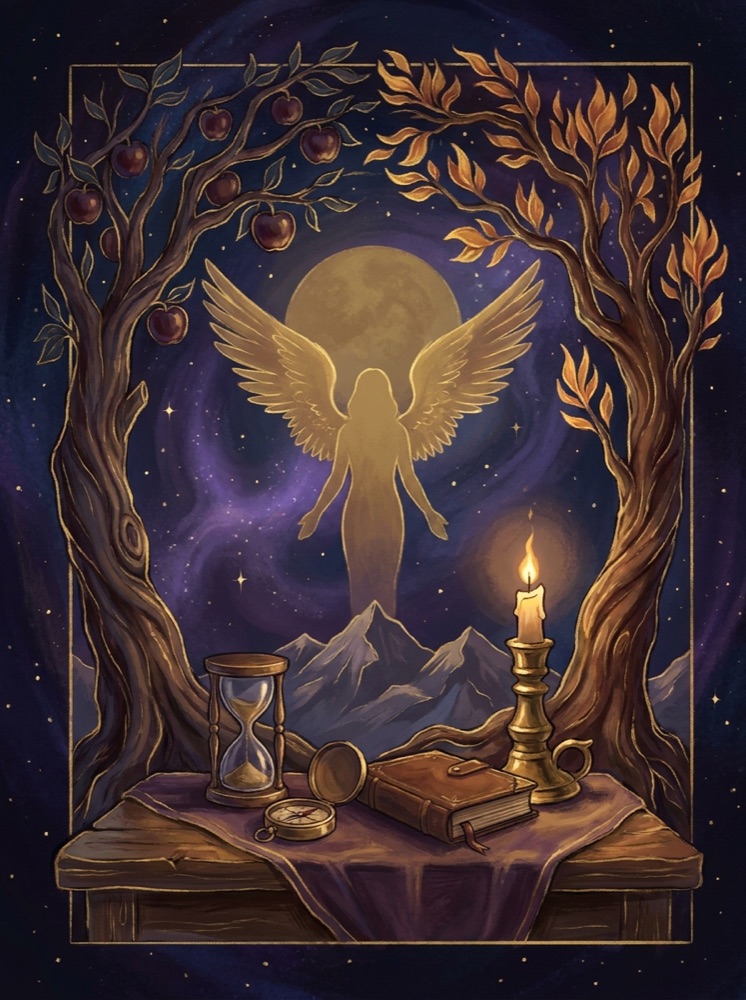
Read each card on its own first: The Hierophant meaning · The Lovers meaning.
These two cards sit right next to each other in the Major Arcana: five and six, tradition and choice. The proximity is not accidental. The Hierophant’s world of doctrine, ceremony, and collective authority gives way, one step later, to The Lovers’ moment of personal reckoning. The question they raise together tends to be the one people carry for years before they say it plainly: can I belong here and also be honest about what I actually want?
When The Hierophant and The Lovers Meet
The Hierophant in the Rider-Waite-Smith tradition is the keeper of established teaching. He sits between two pillars, robed in formal authority, two acolytes before him. He holds the keys — not to hidden mystery like the High Priestess, but to the publicly sanctioned path: the church, the institution, the tradition the family or community has built its meaning around. The card often reflects the structures of belonging we inherit rather than choose, and the very real comfort those structures can provide.
The Lovers, one card on, is the crossroads. An angel presides over two figures, and the man looks toward the woman, the woman toward the angel. The whole image is a moment of weighted decision. Pollack notes that the card predates its later narrowing into “romance”; it originally represented a choice between two paths, made with eyes open. Conscious, consequential, aligned with what the person actually values.
When these two appear together, they tend to name a specific kind of pressure: the choice that has to be made in full view of a tradition that has its own opinion about the correct answer.
The Tension Between These Cards
Both belonging and authentic choice are real needs. That is what makes this pair uncomfortable rather than simple. The Hierophant is not automatically the villain. The structures it represents, family expectation, religious or cultural tradition, the conventions of a community, can carry genuine wisdom and provide genuine belonging. The pull toward them is not weakness.
But The Lovers won’t let you off the hook with that observation either. Conscious choice is the card’s whole point. The reading often lands on the specific difficulty of choosing in a way that disappoints people you love or defy traditions that gave you something real. The pain in this pair tends to be the cost of honesty, not the cost of a bad decision. Those are very different things and they often get confused.
This Pair in Love, Money, and Energy
In love, The Hierophant and The Lovers together most often surface around relationship decisions made under institutional or family pressure: the partner who doesn’t fit the expected mold, the commitment that requires abandoning a religious or cultural framework, or the reverse — the tradition that someone holds onto beyond its usefulness because leaving it means losing a community. The Hierophant meaning and the Lovers meaning are worth reading separately here, because this pair can pull in opposite directions depending on which card the person is being asked to hear.
In money, this pair often reflects the financial structures people inherit — family business expectations, community norms around how money should be made or spent, career paths chosen for legitimacy rather than genuine fit. The Hierophant can represent the safe, socially approved route; The Lovers may be asking whether it is also the true one.
In matters of energy, the two cards together can point to the specific depletion that comes from performing conformity — the effort of living inside a role that doesn’t quite fit, held in place by loyalty to something you’re not sure you’d choose again from scratch.
Reading the Two Cards Together
Greer describes The Lovers as the card that inaugurates the first real individuation on the Fool’s journey: the moment the soul stops inheriting its values and begins choosing them. The Hierophant immediately precedes that moment, which is probably why this pair tends to arrive when someone is right at the threshold of that shift. Read in context, the question is rarely “tradition or freedom” as a binary. It is more often: what in this tradition is genuinely yours, and what belongs to someone else’s story? For how this theme plays out after the choice is made, The Lovers and The Tower follows the thread into rupture territory.
A Question to Sit With
What would you choose here if no one whose opinion you value were watching?
Sit with the gap between that answer and what you are actually doing. The gap is not a verdict. It is the thing the reading may be asking you to look at directly rather than around.
Where to go next