Can Tarot Cards Tell the Future?
No — and the readers worth your time say so. What tarot actually does, why it works anyway, and how to tell reflection from fortune-telling.
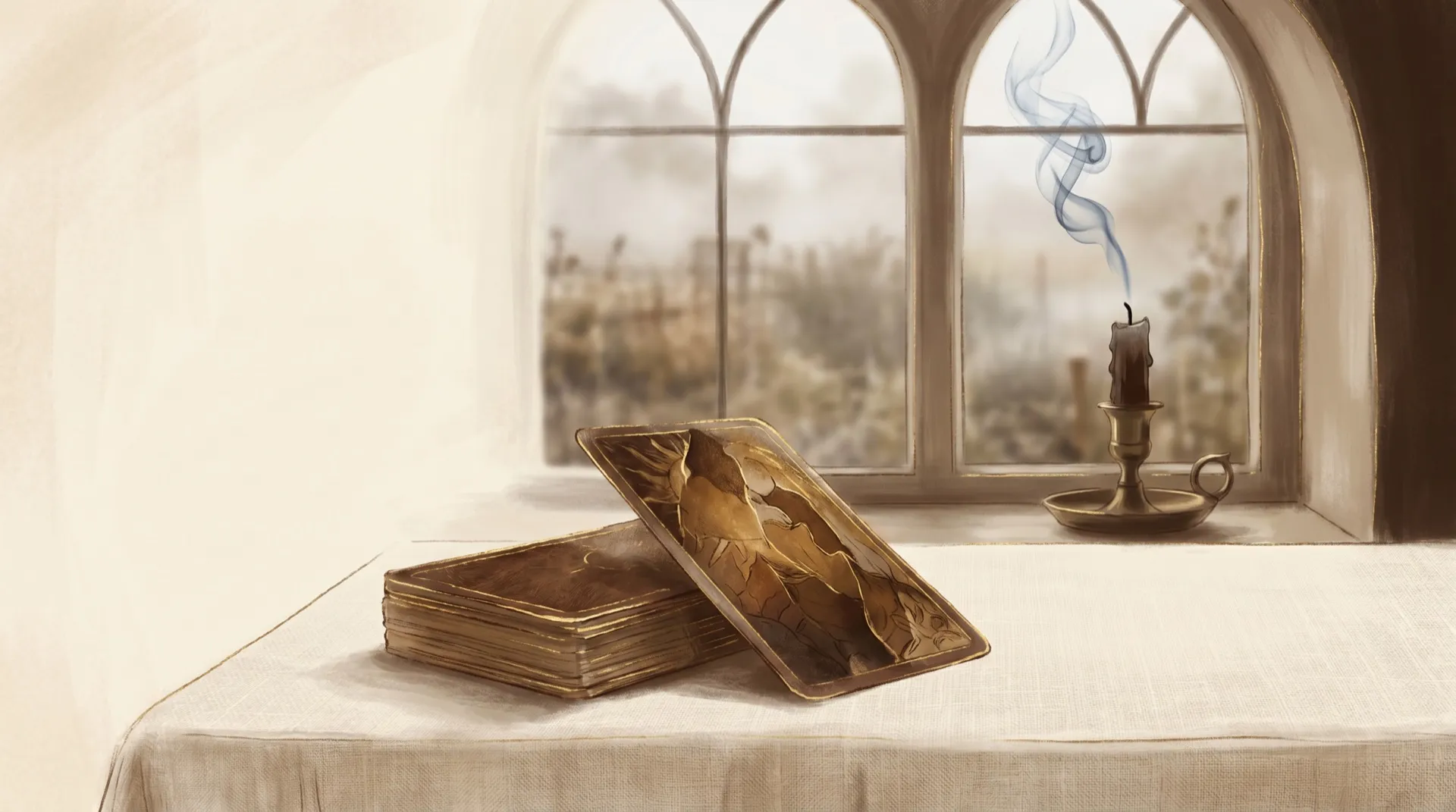
Let me answer the question in the first paragraph, because you came here with it and you deserve better than eight hundred words of throat-clearing. No. Tarot cards cannot tell the future. Not mine, not yours, not anyone’s. I say that as someone who has read cards for over twenty years, owns more decks than dinner plates, and would defend this practice with real heat at any dinner party.
The interesting part is the next question, the one almost nobody stays to ask. If the cards can’t see ahead, why does a good reading feel like someone turned the lights on?
What a deck actually is
A tarot deck is seventy-eight images, refined over roughly five centuries, that catalogue human situations: beginnings, betrayals, long labor, sudden collapse, rest, return. Not predictions. Situations. The Three of Swords is heartbreak. The Eight of Pentacles is unglamorous practice. The Tower is the structure you knew was cracked, finally giving.
When you shuffle and draw, you get a random image from that catalogue. The card knows nothing; randomness is the entire mechanism, and an honest reader never pretends otherwise. What happens next is the real event: you look at the image, and your own life rushes in to meet it. Draw the Six of Cups, the card of nostalgia, and notice what surfaces without permission. Whatever came up, the card didn’t put it there. It was already in you, waiting for something shaped like a question.
Readers sometimes dress this up in borrowed mystery. It doesn’t need any. A randomly drawn image that your own mind completes is one of the oldest reflective technologies we have, sitting in the same family as dream journals and long walks. The shuffle’s job isn’t magic. It’s to hand you a starting point your defenses didn’t choose.
Why it feels like prophecy anyway
Three honest reasons a reading can feel uncannily accurate, none requiring the cards to see anything.
First, the catalogue is broad and you are human. Most lives at most moments contain a strained relationship, an unresolved money question, and a deferred decision. Seventy-eight situation-cards land on one of yours easily, and the hit feels personal because the material it touches is.
Second, your attention is selective. The card that matched gets remembered; the two that didn’t get quietly filed away. Stack months of that and the deck develops a reputation it never earned alone. I’ve written about a cousin of this effect, the card that seems to follow you, in What It Means When the Same Card Keeps Appearing.
Third, and this is the one that matters: you already know most of what a reading reveals. Not consciously, or you’d have acted on it. But the knowledge that the job is finished, that the friendship has turned, that the spending is fear wearing a festive costume: it’s in you, pre-verbal, waiting. A card gives it a face and suddenly it’s sayable. That’s not the future arriving. That’s the present finally getting through.
The line between reflection and fortune-telling
Here is the line, and it’s bright. Reflection asks what do I notice, what do I already know, what’s mine to do. Fortune-telling asserts what is going to happen to you. Everything on this site, from the daily three-card reading to the horoscopes, lives on the reflection side of that line, on purpose, in writing, in our disclaimer. For entertainment and reflection. Not because lawyers like the phrase, but because it’s true.
And the line has teeth. A reader who tells a frightened person that the cards show their marriage ending, their money doubling, their illness lifting, has stopped reading and started writing fiction with someone else’s life. The predictions can’t be verified in the moment, can’t be falsified politely, and land hardest on people in the exact circumstances that make a stranger’s certainty feel like rescue. If you ever pay for a reading, here’s the field test: a reflective reader hands you questions and leaves the authority with you. A fortune-teller takes the authority home. Walk away from the second kind, especially if a card revealed a curse that more money can remove. That one is not folklore. It’s a documented scam with a long rap sheet.
What the cards are for, then
Everything the honest version offers fits in one sentence: tarot is a structured way to find out what you actually think. That sounds modest next to prophecy. It isn’t. Most of us go weeks without ten undefended minutes in front of our own lives, and a deck enforces those minutes with a strange, patient efficiency.
It helps to ask the deck the kind of question it can actually hold. “Will he call” hands the cards a job they can’t do and hands him the starring role in your reading. “What am I making his silence mean” keeps both the work and the authority where they belong. The craft of a good question is mostly the craft of swapping a prediction for a noticing: not whether the move pans out, but what I’m afraid the move says about me; not when the hard season ends, but what this week of it is asking me to put down. Questions like that get answered every single time, because the answering material is sitting in the chair.
The future shows up in the practice, but through the only door it has ever actually used: the present. You can’t read what June holds. You can read what you’re doing with the second week of June, and what you keep deciding daily compounds into what the months become. The woman who notices, card by card across a season, that every draw somehow becomes a meditation on her draining job is not seeing her resignation foretold. She’s watching herself decide, in slow motion, at a speed she can finally observe. The deck didn’t know her future. It introduced her to the person choosing it, and that’s the more useful acquaintance; I walk through the working version of this in How Often Should You Do a Tarot Reading?
Common questions
So the cards are just random?
The draw is random; the reading isn’t. What you bring to the image is the least random thing in the room: a whole life, pattern-hungry and ready. Randomness is what makes the mirror trustworthy, because nobody, including you, chose which angle you’d be caught from. The same frame holds for angel number patterns: the repetition is ordinary, and the noticing is yours.
Can a reading at least warn me about what’s ahead?
It can surface what you already sense: that the deadline’s unrealistic, that the lease needs a slower read, that you’ve been ignoring a friendship going quiet. Acting on noticing looks like foresight later. The sequence matters: you knew, the card said it, you acted. Nothing was foretold. Something was finally heard.
Is tarot wrong or dangerous, then?
A tool takes the shape of its user. Used as a mirror, it’s about as dangerous as a journal. Used as a substitute for medical, legal, or financial judgment, it’s dangerous the way any abdicated decision is, which is why the real questions belong with licensed professionals and the cards stay in the reflection seat. The deck I’d hand a beginner comes with one rule: it tells you nothing you don’t, on some floor of yourself, already know. Twenty years in, that rule has never once made the practice smaller. It’s what makes it honest enough to keep.
Reading this fresh off a draw? Today's three-card reading and your sign's daily page are the short-form companions to the longer essays here.
Where to go next