How Often Should You Do a Tarot Reading?
Daily, weekly, or only when life shakes? An honest guide to reading rhythm, the over-reading spiral, and the schedule that actually builds clarity.
There are two people who ask me this question, and they need opposite answers.
The first is the careful beginner who reads once every few months and wonders if she’s doing it wrong, if real readers commune with the deck nightly. The second pulled cards about the same situation four times before lunch and suspects, correctly, that something has gone sideways. One needs permission to read more. The other needs permission to stop. So instead of a single number, let me give you the honest principle underneath, and then some actual rhythms that work.
The principle: tarot rewards rhythm and punishes urgency. How often you read matters far less than why, and the two failure modes are both about the why.
The over-reading spiral, named honestly
Start with the second person, because her problem is sneakier. Re-reading the same question is the most common way a healthy practice curdles, and here’s the mechanism. A reading on a question you’re anxious about produces an answer you don’t like, or one that’s ambiguous, which anxiety reads as “ask again.” So you shuffle. The second reading differs from the first (it’s a random draw, of course it differs), and now you have two oracles in disagreement, which feels like a reason for a third. By the fourth pull you’re not reflecting. You’re pulling a lever, waiting for the cards to pay out the answer you walked in wanting.
I described this trap from another angle in Reading Tarot About Your Career, and the tell is always the same: if you already know which card you’re hoping for, the reading is over. Write down what you were hoping for. That’s your actual answer, and no amount of shuffling improves on it.
The deeper cost of over-reading isn’t wasted time. It’s that the deck becomes another room for the anxiety to pace in. A reflection tool should return you to your life with something in hand. If readings keep sending you back into the deck instead, the practice is feeding on the very fog it’s supposed to thin. And if the fog itself is the constant, if you notice you’re reading several times a day to manage dread, that’s worth taking seriously as information about the dread, not the deck; I wrote about that boundary, gently, in The Moon Card, Worry, and When to Talk to Someone.
The rhythms that actually work
Here’s what I’ve seen hold up over years, in my own practice and at other people’s tables.
The daily single card is the workhorse, and it’s the rhythm this site’s daily reading is built around. One card, in the morning with the coffee or at night before the lamp goes off, read in two or three minutes, ideally with one line in a notebook. Its strength isn’t any single day’s insight; it’s the accumulation. Thirty daily cards make a record of where your attention kept going, and patterns surface in that record that no single dramatic reading could show you. The repeated card you’ll eventually notice has its own essay. If you do only one thing from this whole article, do this: small, daily, written down.
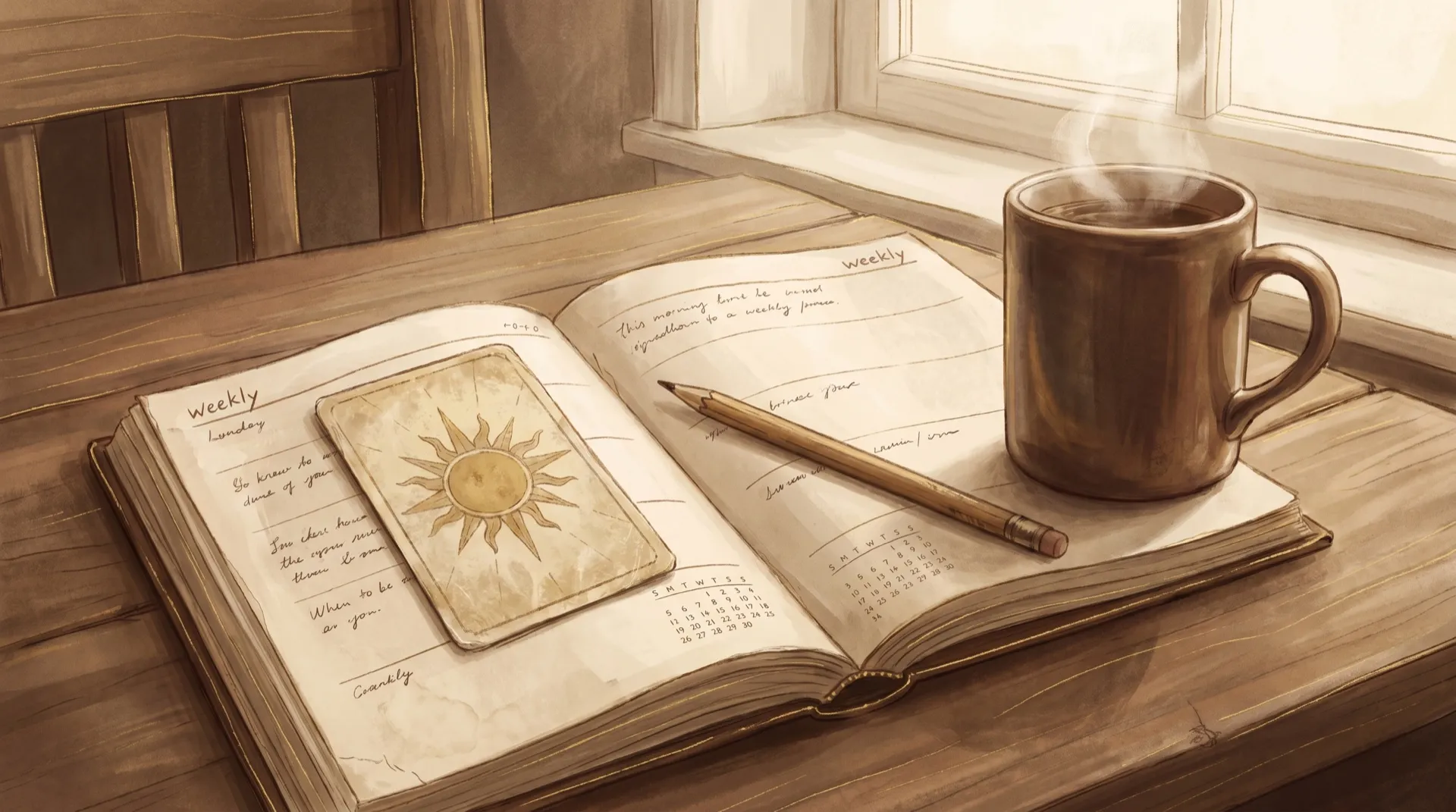
The weekly three-card spread is the deeper rhythm: Sunday evening, fifteen unhurried minutes, three cards read as a conversation about the week behind or the week ahead. Not as forecast, never as forecast, but as agenda: what wants attention, what’s being avoided, what’s actually finished. Weekly is also the natural pace for a specific ongoing question, a job situation, a slow decision, because seven days is long enough for something real to change between readings. That’s the test urgency always fails: a reading earns its repeat when the situation has new information, not when you have new anxiety.
The seasonal or milestone reading, a bigger spread at a birthday, a new year, a move, is the long-exposure photograph. A few times a year, with real time set aside. These are the readings people remember word for word a decade later, partly because of their rarity. Scarcity is an ingredient. A reading you could have any minute is worth about a minute.
And the honest answer for some people is rarely, and that’s fine. If you read four times a year when something genuinely stirs, and those readings land, you don’t have a deficient practice. You have an efficient one. There’s no attendance award in this craft, and no gift requirement either; there’s just whether the mirror gets used honestly when it’s picked up.
When not to read
A few situations where the kindest schedule is “not now.” Don’t read in the first hours of real shock: grief, a firing, the awful phone call. Every card becomes a Rorschach of the wound, and the deck can’t hold what those hours actually need, which is people. Don’t read at 2am on a spiraling night; the 2am reader asks 2am questions and then has to live with 2am interpretations. The deck keeps. And don’t read to overturn a reading you didn’t like; that’s the spiral wearing a scholar’s robe.
For the careful beginner from the first paragraph, the prescription runs the other way, and it’s gentler than she expects. Reading once a quarter isn’t wrong, but a skill visited four times a year never gets past the introductions. If you want the practice to take, borrow the logic of every other quiet discipline: shrink the session until it’s too small to postpone. One card, two minutes, most mornings. You’re not auditioning for anything. You’re letting a vocabulary move in.
A useful rule for all of it: read at the speed of reflection, decide at the speed of evidence. Cards for the noticing. Professionals, spreadsheets, doctors, and honest friends for the deciding, which is the standing arrangement around here.
Common questions
Is it bad to do a tarot reading every day?
A daily single card is one of the best practices there is: small, cumulative, and honest. What turns daily reading sour isn’t frequency, it’s stakes; a quick reflective draw is a habit like journaling, while a full anxious spread every morning about the same dread is the spiral in slow motion. Keep the daily small and the big questions on a weekly leash.
How long should I wait before asking the deck the same question again?
Wait for new facts, not new feelings. If the situation has actually moved, the conversation happened, the offer arrived, the test came back, the question has fresh material and a re-reading can be honest. If nothing changed except your tolerance for the last answer, the re-read is a negotiation, and the deck, being cardboard, always lets you win it. That’s exactly why it can’t be trusted on the second ask.
Does reading too often make the cards less accurate?
The cards don’t have accuracy to dilute; they’re a mirror, not a forecast. What over-reading dulls is you: the tenth reading of the week gets a distracted reader, and reflection done compulsively stops reflecting anything but the compulsion. Rest the practice and the practice sharpens. Like most instruments, including the person holding this one.
Reading this fresh off a draw? Today's three-card reading and your sign's daily page are the short-form companions to the longer essays here.
Where to go next