The Moon Card, Worry, and When to Talk to Someone
Tarot’s card of fog and 3am thinking — what the Moon honestly marks, what a deck can’t carry, and why booking the therapist is the brave reading.
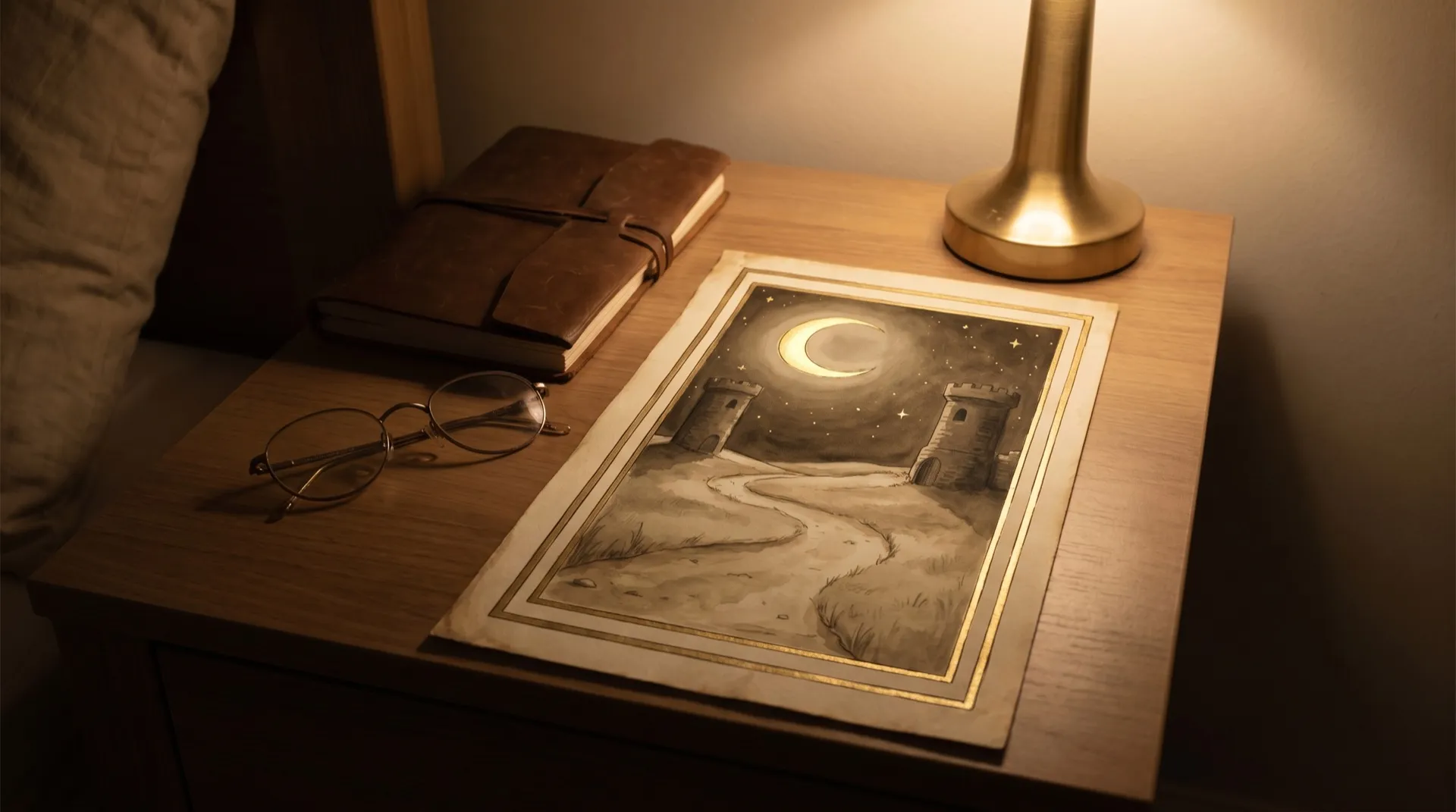
There’s a card in the Major Arcana that I treat differently from all the others, and I want to tell you why, because the why matters more than the card.
The Moon: a dog and a wolf howling at a clouded sky, a crayfish climbing out of a pool, a path running between two towers toward mountains you can’t quite see. No people anywhere. Just creatures, water, and a light that illuminates nothing clearly. It’s the deck’s portrait of fog. Of the 3am hour when every worry grows a second head. Of knowing something is wrong-shaped in your life and not being able to say what.
When the Moon turns up for someone, I slow the reading down. Not because the card is scary. Because it’s the card most likely to be sitting on top of something a deck of cards should not be asked to carry alone.
What the Moon actually marks
In the traditional reading, the Moon is the card of illusion, uncertainty, and the underwater layer of the mind: dreams, old fears, the stories we absorb before we’re old enough to argue with them. The dog and the wolf are the same animal at different distances from the campfire, the tame worry and the wild one, howling at the same light. The path between the towers goes somewhere real, but you can’t see the destination from here, and the card is honest about that. By moonlight, you navigate by feel.
What the card marks, in a practical reading, is usually one of two things. Sometimes it’s ordinary fog: a decision with genuinely incomplete information, a season where the next step is unclear because it actually is unclear. That kind of Moon resolves itself with patience and daylight.
And sometimes it’s the other thing. The worry that has stopped being about anything in particular and started being the water you swim in. The sleep that’s been bad for months, not days. The loop that runs the same three fears in rotation no matter how many times you’ve answered them. When someone describes their life and I hear that, the Moon on the table isn’t the message. It’s the messenger.
What a tarot deck honestly can’t do
Here’s the boundary, stated as plainly as I can build it. Tarot is a reflection practice. It can help you notice what you’re feeling and find words for it. It is not therapy, it is not treatment, and it is not a substitute for either. A card cannot assess what’s happening in your mind, and neither can I, because I’m a reader, not a clinician. Anyone in this trade who implies otherwise, who offers cards as an answer to persistent distress, has crossed from reflection into harm, and I want no part of it. That line is written formally into this site’s disclaimer, but I’d hold it with or without the legal page.
What I can tell you is what I’ve watched. The bravest reading I ever saw didn’t involve cards at all. A woman who’d been coming to me every few weeks, always circling the same exhausted fears, sat down one evening and said, “I made an appointment with a counselor instead of booking another reading.” I could have applauded. That was the reading. Everything we’d done at the table was, at best, the long preface to that sentence.
The noticing practice, and its limit
So where does the deck fit, honestly? Before the threshold, as a noticing tool. A nightly card with a journal can help you see your own weather: which days the wolf was loud, what was happening on the days it wasn’t. Naming a worry on paper often shrinks it from atmosphere back down to object, and the Moon, drawn on a foggy night, can be a strangely kind companion. It says: this state has been human enough, for long enough, that five centuries of card-makers kept painting it. You’re not broken. You’re in the oldest weather there is.
But a noticing practice has a built-in test, and I ask everyone who reads daily to apply it. Is the practice moving anything? If journaling and reflection are helping you sort signal from fog, you’ll know within a few weeks; things get incrementally lighter and more specific. If you’ve been pulling cards about the same heaviness for months and the fog hasn’t moved, the practice isn’t failing because you’re doing it wrong. It’s telling you the question has outgrown the tool. There’s a version of this in every discipline I respect: the point where the home remedy honors itself by referring you onward. I wrote about healthy reading rhythms in How Often Should You Do a Tarot Reading?, and the short version is that more cards are never the answer to a question cards can’t hold.
What talking to someone actually offers
I want to praise the thing itself for a moment, not abstractly. A licensed therapist or counselor offers what no deck can: a trained human who tracks you across time, notices what you can’t see from inside, and is accountable, by license and ethics, for the care they give. Counseling isn’t a verdict that something is wrong with you. It’s a room where the worry can finally be set on the table in front of someone equipped to help you work with it. People in my world sometimes treat seeking support as the failure of their spiritual practice. I’d put it exactly backwards: knowing the limits of your tools is the spiritual practice. The Moon’s path runs between the towers and beyond the frame, and some stretches of it deserve a guide who does this for a living.
If cost is the obstacle, it’s worth knowing the landscape has more doors than most people assume: community mental health centers, therapists with sliding-scale fees, counseling through workplaces and schools. Finding the right fit can take a few tries. That’s normal, and it’s effort spent on the most important infrastructure you own.
And if the night is genuinely bad, not foggy but frightening, that is not a tarot moment at all. In the US, the 988 line answers calls and texts around the clock. Please put the deck down and pick the phone up. The cards keep.
The Moon, revisited in daylight
Here’s the gentlest thing about this card, and I save it for last on purpose. The Moon is the eighteenth card of the Major Arcana. The nineteenth is the Sun: the clear sky, the child on the horse, everything visible again. The deck’s old sequence quietly insists that fog is a place on the path, not the end of it, and that people walk out of it, usually with help. Not always quickly.
The dog and the wolf, by the way, never stop being part of you. The fears don’t abolish; they domesticate. The card has been teaching that for five hundred years, and so has every honest counselor: the goal was never a life without the howling. It was learning which howls carry information, which carry only echo, and who to sit with while you sort them. A deck can keep you company in that sorting, the way a quiet daily draw keeps company. The sorting itself, when it’s heavy, deserves human hands. The reflection is mine to offer, like everything here, including the question of what tarot can see at all. The care is a professional’s. Knowing the difference is the whole craft.
Common questions
Does pulling the Moon card mean something is wrong with me?
No. It marks a state, not a condition: fog, uncertainty, worry doing its 3am arithmetic. Everyone draws it; everyone has lived in it. If the state it names has been your constant weather for a long stretch, treat the card as a nudge toward a conversation with a counselor, which is information, not indictment.
Can tarot help with my worry?
A reflective card practice can help you notice and name what you’re feeling, and for everyday fog that naming genuinely helps some people. It cannot treat anything, and persistent or heavy distress deserves a licensed professional. The honest sign a practice is working: things get lighter and more specific. If they don’t, the next appointment shouldn’t be with a deck.
Is it strange to do tarot and also see a therapist?
Not in the least. They occupy different floors of the same house: one is a private noticing ritual, the other is professional care. The readers I respect most are the ones quickest to say so.
If you want the card in full, here is the complete Moon card meaning, upright and reversed.
Reading this fresh off a draw? Today's three-card reading and your sign's daily page are the short-form companions to the longer essays here.
Where to go next