The Nine of Pentacles and Financial Independence
A woman alone in a vineyard she owns. What the deck’s self-sufficiency card asks about savings, work, and the difference between rich and free.
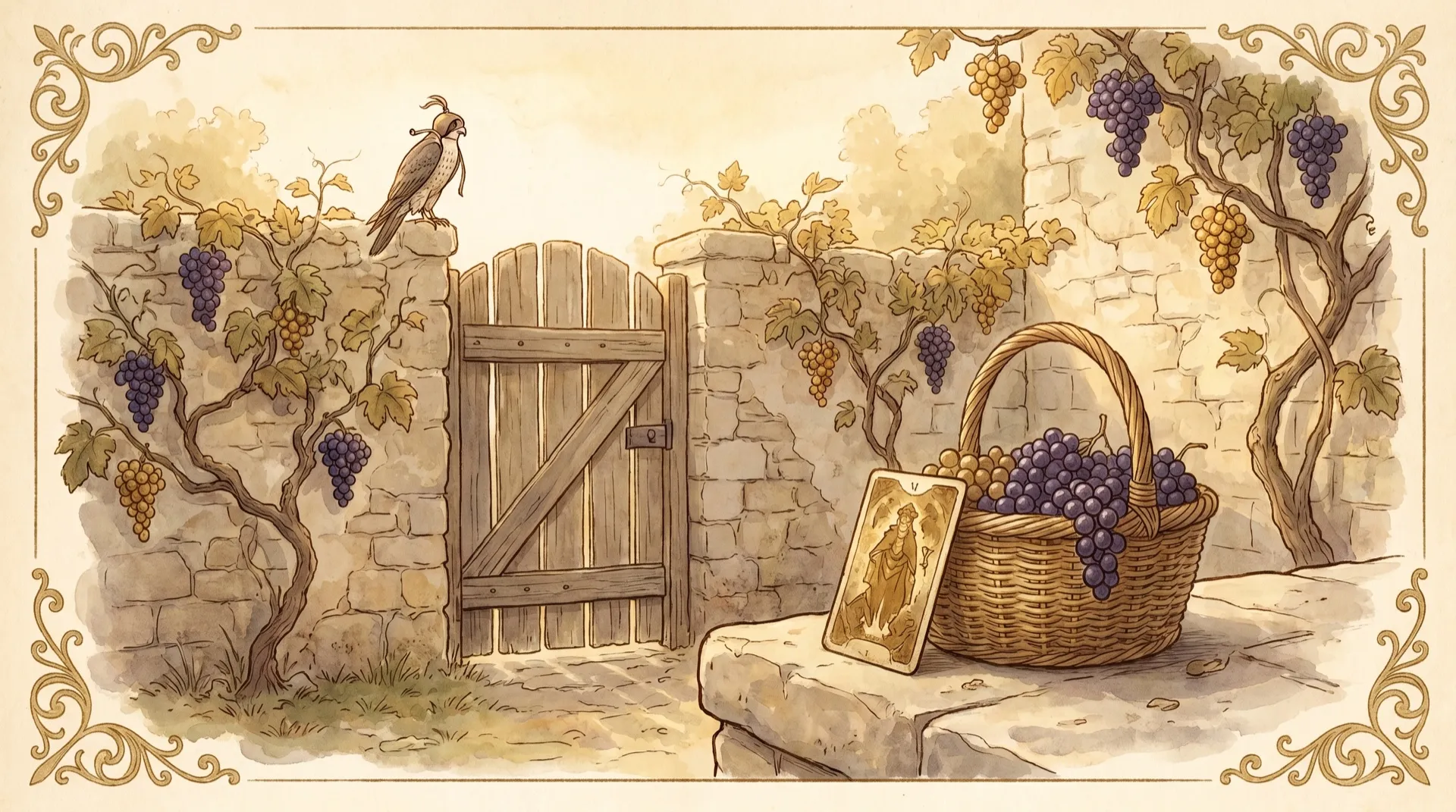
There’s a card in the deck that makes a certain kind of woman go quiet when it lands in front of her. Not the Lovers. Not the Star. The Nine of Pentacles: a woman standing alone in a vineyard, dressed well, a falcon hooded and calm on her glove. The grapes behind her are heavy. Nothing in the image is urgent. She isn’t waiting for anyone.
I’ve watched someone look at that card for a long ten seconds and then say, “I don’t know a single woman whose life looks like that.” Which is exactly why the card matters. It isn’t a portrait of someone’s life. It’s a portrait of a relationship to money that most of us were never shown.
What the card actually depicts
In the Rider-Waite-Smith image, the vineyard is cultivated. That word is doing the work. Nothing in this card arrived by luck or rescue. The Nine of Pentacles is the suit’s eighth chapter of labor finally turning into a ninth chapter of ease: discipline that became a garden. Traditional meanings cluster around self-sufficiency, earned comfort, refinement, and solitude that feels chosen rather than imposed.
The falcon is my favorite detail. A trained falcon is a wild appetite under deliberate command. Most money problems I’ve ever heard at my table, including my own in my twenties, were not income problems. They were unhooded-falcon problems. The wanting flew at everything that glittered.
The honest definition of financial independence
Strip the seminar language away and financial independence is a plain idea: your life is funded by what you’ve built, at a level you chose, for long enough that you don’t have to say yes out of fear. For some people that’s the formal version, the retirement math, the savings rate, the long argument about what’s enough. For others it’s smaller and nearer: three months of expenses in an account nobody else can drain, so that a bad job or a bad relationship becomes a decision instead of a trap.
The Nine of Pentacles doesn’t care which version is yours. It asks a sharper question: whose garden are you standing in? Plenty of people live in comfort that belongs, structurally, to someone else. A spouse’s income. A parent’s safety net. A company whose loyalty is one reorganization deep. None of that is shameful. The card just asks you to know the difference between being kept comfortable and being free, because the two feel identical right up until the day they don’t.
The reflection, in three honest questions
When the Nine of Pentacles turns up for someone, I usually set the rest of the spread aside and sit with three questions. You can do this without a deck, tonight, with a notebook.
First: what in your life did you build with your own name on it? Not what you have access to. What’s yours. An account, a skill that bills by the hour, a small paid-off thing. Most people find the list is shorter than they assumed and more solid than they feared. Numerology asks the same question through its foundation number; if fours have been following you around lately, the 444 angel number page sits with exactly this.
Second: what does your version of the vineyard actually cost? Not the fantasy number. The real one: the monthly figure at which you’d stop making decisions out of fear. People are often startled by how much smaller it is than the number they’ve been chasing. The card’s luxury is calm, not marble.
Third: what is the falcon in your hand? Everyone has one appetite that, left unhooded, eats the savings rate. For one woman I read for, it was rescuing her adult son’s finances every March. For me, for years, it was the belief that buying the tool was the same as doing the work. Naming the falcon is most of training it.
Where the card sends you next
Here is where I’m careful, and where I’d want any reader you ever pay to be careful too. The Nine of Pentacles can surface the questions. It cannot run the numbers. Whether you can retire at 60, whether the rollover makes sense, whether to pay the mortgage down or invest the difference: that conversation belongs to a fee-only financial advisor or a planner with credentials and a fiduciary duty, someone whose job is the math and who answers for it. The cards are for the evening before that appointment, when you’re working out what you actually want the money for. Anyone who tells you a card settled an investment question has left reading and started gambling with your rent. Our disclaimer draws this line formally; I’m drawing it here because I mean it.
What the card is for, and genuinely good at, is the part the advisor’s spreadsheet can’t see. The spreadsheet doesn’t know you undercharge because your mother called ambition unbecoming. It doesn’t know the falcon’s name. Tarot works the soil the numbers grow in. That’s the whole partnership, and I went deeper on the full set of money cards in Which Tarot Cards Mean Money? if you want the map this card sits inside.
The shadow side: the locked garden
Reversed, or sometimes even upright in a tense spread, the Nine of Pentacles has a shadow worth naming. Self-sufficiency can calcify into a wall. The woman in the vineyard is alone, and the card never tells us whether that’s peace or a fortress. I’ve met people whose entire net worth was a monument to never needing anyone again, built brick by brick after someone left or someone died. The garden was beautiful. Nobody was ever invited in.
If that’s the chord the card strikes for you, the work isn’t financial at all, and it might be worth reading what I wrote about the Moon card and knowing when to talk to someone, because a garden that exists to keep people out eventually needs a different kind of tending.
A note on earning it slowly
We live in a moment that sells financial independence as an event: the exit, the windfall, the one trade. The Nine of Pentacles is quietly contemptuous of all that. It’s the ninth card of the suit. Eight cards of apprenticeship, craft, setbacks, and unglamorous repetition come before it. The vineyard took years, and the card wears those years as texture, not as damage.
That’s the version of the money story I trust, and it’s the same logic a daily practice runs on. One card a day, one honest noticing at a time, the way today’s three-card reading works. Slow is not the consolation prize. Slow is the method.
Common questions
Does the Nine of Pentacles mean wealth is on its way to me?
No card carries a delivery date, and this one especially doesn’t, because its whole character is “built, not granted.” If it shows up, read it as a question about self-sufficiency: what’s yours, what it cost, and whether the comfort you live in could survive the structure under it changing.
Is the Nine of Pentacles a good card for career questions?
It’s a strong one, because it separates income from independence. A career reading with this card usually turns toward leverage: skills that travel, work that compounds, the difference between a salary and a foundation. I wrote more about that frame in Reading Tarot About Your Career.
What does the falcon mean?
Trained instinct. Appetite under command rather than appetite denied. The bird isn’t caged; it’s hooded, calm, and hers. That’s the card’s quietest teaching about money: the goal was never to stop wanting things. It was to decide which wanting gets to fly.
Reading this fresh off a draw? Today's three-card reading and your sign's daily page are the short-form companions to the longer essays here.
Where to go next