Which Tarot Cards Mean Money? The Honest Answer
The Pentacles carry the deck’s money story — income, debt, savings, inheritance. What each money card actually marks, without the fortune-telling.
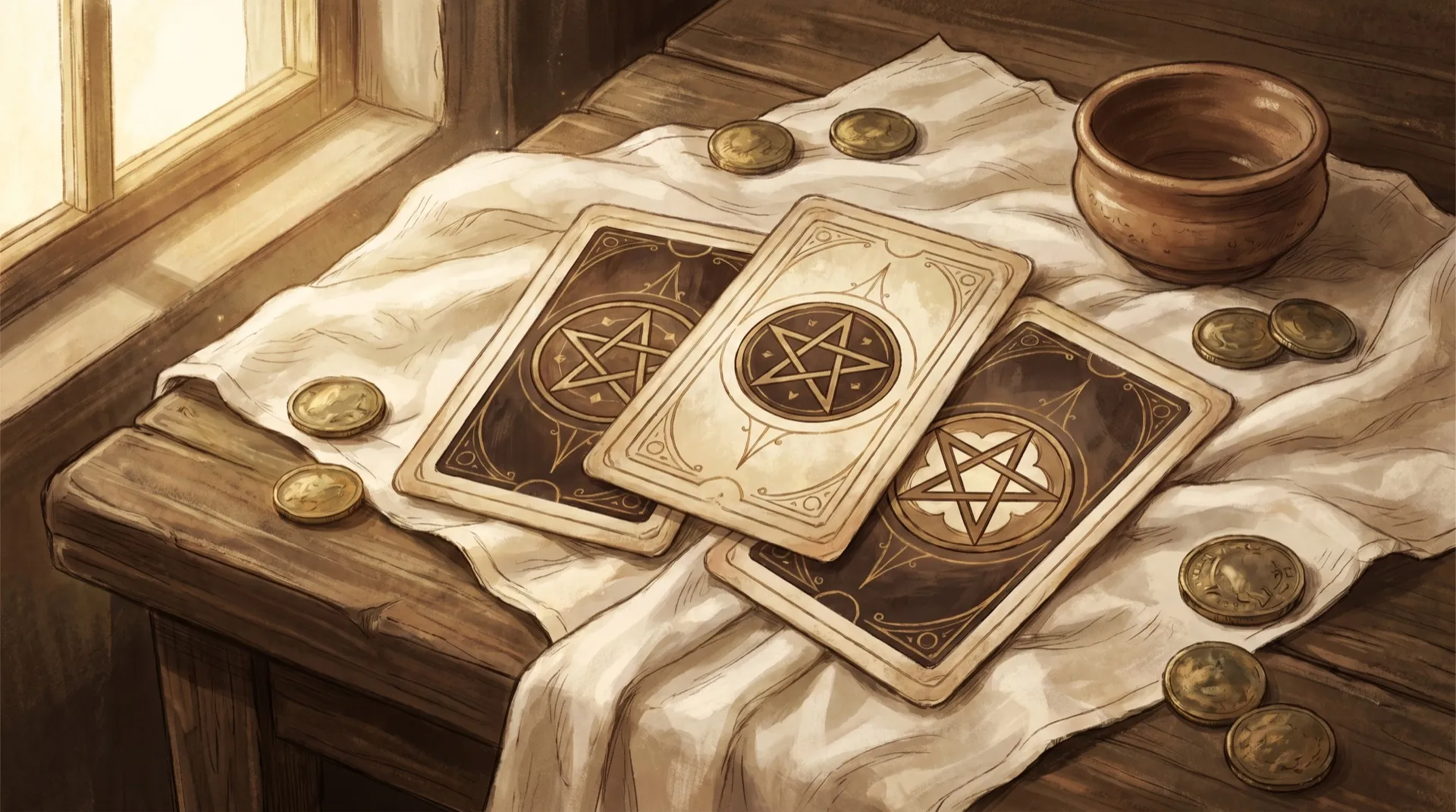
It’s one of the questions readers ask most often, usually once the polite questions are out of the way. Which cards mean money. People ask it quietly, like it’s a little embarrassing to want to know.
It isn’t. Money is in the deck because money is in every life. So here’s the honest answer, with one condition attached: a tarot card can name the money story you’re living inside. It cannot tell you your account balance in March. If you want to know what tarot can and can’t do, I wrote about that directly in Can Tarot Cards Tell the Future? The short version is that the cards are mirrors, not forecasts. Keep that in your pocket while we walk the money cards.
The suit of Pentacles is the money suit
Tarot has four suits, and Pentacles (sometimes called Coins or Disks) is the one that handles the material world: income, work, property, the body, the slow accumulation of things that hold their value. When a reading is heavy with Pentacles, it’s usually pointing at the practical layer of your life. Not your feelings about money. The actual texture of it: the paycheck, the rent, the number you don’t look at.
That’s the suit. The individual cards each mark a different chapter of the money story.
The Ace of Pentacles: the offer in the open hand
Every Ace is a beginning, and this one is material. A new income source, a job listing you keep reopening, the first month of actually tracking what you spend. The Ace doesn’t say the opportunity pans out. It says one is visible. The reflection question it carries is simple: what material beginning are you currently pretending not to see?
The Six of Pentacles: money moving between hands
This card shows a merchant weighing coins, giving to two figures below him. It’s the card of lending and borrowing, of generosity and debt, and of the strings that come attached to both. When it shows up, I ask people to look at the flow: who do you owe, who owes you, and which of those debts is really about money. Some loans between family members are loans. Some are leverage wearing a kind face. The Six of Pentacles is honest about that in a way most of us aren’t.
The Nine of Pentacles: the garden you bought yourself
A woman alone in a vineyard she owns, a bird on her glove. This is the card most readers point to when someone asks about financial independence, and it deserves its own essay, so I gave it one: The Nine of Pentacles and Financial Independence. The compressed version: it marks self-sufficiency that was built, not granted. Savings with your own name on them. The quiet pleasure of not needing to ask.
The Ten of Pentacles: money across generations
The Ten is the long view. Family wealth, inheritance, the house that stays in the family, the estate questions nobody wants to raise at dinner. It also carries the heavier side of all that: what gets passed down besides assets. Habits get inherited too. If your parents flinched at restaurant bills, there’s a fair chance your hand does the same thing theirs did. The Ten of Pentacles asks what you received, and what you’d rather not pass on.
The Wheel of Fortune: the part you don’t control
The one Major Arcana card I’ll put on this list. The Wheel is not a money card exactly; it’s the card of circumstance. Markets turn. Industries shrink. A layoff lands in a year you did everything right. The Wheel’s honest teaching is that some portion of every financial life is weather, and the dignity is in how you hold the part that’s yours: the preparation, the response, the refusal to read luck as a verdict on your worth. I wrote about the harder end of this in The Tower Card and the Emergency Fund. And if your noticing runs to repeating numbers rather than cards, the same harvest-and-cycle reflection lives in the numerology of angel number 888.
The court cards: money as a personality
The Queen and King of Pentacles round out the family. The Queen is resourcefulness at the household scale, the person who makes a number stretch and still sets a warm table. The King is stewardship at the larger scale, the steady hand on something built over decades. When these show up, the reading is usually about how you handle money rather than how much of it exists. Which is, most weeks, the more useful question.
What a money card is actually for
Here’s the part I’d want you to keep if you forget everything else. When the Six of Pentacles lands on the table, the useful move is not to wonder what’s headed toward you. It’s to notice what you recognized the moment you saw it. The friend you lent money to in 2023. The credit card balance you’ve stopped opening. The salary you suspect is under market but haven’t checked. The card didn’t know any of that. You did. The card just made it impossible to keep not-knowing it.
And then, if the reflection turns up something real and practical, the next conversation isn’t with a deck. Questions about consolidating debt, retirement accounts, or whether you can afford the house are questions for a financial advisor or a credit counselor, someone licensed, paid, and accountable. The cards are for the half hour before that, when you’re getting honest about what you actually want to ask. Our disclaimer says this in formal language; we’re saying it plainly here. Tarot is reflection, not financial advice, and a good reader never confuses the two.
A simple money reading you can do tonight
Pull three cards. Don’t assign them positions like past, present, future; that’s the forecast trap. Instead, ask three questions, one per card:
- What is my money story right now? (Read the first card as a description, not a prediction.)
- What am I not looking at? (This is usually the card that stings a little.)
- What’s one honest move that’s mine to make? (Not the outcome. The move.)
If the third card points at something concrete, like finally listing the freelance rate or booking the meeting about the retirement account, write it down before you shuffle the deck back together. The deck’s whole job was those thirty seconds of honesty. You can see how this sits alongside a daily practice in today’s three-card reading, which works the same way at a smaller scale.
Common questions
What is the single best card for money in tarot?
If I’m forced to pick one, the Ace of Pentacles, because it marks material opportunity in its rawest form. But “best” is the wrong frame. The Five of Pentacles, the suit’s hardship card, has been more useful to more of my querents than the Ace ever was, because it names the cold-shoulder season honestly and asks who you haven’t let help you.
Does a Pentacles card in a reading mean I’m about to receive money?
No. No card means that, and a reader who tells you otherwise is selling something. A Pentacles card means the material layer of your life is asking for attention. What you do with that attention is the entire game.
What about reversed money cards?
Reversed Pentacles usually point at the same territory with the current blocked or turned inward: the Six reversed often raises one-sided giving, the Nine reversed self-worth that’s been outsourced to a paycheck. Read them as the same conversation, held in a tenser room.
The money cards are some of the most honest in the deck, precisely because money is where our stories get specific. Numbers don’t blur the way feelings do. Pull the cards, let them name the chapter, and then go have the real conversation, whether that’s with a spreadsheet, an advisor, or the person who shares the checking account.
Reading this fresh off a draw? Today's three-card reading and your sign's daily page are the short-form companions to the longer essays here.
Where to go next