How to Read a 3-Card Tarot Spread: Past, Present, Future
The honest guide to the three-card spread: what each position actually reflects, how the cards talk to each other, and the one mistake most beginners make.
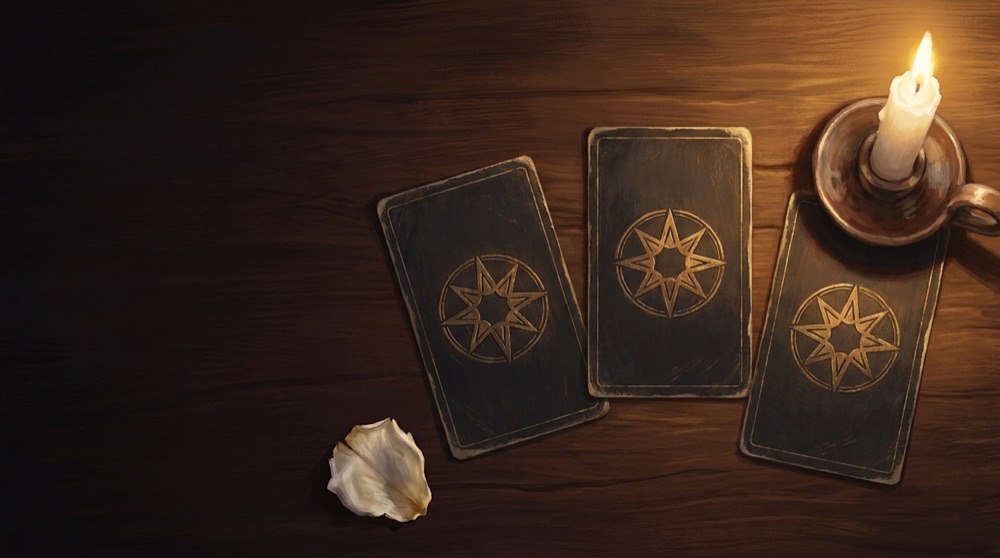
There was a year when I was trying to decide whether to leave a comfortable situation for something that felt larger and more uncertain. I am not going to tell you what the cards said, because that is not how this works, but I will tell you that the spread I kept coming back to was a three-card layout with positions for past, present, and future. Not because those three cards knew what would happen, but because those three positions held the exact shape of the question: where this started, where I actually am right now, and what is asking to happen next.
That spread is still the one I reach for first.
Why the three-card spread specifically
The three-card spread is the workhorse of the practice. Not the most dramatic layout, not the most comprehensive, but arguably the most honest. Its simplicity is a feature. A Celtic Cross gives you ten cards, which means ten possible escape hatches; if you do not like what you see, there is always another card to interpret. Three cards give you nowhere to hide.
The past-present-future structure is also the most human shape for a question. We all understand narrative: where something came from, where it stands, where it seems to be going. The positions do not require special knowledge. You do not have to memorize what position seven in a ten-card spread means for the eventual outcome. You just have to be willing to look.
What the three positions actually mean
Here is where I want to be careful, because the word “future” in a spread title does real damage if you let it.
The past position holds what shaped the present. Not a verdict on whether the past was good or bad, not a story you need to retell or defend, but the energy, pattern, or situation whose fingerprints are still on right now. Sometimes it is an obvious origin story. Sometimes it is something you thought was finished that clearly is not. Draw the Five of Cups in the past position of a question about a new opportunity and the card may be pointing at a loss you are still carrying forward, even into something new.
The present position is usually the most useful and the most uncomfortable. It reflects the actual situation, not the version you have been describing to yourself or to your friends. I have seen this position reliably hand people the thing they already knew but had not yet named. The Tower in the present does not mean something terrible is happening; it means something that has been cracking is now actively moving. The naming is the gift.
The future position is where people get tripped up, and treating it as a prediction is the single most common mistake I see beginners make with this spread. I will say what I said in Can Tarot Cards Tell the Future?: no card in this position is predicting anything. What the future card reflects is the direction things are already moving, or the energy called forward by the present card, or the question the situation is setting up for you. Read it as “what is this building toward” rather than “what outcome is predetermined.” That one reframe changes everything, because it keeps the decision in your hands.
Reading the three cards as a conversation
This is the part most guides skip, and it is where the reading actually lives.
Three cards laid out in a line are not three separate messages. They are a conversation, and the middle card is where the conversation pivots. The past card explains why the present card looks the way it does. The future card is what the present card is leaning into. When you read them in sequence, you are reading a story, and stories have logic.
Try this: after noting each card individually, read them left to right in one sentence without stopping. “Coming out of [past card], I am currently in [present card], and that is moving toward [future card].” Do not worry about getting it perfect. Say the sentence out loud and notice where something tightens or releases. The spot that reacts is usually the spot that is true.
The places where the cards seem to contradict each other are often the most interesting rather than the most confusing. A gentle, hopeful past card alongside a turbulent present card is not a bad reading; it is an accurate one. It is saying: something that worked before is not working now, and the turbulence is real. What the future card makes of it is where the reading finds its shape.
A worked example
Someone wrote to ask about a creative project she had been putting off for two years. She drew: the Six of Cups in the past, the Eight of Swords in the present, the Ace of Wands in the future.
The Six of Cups in the past showed up as a reminder of why the project originally mattered: nostalgia, a younger version of her creative self, a time when making things felt uncomplicated. That was the origin.
The Eight of Swords in the present showed the bind she was in: the feeling of being trapped by her own thinking, unable to act even though the blindfold in the card is one the figure herself put on. The card reflected what she already knew. The obstacle was mostly internal.
The Ace of Wands in the future position was not a promise that the project would succeed. It was reflecting the spark available to her if she moved, the energy of a fresh start that tends to arise when something has been too long deferred. Whether that spark catches is hers to decide. That is always the point.
She sat with that reading for a week and started the project on day eight. The cards did not make that happen. She had already been ready.
How to do your own reading
Shuffle the way you like to shuffle, which is the only correct answer to that question. Cut the deck if it feels right. Draw three cards and lay them face down, left to right: past, present, future.
Turn them over one at a time, pausing between them. Read the past card on its own first. Then the present card. Then the future card. Then read all three together.
Write a few lines in a notebook and date the entry. A reading is a data point, and data points need dates to mean anything. I explained the longer case for this in How Often Should You Do a Tarot Reading?, but the short version is that dated entries are what turn a stack of readings into something you can actually learn from.
If you want to go deeper than a spread can reach, the Birth Card Constellation reading looks at the Major Arcana through your own numerological signature, which is a different kind of anchor than a single three-card pull. And if you are sitting with a reading that feels charged or simply confusing, you are welcome to talk it through with me directly.
One thing worth knowing about the future position: the card that lands there often changes meaning once you act. A heavy future card in a reading from six months ago may sit in the past position today, and the present has moved on entirely. The future is not a fixed destination. It is a direction, and directions shift when you do.
Common questions
Can I use this spread for any question?
For most reflective questions, yes. It works best when there is a clear present situation to examine: a decision, a relationship, a creative block, a slow-burning uncertainty. It works less well for yes-or-no questions, which call for a different format, and which I covered separately in How Accurate Is a Yes/No Tarot Reading?
What if two or three of the cards repeat a suit or theme?
That is information, not a problem. Two Major Arcana cards in a three-card spread suggests the question carries some deeper, foundational weight. Two cards from the same suit means the energy of that suit runs through the whole story. Patterns inside a spread work like recurring cards across multiple spreads: the repetition flags something worth pausing on.
What do I do with reversed cards in a three-card spread?
Read them the same way you would in any reading: a reversal is not a negation but a modifier, often pointing to the same energy running inward instead of outward, delayed, or blocked rather than absent. A reversed past card might suggest the situation behind you was never fully resolved. A reversed present card might say the quality you are drawing on is available but not yet fully operational. The position is still the frame. The reversal just adjusts the angle.
Should the reading tell me what to do?
No, and any reading that feels like it is issuing instructions deserves a second look. A good three-card spread shows you the shape of the situation, where it came from, where it stands, and what it is leaning toward. What you do with that shape is the part that belongs entirely and permanently to you.
Reading this fresh off a draw? Today's three-card reading and your sign's daily page are the short-form companions to the longer essays here.
Where to go next