Is the Death Card Bad? What It Actually Marks
The deck’s most feared card almost never means what the movies taught you. What Death marks in a real reading, and why some people are relieved to see it.
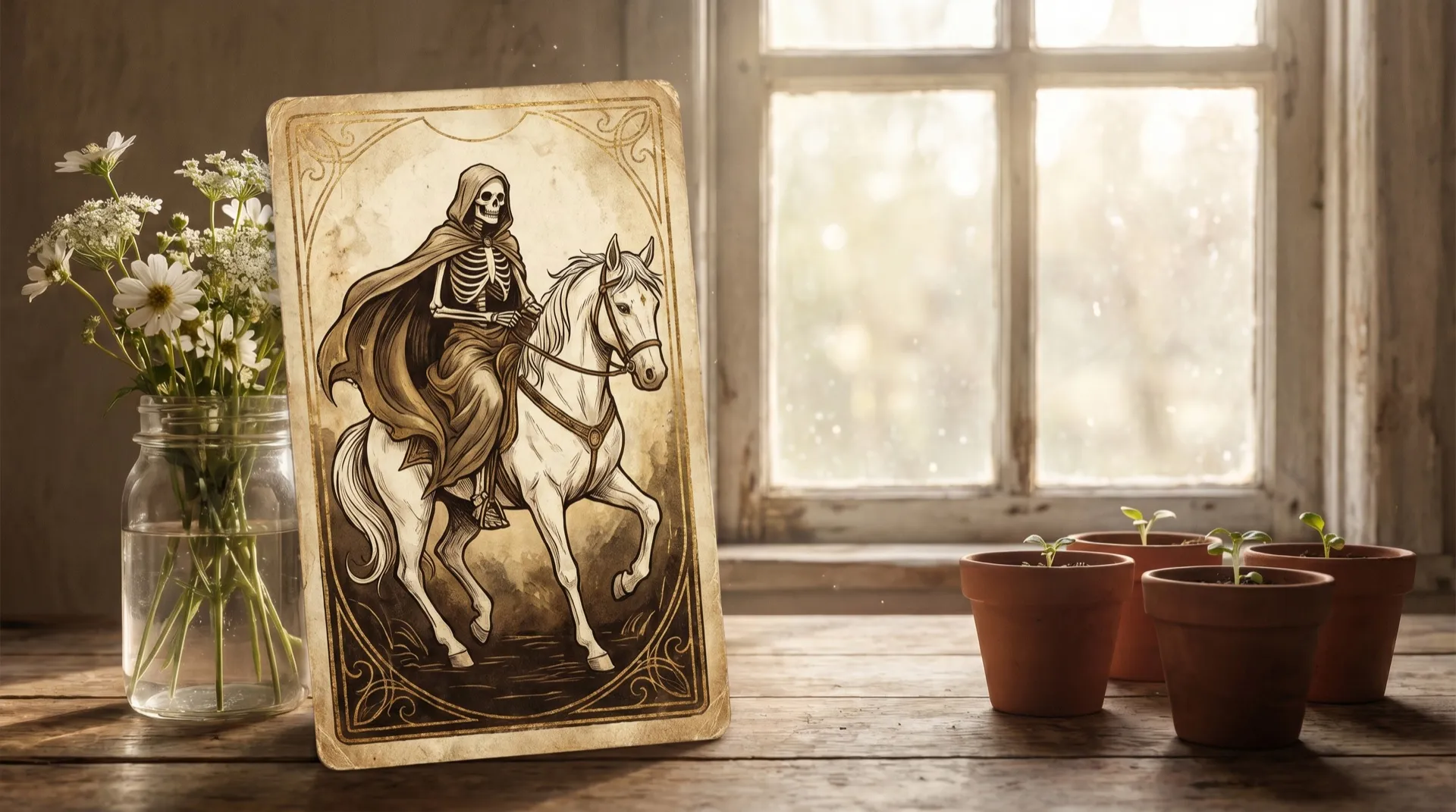
I can tell when someone at my table has only met tarot through the movies, because the Death card comes up and their whole body answers before I can. The sharp little inhale. The half-laugh. The eyes that flick up to check my face for bad news.
So let’s do this properly. Is the Death card bad? No. It is also not secretly wonderful, which is the overcorrection half the internet sells. It’s something more useful than either: the deck’s most honest card about how lives actually change. And no, it does not predict death. Let me start there, because the fear deserves a direct answer before the meaning gets its turn.
The fear, answered first
Tarot cards don’t predict anything, death included. I’ve made the long version of that argument in Can Tarot Cards Tell the Future?, and it applies double here: a shuffled deck has no information about anyone’s health, and a reader who implies otherwise is committing the cruelest kind of malpractice this craft allows. In twenty-plus years of reading, I have never read Death as literal death, and no reader worth sitting with does. The card scared its way into cinema because a skeleton makes a good jump-scare, not because that was ever its working meaning at the table.
What the movies never show is what the card actually depicts, so look closely at the classic Rider-Waite-Smith image. Yes, a skeleton in armor on a white horse. But the sun is rising between two towers in the distance. A child offers the rider a flower. A bishop stands his ground and pleads. A king lies fallen, crown in the dirt, and the detail that organizes the whole picture is that the crown stayed on the ground. Whatever this rider takes, status cannot argue with it, bargaining cannot delay it, and innocence isn’t afraid of it.
What Death actually marks
In a real reading, Death is the card of endings that are already underway. Not the lightning-strike collapse, that’s the Tower’s territory, but the organic kind: the season turning, the chapter that has finished even though the book is still in your hands. The job you’ve already left in every way except formally. The friendship running on archive footage. The version of yourself, the title, the role, the story, that you’ve outgrown and keep wearing anyway because taking it off feels like a small dying.
That’s why the card’s deep meaning is transformation, and why I resist saying that word too quickly. “Transformation” has been polished into a spa brochure. The card is more honest: transformation has a cost, and the cost is real loss. Something true ends. You don’t get the new chapter and the old one. The skeleton doesn’t negotiate, and the card’s strange mercy is that it stops you from negotiating too, which, if you’ve ever spent two years half-leaving something, you’ll recognize as a kindness.
Why some people are relieved to see it
Here’s the thing I wish the frightened first-timers could watch: the regulars who exhale when Death turns up. I’ve seen a woman in the last weeks of a long divorce look at the card and visibly settle, because it was the first thing in months that matched her insides. The paperwork said dissolution. Her friends said new beginnings, too brightly. The card said: a death is occurring, a real one, grieve it properly, and notice the sun coming up between the towers anyway. Sometimes the most comforting thing in the world is an image that declines to pretend.
The card also has a sharp question for people in the opposite position, the ones keeping something alive past its time. CPR on a career, a project, an identity that ended a while ago is exhausting work, and it’s usually fear of the blank space wearing the costume of loyalty. When Death shows up for someone like that, the reflection almost asks itself: what are you still resuscitating, and what would the effort you’re spending on it do if you let it go where it wants to go?
Reading Death in context
A card never reads alone; the neighbors change everything, which is part of why I always suggest a small spread rather than single-card verdicts for anything that matters. Death next to the Six of Cups, the nostalgia card, often points at the past needing a funeral rather than a museum. Death with the Fool on the other side is one of the kindest pairs in the deck: the ending and the untested beginning in the same breath. Death surrounded by Pentacles usually marks a material chapter closing, a career form, a financial arrangement, and turns the reading practical, the way I described in Which Tarot Cards Mean Money?
Reversed, Death tends to mark the stalled ending: the change that’s due and being resisted, the molting that’s overdue because the old skin is familiar. Same conversation, more friction.
If Death has turned up for you recently, here’s the reflection I’d hand you at the table, in three short questions. What in your life has already ended that you haven’t announced, to others or to yourself? What are you keeping on life support, and what is that costing per week? And the quiet third one: if the ending finished tomorrow, cleanly, what’s the first thing you’d do with the room it leaves? People answer that last question fast. The speed is the tell.
And remember what the card sits inside. The Major Arcana is a sequence, and Death is the thirteenth chapter of twenty-two, not the last. After it comes Temperance, the card of patient remixing, of the angel blending two cups into something neither was alone. The deck’s old arrangement is quietly insistent on this point: endings are mid-story. Every reader I know who has lived a real Death-card season, and I have, says some version of the same sentence afterward. It ended me and it didn’t end me, and both halves were true.
Common questions
Does the Death card ever mean literal death?
In honest practice, no. The card marks endings and transformation: chapters, identities, seasons. A reader using it to forecast anyone’s health or lifespan has left legitimate tarot entirely, and you should leave their table. Real concerns about health belong with a doctor, full stop, which is the standing rule of everything on this site.
What does Death mean in a love reading?
Usually that something in the relationship has finished its current form: a dynamic, a phase, sometimes the relationship itself, but just as often the version of it you’ve both outgrown. Couples survive Death-card seasons all the time; what doesn’t survive is the pretending. The reflection question is gentle and hard: what are we no longer, and what might we be if we admitted that?
Is Death the worst card in the deck?
There’s no worst card, but if you forced the question, most working readers would point somewhere else entirely, at the quiet grinders like the Eight of Swords, self-imprisonment, before a clean ending like Death. An honest ending is one of the better things that can show up on a table. The worst things in a life are rarely the deaths. They’re the things we wouldn’t let die.
If you want the card in full, here is the complete Death card meaning, upright and reversed.
Reading this fresh off a draw? Today's three-card reading and your sign's daily page are the short-form companions to the longer essays here.
Where to go next